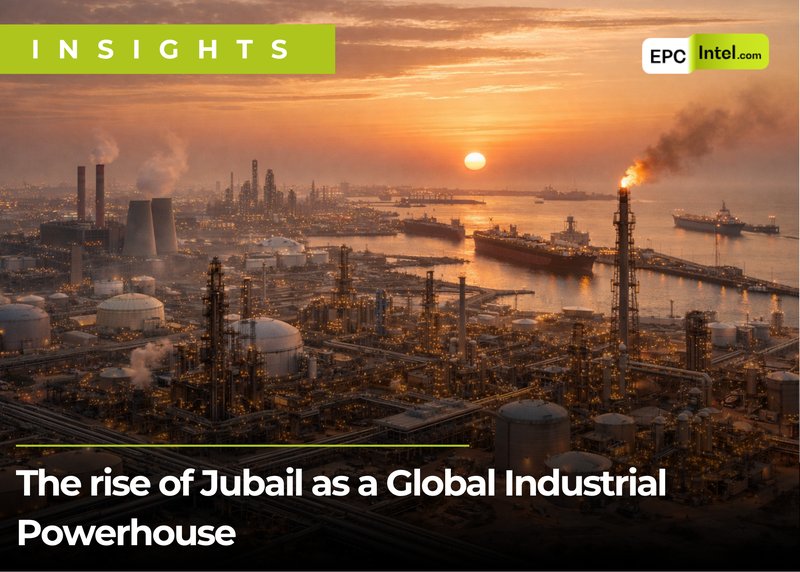
Jubail Industrial City has evolved far beyond a traditional refining and petrochemical hub. What began as a strategic downstream cluster is now arguably the most integrated industrial ecosystem in the world, linking hydrocarbons, petrochemicals, utilities, and export infrastructure into a single, highly efficient platform.
At the center of this transformation sits Saudi Arabia’s Vision 2030, which positions Jubail as a cornerstone for industrial diversification. The city is no longer just about processing crude, it is about maximizing value across the entire energy chain.
Refining anchors driving downstream depth
Jubail’s industrial DNA is still anchored in refining, with complexes like SASREF and SATORP forming the backbone of feedstock supply. These facilities do more than produce fuels, they provide critical intermediates that feed directly into adjacent petrochemical and specialty chemical plants.
From an EPC perspective, refinery upgrades and integration projects typically account for 25 to 30 percent of total capital deployment in Jubail. Brownfield debottlenecking, residue upgrading, and hydrogen management systems continue to generate steady contract flow for contractors and licensors.
Petrochemical integration at unmatched scale
The real differentiator in Jubail is the seamless integration between refining and petrochemicals. SABIC’s core assets, combined with mega projects like Sadara, have created one of the most complex chemical value chains globally.
Sadara alone introduced a new wave of specialty chemicals production, moving Saudi Arabia further downstream into higher margin products. Meanwhile, the Amiral project represents the next phase, expanding mixed feed cracking and derivative units to capture even more value from existing streams.
Typical capital allocation for petrochemical complexes in Jubail ranges from 35 to 45 percent of total project spend. This includes steam crackers, derivative units, and associated storage and logistics infrastructure. For EPC players, this segment remains the largest opportunity pool, particularly for licensors, process package providers, and modular construction specialists.
Utilities as the silent enabler
Behind the scenes, companies like Marafiq play a critical role in sustaining Jubail’s industrial ecosystem. Power generation, desalination, and industrial water networks are not just support functions, they are essential enablers of continuous operations across the city.
Utility infrastructure typically represents 10 to 15 percent of capital investment across major Jubail projects. This includes combined cycle power plants, cogeneration units, desalination facilities, and district cooling systems.
For contractors, these projects offer stable, long-term opportunities with lower technical risk compared to upstream or petrochemical units, but with significant scale and recurring expansion phases.
Logistics and export infrastructure
Jubail’s success is also built on its ability to move products efficiently to global markets. King Fahd Industrial Port serves as the primary export gateway, handling refined products, petrochemicals, and bulk materials.
Investment in port expansion, storage terminals, and pipeline networks typically accounts for 10 to 15 percent of total capital spend. This segment is increasingly important as production volumes grow and supply chains become more complex.
EPC opportunities here span marine works, tank farms, loading systems, and digital logistics optimization, all critical to maintaining Jubail’s competitiveness.
The next wave of expansion
Projects like Amiral signal that Jubail’s growth story is far from over. The focus is shifting toward deeper integration, higher value chemicals, and improved energy efficiency.
Future developments are likely to include:
- Advanced chemical recycling and circular economy initiatives
- Blue and low-carbon hydrogen integration
- Electrification and decarbonization of industrial processes
- Digitalization of plant operations and logistics
These trends will reshape the EPC landscape, creating new demand for specialized contractors, technology providers, and integrated delivery models.
Why Jubail stands apart
What makes Jubail unique is not just its scale, but its level of integration. Few industrial cities globally can match its ability to connect feedstock supply, processing, utilities, and export infrastructure within a single, coordinated system.
This integration reduces costs, improves efficiency, and attracts global partners looking for reliable, large-scale industrial platforms.
From an EPCIntel.com perspective, Jubail represents one of the most consistent and diversified sources of contract opportunities globally. Across refining, petrochemicals, utilities, and infrastructure, the city continues to generate multi-billion dollar project pipelines with long-term visibility.
Final thoughts
Jubail is no longer just an industrial city, it is a blueprint for how energy-rich nations can transform raw resources into high-value industrial ecosystems.
With continuous investment, global partnerships, and a clear strategic direction, Jubail is setting the benchmark for integrated industrial development.
Is it the most advanced industrial city in the world?
From an EPC and project delivery standpoint, it is certainly one of the strongest contenders.