Project momentum
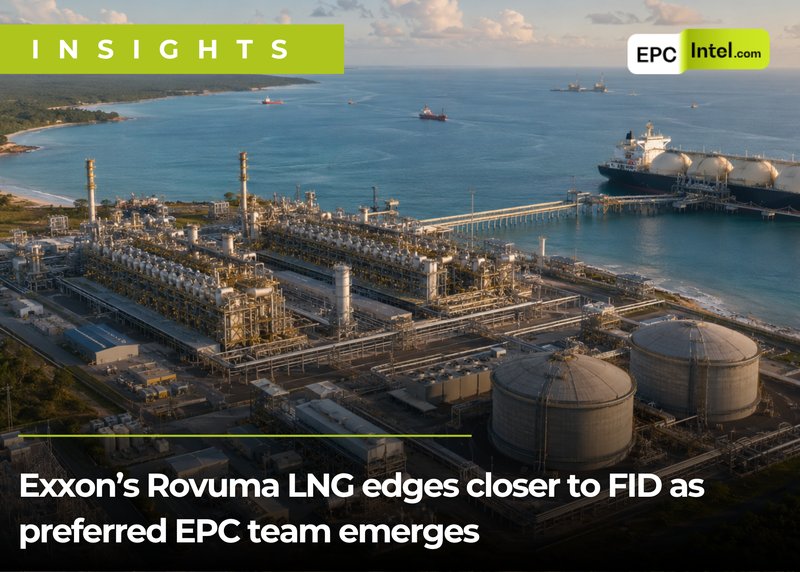
Rovuma LNG is moving back into the centre of the global LNG conversation, and this time the market has a reason to pay attention.
After years of delays linked to security conditions in northern Mozambique, ExxonMobil appears to be advancing one of the most important pre-FID LNG developments in the world. Recent reporting indicates that a preferred EPC consortium has been selected for the proposed onshore liquefaction development, a major step for a project that has been watched closely by contractors, lenders, equipment suppliers and governments.
The reported preferred team includes Saipem, McDermott, CPECC and Daewoo. ExxonMobil has not yet announced a final EPC award, so the key word remains “preferred.” But in a project of this scale, the move is still meaningful. Preferred bidder status usually means commercial and technical negotiations are entering a more decisive stage, and that the owner is working toward converting years of engineering, revalidation and security review into an executable delivery model.
Why it matters
Rovuma LNG is designed around approximately 18 mtpa of liquefaction capacity in Mozambique’s offshore Area 4 development. That makes it one of the largest proposed LNG projects in Africa and one of the few remaining global LNG schemes with the scale to materially affect long term supply.
For Mozambique, the project would be transformational. Rovuma LNG would deepen the country’s position as a major gas exporter, add construction employment, create long term fiscal revenue and strengthen the industrial base around Cabo Delgado. For ExxonMobil and its partners, it is a strategic LNG growth platform at a time when buyers continue to seek long duration, diversified supply.
For the EPC market, the implications are even more direct. This is not a small modular LNG job or a brownfield debottlenecking package. It is a multi-year, capital intensive development requiring heavy engineering, large fabrication capacity, global procurement, marine logistics and disciplined site execution in a complex operating environment.
Package opportunities
Based on EPCIntel.com’s database of LNG megaproject capital allocation, a development of this type typically creates a wide spread of package opportunities.
For a total project framework often discussed around the tens of billions of dollars, the onshore EPC and associated infrastructure scope could represent one of the largest EPC prizes in the LNG market. The liquefaction trains and process units would likely account for the largest share of direct capital spend, potentially 35% to 45% of the onshore project value.
Rotating equipment is another major category. Gas turbines, refrigerant compressors, boil off gas compressors, drivers, pumps and auxiliaries can represent 10% to 15% of core plant spend. This is where suppliers such as major turbine OEMs, compressor manufacturers and cryogenic equipment specialists will watch the project closely.
LNG storage, loading and marine export facilities can account for another 10% to 15%, depending on tank configuration, jetty scope and shared infrastructure arrangements. Utilities, power generation, water systems, flare systems, nitrogen, air systems and control infrastructure can add a further 15% to 20%.
Civil works, site preparation, camps, roads, logistics areas and construction support facilities are also material. In remote LNG developments, enabling works can become a significant early spend category, particularly where security, accommodation and logistics must be rebuilt around a large workforce.
Electrical, instrumentation and digital systems will form another important supplier lane, covering substations, cabling, DCS, safety systems, telecoms, metering and cybersecurity. These packages may not dominate the headline value, but they are essential to execution and commissioning.
Contractor positioning
The reported preferred consortium is logical. Saipem and McDermott both bring large LNG, offshore and modular execution experience. CPECC brings Chinese engineering and procurement depth, while Daewoo adds major yard and construction capability. If confirmed, the structure points to a delivery model built around scale, fabrication capacity and cost discipline.
The biggest question is not only who wins the EPC work, but how much of the scope is awarded as a single integrated package versus divided into major workstreams. LNG megaprojects often require a balance between central accountability and package specialization. Owners want one clear execution structure, but the supply chain beneath it can be broad.
Market signal
Rovuma LNG is more than a potential EPC award. It is a signal that large scale LNG investment is not fading. Security concerns, inflation, contractor capacity and financing challenges have slowed several LNG developments, but buyers still need long term baseload LNG supply.
If ExxonMobil reaches FID in 2026, Rovuma LNG would become one of the most important new EPC opportunities of the decade. It would also reinforce Mozambique’s return to the global LNG buildout after years of uncertainty.
For contractors and suppliers, the message is simple. Rovuma LNG is not yet a final award, but it is no longer just a distant project on a watchlist. It is moving toward the point where commercial positioning, fabrication strategy and supplier engagement start to matter.