Argentina has spent years talking about converting its abundant natural gas into higher-value products. Pampa Energía is now putting serious money behind that argument.
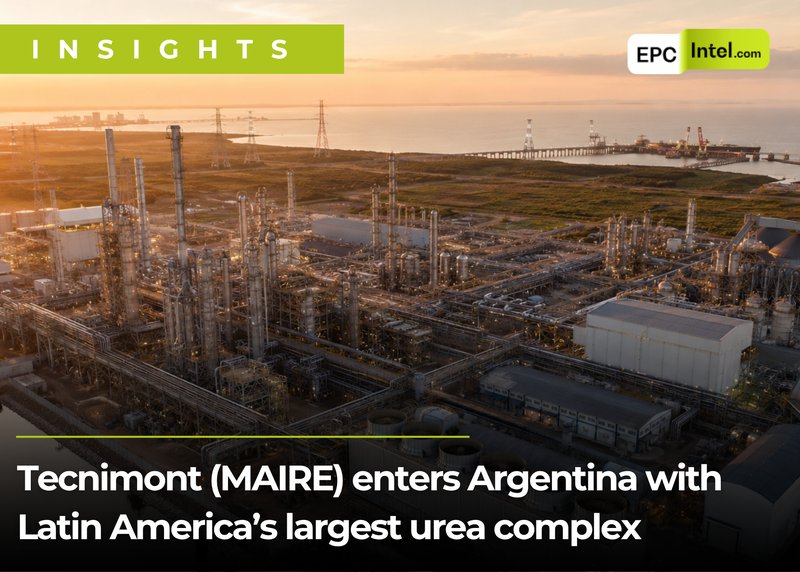
Through its subsidiary Fértil Pampa, the company has approved a large ammonia and urea complex at the Bahía Blanca Industrial Complex, with total investment estimated at approximately US$2.7 billion. The development will produce 2.1 million tonnes per year of granular urea, making it the largest urea production facility in Latin America.
The headline EPC-related award goes to MAIRE subsidiary Tecnimont, which has secured a contract worth approximately €1.3 billion. This includes engineering, procurement, commissioning and start-up, while Argentine contractor SACDE will execute the construction scope.
That division of responsibility matters. Tecnimont brings the fertilizer process integration and international procurement capability, while SACDE provides the local construction capacity needed to mobilize thousands of workers and manage execution inside Argentina.
A major fertilizer build
The complex will include a large-scale ammonia plant and two parallel ultra-low energy urea trains, each equipped with its own granulation unit.
Combined production capacity will reach 6,000 tonnes per day, equivalent to approximately 2.1 million tonnes per year. The project is scheduled for completion within 41 months.
The plant will occupy an 80-hectare site in Bahía Blanca, one of Argentina’s most established industrial and export hubs. It will sit close to Pampa Energía’s existing power generation assets and benefit from access to gas pipelines, electricity transmission, industrial water infrastructure and a deep-water port.
This is not just a convenient plot of land. Natural gas and electricity account for around 70% of urea production costs, according to Pampa. Locating the facility beside Pampa’s own energy assets and close to the Vaca Muerta gas system should give the project a meaningful operating advantage.
Technology lineup
The technology package brings together several familiar names in fertilizer engineering.
KBR will provide the ammonia production technology. Nextchem will coordinate the urea technology package through Stamicarbon’s urea melt and granulation technologies, including the process design package and proprietary equipment.
KT Tech will supply the primary reformer used in syngas production.
Nextchem’s portion of the Tecnimont award is valued at approximately €140 million, demonstrating how much value sits in licensing, process design and proprietary equipment before heavy construction even begins.
The remaining Tecnimont scope covers the engineering and procurement backbone needed to integrate the ammonia, urea, utilities, storage and export systems into one operating complex.
Where the money goes
Based on comparable fertilizer projects tracked by EPCIntel.com, the ammonia and urea process units are likely to absorb the largest share of capital expenditure.
A reasonable package breakdown for a US$2.7 billion development would place approximately US$650 million to US$800 million into the ammonia plant, including reforming, synthesis gas processing, ammonia synthesis and refrigeration.
The two urea trains and granulation units could represent another US$500 million to US$650 million.
Utilities and offsites, including steam generation, cooling water, water treatment, electrical systems, flare systems and air separation requirements, could account for US$350 million to US$450 million.
Storage, product handling, conveyors, bagging, warehouses and port-related facilities may require US$200 million to US$300 million.
Civil works, buildings, site preparation and construction infrastructure could add US$300 million to US$400 million, with the balance covering engineering, project management, commissioning, contingencies and owner costs.
These figures are EPCIntel estimates rather than disclosed contract values, but they show why the opportunity extends well beyond the main Tecnimont and SACDE awards.
Major subcontracting opportunities should include pressure vessels, heat exchangers, compressors, reformer components, high-pressure piping, rotating equipment, electrical substations, instrumentation, bulk materials, storage systems and product export infrastructure.
Argentina bets on gas monetization
The project is expected to create more than 3,500 direct jobs during peak construction, with additional work distributed across local fabrication, civil construction, logistics and industrial services.
More importantly, it gives Argentina another route for monetizing Vaca Muerta gas without relying entirely on pipeline exports or LNG.
Instead of exporting only the molecule, Pampa plans to convert gas into a higher-value agricultural product that can serve domestic demand and regional export markets.
Tecnimont may have captured the €1.3 billion headline, but the broader US$2.7 billion development creates a much larger opportunity across technology, equipment supply, construction and logistics.
For contractors and suppliers, Bahía Blanca is about to become one of Latin America’s most important fertilizer construction sites.