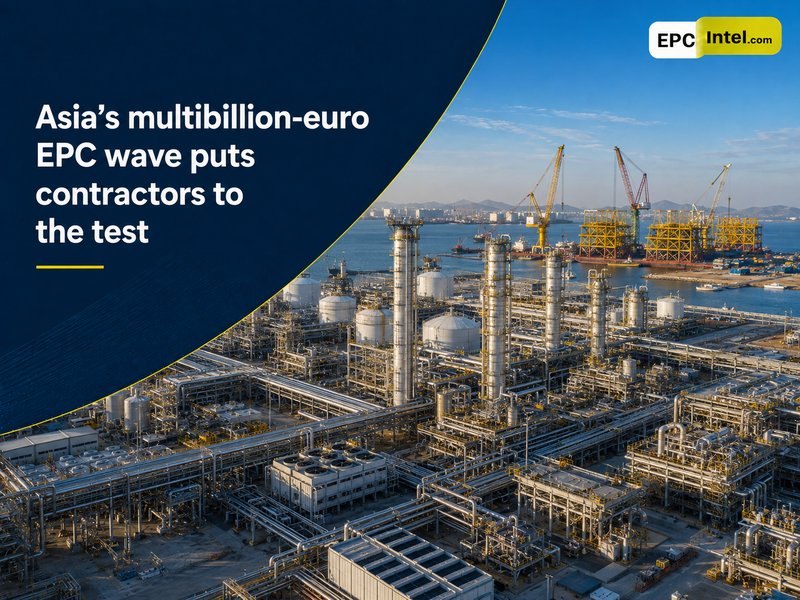
Asia’s EPC market is not short of megaprojects in 2026, but the largest packages are becoming increasingly concentrated in gas processing, offshore production and major power infrastructure.
Four of the biggest awards tracked by EPCIntel.com this year have a combined value of approximately €10 billion. Three are located in the UAE, while the fourth covers an undisclosed offshore development elsewhere in the Middle East.
The ranking also shows that Asian contractors are no longer simply supporting international EPC companies. Wison Engineering, Energy China and Larsen & Toubro are taking direct responsibility for multibillion-euro packages where engineering integration, procurement performance and schedule risk sit firmly with the contractor.
Tecnimont takes the largest package
Tecnimont leads the ranking with ADNOC Gas’ Rich Gas Development Phase 3 project in Ruwais.
The approximately $4.3 billion, or €3.7 billion, EPC package covers the addition of a fifth natural gas liquids fractionation unit at the Ruwais NGL complex. The facilities will process around 23,000 tonnes per day, equivalent to approximately 8 million tonnes per year.
Tecnimont’s scope includes fractionation, treatment and sweetening systems, regeneration gas facilities, propane refrigeration, storage and associated infrastructure. Completion is targeted for 2030.
This is a major process integration job, not simply the addition of another production train. The contractor must connect substantial new facilities to an operating gas-processing complex while maintaining safety and production continuity.
That creates opportunities for process equipment manufacturers, compressor and refrigeration suppliers, storage contractors, automation companies and specialist brownfield subcontractors.
Wison enters a different EPC league
Wison Engineering’s $4.04 billion award for Rich Gas Development Phase 2 is the largest EPC project in the Chinese contractor’s history.
The project will add a new natural gas processing train at Habshan, including gas pipelines, separation and condensate stabilisation, acid gas removal and deep NGL recovery facilities. Wison will also deliver a 220 kV switch station.
ADNOC Gas identifies the core Phase 2 EPC package at $3.9 billion, with the switch station taking Wison’s total scope to approximately $4.04 billion. Combined with Tecnimont’s Phase 3 package, ADNOC Gas has committed $8.2 billion to the two principal RGD EPC awards.
The biggest challenge for Wison will be scaling its project controls, procurement and construction organisation to match the size of the award. A contractor can have the technical capability to design a processing train, but managing thousands of vendor documents, interfaces and site activities on a $4 billion project is a different test entirely.
Energy China strengthens its Gulf position
A consortium led by Energy China has secured the approximately $1.69 billion, or €1.46 billion, EPC package for the 2.6 GW Taweelah C independent power project in Abu Dhabi.
The consortium includes Energy China International, Guangdong Power Engineering and Guangdong Electric Power Design Institute. The combined-cycle gas turbine facility is expected to be completed within approximately 32 months.
Taweelah C gives Chinese engineering groups another major reference in the Gulf’s power market. It also creates a sizeable procurement programme covering gas turbines, steam turbines, heat recovery steam generators, transformers, switchgear, cooling systems, water treatment and balance-of-plant construction.
The schedule may prove more challenging than the technology. A 32-month delivery period leaves limited room for delays in turbine manufacturing, heavy equipment transport, commissioning or grid-interface works.
L&T takes on another offshore test
L&T Energy Hydrocarbon Offshore has announced an ultra-mega EPCIC award for the development of multiple offshore facilities in the Middle East.
The company classifies ultra-mega orders as those exceeding INR150 billion, placing the award above approximately $1.7 billion, or €1.45 billion.
The client and development were not identified in L&T’s initial announcement. However, the package covers multiple offshore facilities, with L&T acting as the lead consortium member and executing a substantial portion of the fabrication through its own yards.
Keeping fabrication in-house gives L&T more control over quality, sequencing and offshore readiness. It also concentrates risk within its yard network.
Offshore projects rarely fail because of a single major engineering error. Delays usually accumulate across steel availability, vendor equipment, welding productivity, module integration, load-out preparation, installation-vessel schedules and offshore hook-up.
For suppliers, the award points to demand for structural steel, piping, valves, electrical equipment, instrumentation, subsea components, coatings, inspection services and specialist marine support.
The bottleneck begins before construction
These four projects will compete for many of the same critical resources.
High-alloy process equipment, compressors, large pressure vessels, structural steel, electrical packages, welding capacity, NDT personnel and third-party inspectors will all face increasing demand. Vendor-document approval and material-release delays can begin affecting the schedule months before equipment reaches the fabrication yard or construction site.
The most difficult execution risk arguably sits with the two Rich Gas Development packages. Tecnimont and Wison must deliver parallel multibillion-dollar projects for the same wider programme, with both packages drawing from an overlapping international supplier base.
That is where expediting stops being an administrative function and becomes one of the main factors deciding whether these megaprojects finish on time.