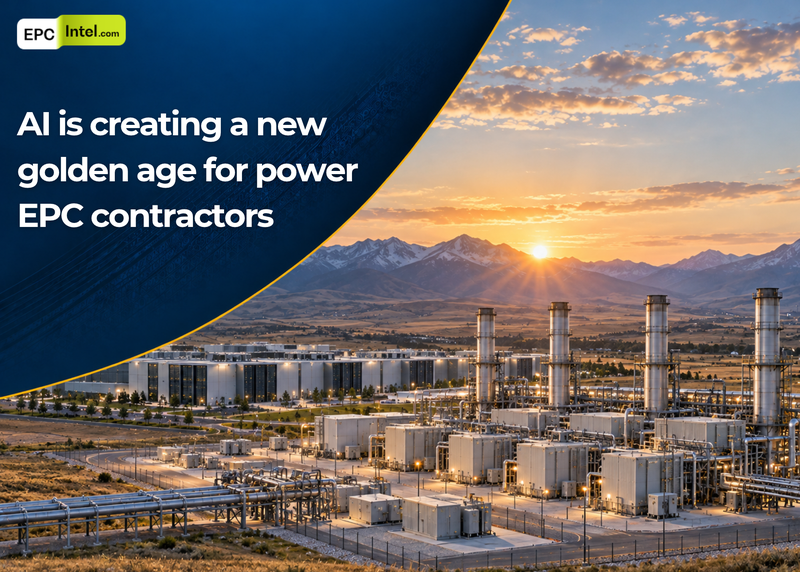
The AI revolution needs more than data centers
The artificial intelligence boom has already created enormous demand for data centers. Now it is creating something equally interesting for the energy industry: a new generation of dedicated power plants.
And the investment numbers are becoming difficult to ignore.
On October 14, 2026, American Electric Power (AEP) announced plans for a $4 billion, 702 MW fuel cell generation project near Cheyenne, Wyoming, designed to supply electricity to Google’s expanding data center operations.
The project will be developed through Cheyenne Fuel Cell LLC, with AEP holding approximately 92% ownership and funds advised by Basalt Infrastructure Partners holding the remainder.
Construction is expected to begin in 2026, with full operations targeted by the end of 2028.
A 20-year power purchase agreement with Google underpins the development.
For the EPC industry, the interesting part is not simply the size of the investment. It is the contracting opportunities emerging around a completely different approach to powering large industrial electricity consumers.
Google is effectively helping create an entirely new power generation development market.
Bloom Energy gets the technology, but who gets the construction?
Bloom Energy has been selected to provide solid oxide fuel cell technology for the development.
The technology generates electricity through an electrochemical process rather than conventional combustion, offering a modular alternative to traditional gas-fired generation.
AEP has previously disclosed a fuel cell equipment purchase commitment of approximately $2.65 billion associated with the development programme.
That represents a substantial portion of the overall investment.
But fuel cells do not install themselves.
A 702 MW development still requires foundations, site preparation, power conversion systems, electrical distribution, substations, gas infrastructure, cooling systems, controls and commissioning.
The project also envisages carbon capture integration, creating another potential market for engineering and specialist technology providers.
The remaining balance-of-plant scope could represent hundreds of millions of dollars in additional contracting opportunities.
And this is where the project becomes particularly interesting for companies outside the primary technology supply agreement.
Where could the $4 billion go?
Based on comparable power generation developments and typical EPC cost structures, EPCIntel estimates the following potential capital expenditure distribution.
| Major package | Estimated value |
|---|---|
| Fuel cell equipment and associated systems | $2.4–2.7bn |
| Civil works, foundations and buildings | $200–300m |
| Electrical systems and substations | $250–400m |
| Gas infrastructure and mechanical works | $150–250m |
| Cooling, utilities and auxiliary systems | $100–200m |
| Carbon capture integration | $150–300m |
| Engineering, commissioning and contingency | Remaining budget |
These are indicative EPCIntel.com estimates rather than announced contract values. Package boundaries and expenditure may overlap, and the ranges should not be added together.
Bloom Energy already occupies the most valuable technology position, but the detailed allocation of construction responsibilities and remaining subcontracting packages has not been publicly established.
That leaves an important area to monitor.
Electrical contractors, modular construction specialists, mechanical installation companies, civil contractors and engineering firms could all find opportunities as the project moves into execution.
Wyoming is becoming a power EPC hotspot
The AEP project is not the only major power investment emerging around Google’s operations in Wyoming.
Just days earlier, Black Hills Corporation announced plans to invest approximately $1.8 billion in 564 MW of natural gas-fired generation at its Cheyenne Prairie Generating Station.
The company will also manage approximately 2.1 GW of third-party contracted power resources through a private microgrid serving Google’s development.
Combined, the AEP and Black Hills announcements represent approximately $5.8 billion in separate generation investments.
And that is before considering the broader electrical infrastructure required to connect and operate these facilities.
For EPC contractors, this creates a particularly attractive combination: several major generation technologies, different contracting structures and substantial investment concentrated in one industrial location.
The contractors positioned for the next wave
The AI power market is becoming increasingly attractive to companies with experience in fast-track generation, modular construction and large-scale electrical infrastructure.
Bechtel, Fluor, Kiewit and Black & Veatch have established capabilities across major power infrastructure and engineering projects.
Meanwhile, Siemens Energy, GE Vernova and Wärtsilä are positioned across various equipment and generation technology segments.
Their involvement in the Wyoming fuel cell development has not been announced, but the wider market developing around hyperscale data centers fits several of their core capabilities.
For subcontractors, the opportunity may be even more immediate.
High-voltage electrical systems, transformers, switchgear, gas conditioning equipment, industrial cooling packages, modular substations and construction services are all becoming critical components of dedicated power developments.
Suppliers capable of delivering quickly, meeting demanding technical specifications and supporting accelerated construction schedules may be particularly well positioned.
AI could reshape the power EPC market for years
What makes this investment cycle different is the customer.
Traditional power projects depend heavily on utility planning, government procurement and regulated electricity markets.
AI infrastructure is introducing technology companies as increasingly influential drivers of new generation capacity.
Long-term electricity agreements can provide revenue visibility, making large investments easier to finance and potentially accelerating project execution.
For contractors, that could mean more projects reaching construction with clearer commercial foundations.
AEP’s Wyoming development is a compelling illustration of this shift.
The technology contract is substantial, the construction requirements are significant, and the broader Google power ecosystem is already attracting billions of dollars.
The AI boom may have started with chips and data centers, but for the EPC industry, the real opportunity is increasingly in the infrastructure needed to keep them running.
And the companies securing positions in this new supply chain today could be looking at one of the most attractive power construction markets of the next decade.