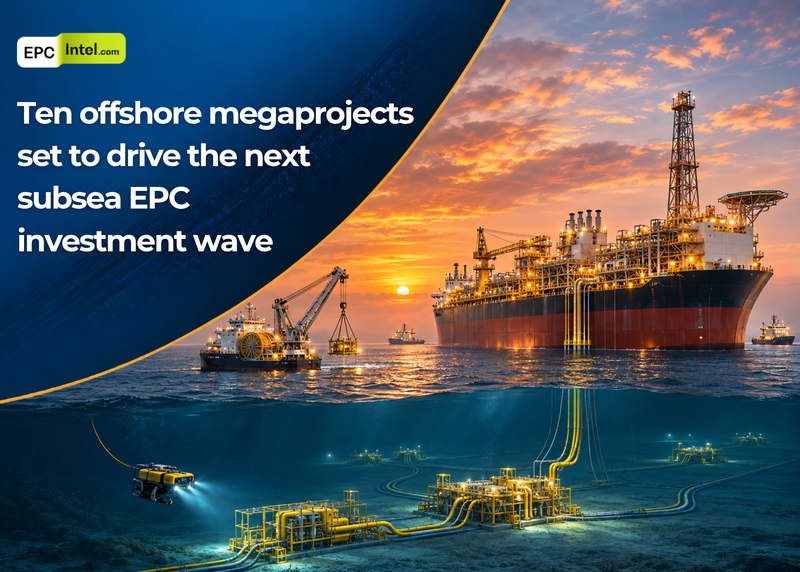
The next offshore investment cycle is beginning to look expensive. And for the subsea supply chain, that is potentially very good news.
Across Africa, South America, the Mediterranean, Asia-Pacific and the North Sea, operators are advancing developments that will require everything from floating production facilities and subsea processing systems to hundreds of kilometres of pipelines, umbilicals and flowlines.
Some projects have reached final investment decision (FID). Others remain in engineering, regulatory approval or commercial development. Several have already awarded major contracts.
The interesting question is no longer simply which projects will move forward, but how much of their remaining capital expenditure will reach the EPC and equipment supply chain between 2027 and 2030.
Africa leads the opportunity pipeline
Namibia’s Venus development, operated by TotalEnergies, is arguably one of the most strategically important projects on the list.
Located in approximately 3,000 metres of water, Venus is expected to introduce large-scale deepwater production infrastructure into a frontier basin. Its development concept includes an FPSO, subsea production systems and extensive offshore installation work, with first oil targeted for 2030.
For contractors, Venus represents a potential multibillion-dollar opportunity spanning FPSO construction, subsea trees, manifolds, risers, flowlines and installation. However, full-scale commitments remain dependent on project sanction.
Elsewhere in West Africa, three developments are creating distinct contracting opportunities.
Baleine Phase 3, offshore Côte d’Ivoire, received FID in May 2026. SLB OneSubsea has already secured an EPC contract covering production systems for 13 wells.
Greater PAJ, offshore Angola, will combine five fields through a new 95,000-barrel-per-day FPSO and a 17-well subsea development, targeting first oil in 2029.
Meanwhile, Greater Tortue Ahmeyim (GTA) Phase 2, offshore Mauritania and Senegal, offers potential additional LNG and offshore gas infrastructure work, although its next investment phase remains subject to further development decisions.
Mozambique and Guyana could unlock major contract values
Few projects illustrate the scale of future EPC spending better than Rovuma LNG.
ExxonMobil’s planned 18.6-million-tonne-per-year development involves substantial offshore gas gathering and transportation infrastructure alongside the onshore LNG complex.
The SMDC joint venture, comprising Saipem, McDermott, Daewoo E&C and CPECC, has been selected for preliminary midstream work, while Saipem and Jan De Nul have secured an offshore EPCI letter of intent.
The full construction awards remain conditional on FID and required approvals, leaving substantial future commitments to be unlocked.
Across the Atlantic, Longtail, ExxonMobil’s proposed gas and condensate development offshore Guyana, is advancing through engineering.
SBM Offshore has secured FPSO FEED contracts, while Saipem has received a limited notice to proceed for subsea EPCI work worth approximately $150 million initially. The larger construction scope depends on subsequent approvals and investment decisions.
The Mediterranean and Asia-Pacific join the investment cycle
Eni’s Cronos gas development offshore Cyprus is moving towards first gas in 2028, using a subsea connection to existing Egyptian infrastructure.
McDermott is involved in subsea engineering and installation, while Baker Hughes has secured the subsea production systems contract.
In Indonesia, Geng North and Gehem form the centrepiece of Eni’s new North Hub development offshore East Kalimantan. Following FID in March 2026, the project will require a new floating production facility and extensive subsea infrastructure, with start-up targeted for 2028.
Norway demonstrates the value of subsea tiebacks
Not every major offshore opportunity requires a new FPSO.
Norway’s Lyra, formerly Kjøttkake, and Fram Sør developments show how subsea tiebacks can unlock resources through existing infrastructure.
Subsea7 secured a $150 million to $300 million EPCI contract for Lyra in November 2026, while Fram Sør has already generated significant awards for Subsea7, SLB OneSubsea, Aker Solutions and Worley Rosenberg.
These projects demonstrate that even relatively compact developments can generate substantial spending on pipelines, subsea structures, control systems and offshore installation.
Where the capital will be spent
For EPC contractors and suppliers, the largest opportunities sit within several familiar capital-intensive packages.
| Major package | Indicative value per major deepwater development |
|---|---|
| FPSO construction and integration | $1.5–3.5 billion |
| Subsea production systems | $300–900 million |
| SURF engineering and installation | $500 million–1.5 billion |
| Subsea survey, metrology and positioning | $15–60 million |
| Topsides modifications and tie-ins | $50–300 million |
Indicative EPCIntel.com planning benchmarks, not disclosed project budgets or confirmed contract values. Actual expenditure depends on development scale, water depth, equipment configuration and scope boundaries. Packages are not necessarily additive.
The real opportunity starts before installation
The most attractive opportunities are not limited to companies securing headline EPCI awards.
Survey contractors, subsea fabrication specialists, control-system suppliers, equipment manufacturers and offshore service providers can all benefit as projects progress from engineering into construction.
Importantly, the ten developments are not at the same stage. Some major packages are already committed, while others remain dependent on FID, regulatory approval or project economics.
For suppliers preparing capacity for 2027–2030, understanding that difference will be just as important as identifying the projects themselves.
The next offshore investment wave is taking shape. The winners will be the contractors and suppliers positioned early enough to capture it.