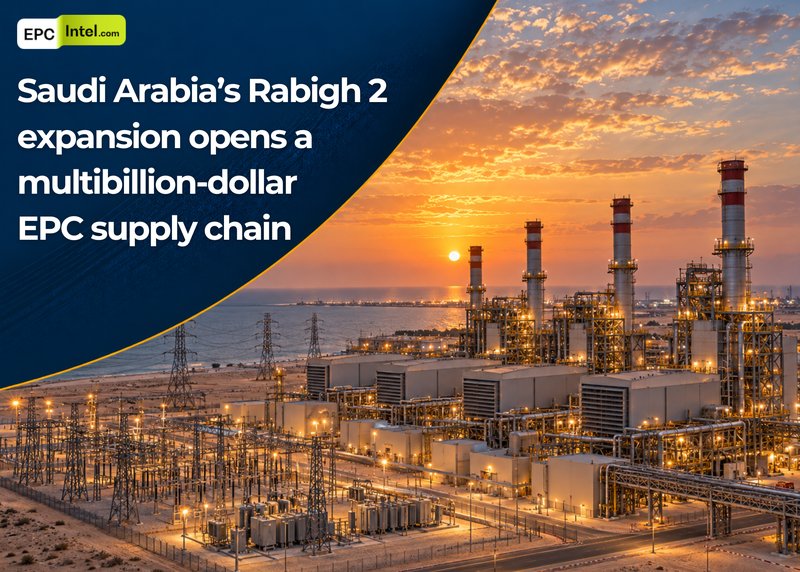
Another Saudi power megaproject moves into construction
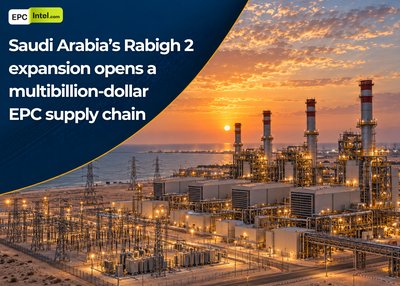
Saudi Arabia is building gas-fired power plants at a pace that should keep the region’s major EPC contractors and equipment suppliers busy for years. The latest project to move forward is the Rabigh 2 Independent Power Producer (IPP) Expansion, where Elsewedy Electric and China’s Sinohydro, part of POWERCHINA, have formally signed the EPC agreement.
The signing follows financial close earlier in October 2026, when the project secured approximately US$2.58 billion in long-term financing. That removes a major financing hurdle and provides the backing needed for large-scale construction and procurement.
With a planned capacity of 2,313.5 MW, Rabigh 2 is among the Kingdom’s larger combined-cycle gas turbine developments. But the real story for the EPC market is not simply the addition of another 2.3 GW of generation capacity. It is the volume of engineering, equipment supply, installation and specialist subcontracting required to deliver it.
Chinese and Egyptian contractors take the lead
The EPC structure brings together Elsewedy Electric’s power construction capabilities and Sinohydro’s international infrastructure delivery experience under the broader POWERCHINA umbrella.
The consortium is responsible for delivering a new combined-cycle power facility in Saudi Arabia’s Makkah region, with the project also requiring an extension to a 380 kV electrical substation. The development is being undertaken by Al Morjan Two Electricity Company, with ACWA Power and Saudi Energy each holding an effective 40% interest.
The structure is particularly interesting because it combines an Egyptian industrial and EPC group with a major Chinese construction contractor.
For suppliers, this creates several potential procurement channels. International original equipment manufacturers will be competing for large technology packages, while regional companies could secure substantial construction, electrical, mechanical and balance-of-plant work.
Where the EPC money will go
Although the EPC contract value has not been publicly disclosed, the project’s financing and technical specifications provide a useful basis for assessing the potential scale of the construction market.
For EPCIntel.com‘s preliminary package analysis, we estimate a US$2.0 billion to US$2.6 billion EPC and construction opportunity, subject to confirmation of the actual contracting value and package boundaries.
The following represents an indicative allocation based on comparable large-scale CCGT developments, rather than confirmed Rabigh 2 purchase orders.
| Major EPC package | Estimated value |
|---|---|
| Gas turbines, generators and associated systems | $550m to $700m |
| Steam turbines, HRSGs and steam-cycle equipment | $300m to $400m |
| Mechanical balance of plant and piping | $250m to $330m |
| Civil works, structures and buildings | $220m to $290m |
| Electrical systems, transformers and grid connection | $200m to $260m |
| Instrumentation, control and automation | $90m to $130m |
| Cooling, water treatment and utilities | $130m to $180m |
| Construction support, commissioning and other EPC costs | $260m to $310m |
| Indicative total | $2.0bn to $2.6bn |
These ranges are analytical estimates, not disclosed project budgets, and are intended to illustrate where the principal procurement expenditure could be concentrated.
The largest individual opportunity is expected to involve the gas turbine and power generation island. The turbine supplier for the new expansion has not been publicly confirmed.
This makes the selection of the major rotating equipment manufacturer an important development to watch, particularly as such awards typically influence the downstream supply of generators, controls, auxiliary equipment and long-term service packages.
Subcontractors have plenty to compete for
While the turbine packages will attract the largest international manufacturers, substantial opportunities sit further down the contracting chain.
Mechanical subcontractors will be needed for pipe fabrication, equipment installation, steel structures and plant assembly. Electrical specialists could compete for substations, transformers, switchgear, cabling and control system installation.
Civil contractors will also have a sizeable role, including foundations, buildings, underground networks, access infrastructure and heavy equipment installation support.
The project’s carbon capture readiness adds another interesting dimension. Although a carbon capture plant is not part of the currently confirmed construction scope, provisions for future integration may influence plant layout, utilities and connection interfaces.
For companies targeting the Saudi power market, the immediate question is which procurement packages will remain open to competitive bidding and how responsibility will be divided between consortium members.
Rabigh is becoming a bigger power construction hub
The new development also sits alongside the existing Rabigh power infrastructure.
The original Rabigh 2 IPP was developed with Samsung C&T as EPC contractor and Siemens supplying major generation equipment. That earlier development is distinct from the new 2,313.5 MW expansion.
The latest project therefore adds another significant construction programme to an established generation location rather than creating an entirely new power cluster.
For Elsewedy Electric and POWERCHINA, the award strengthens their position in Saudi Arabia’s expanding gas-fired generation market.
For suppliers, however, the more interesting issue is what happens after the signing ceremony. With financing secured and EPC execution advancing, procurement decisions across the main plant equipment, electrical systems, mechanical works and construction packages will determine which companies capture the next wave of spending.
EPCIntel.com‘s view: Rabigh 2 is not just another large Saudi power project. It is a multibillion-dollar contracting opportunity where the choice of major equipment suppliers and the division of subcontracting responsibilities could be just as commercially significant as the headline EPC award.