There is no shortage of oil beneath Brazil’s deep waters.
The more uncomfortable question is whether there is enough financing, engineering talent, fabrication capacity and management attention above water to turn all those discoveries into producing projects.
SBM Offshore has just secured the P-81 and P-87 FPSOs for Petrobras’ Sergipe Deepwater project, covering SEAP I and SEAP II. Its pro-forma Directional backlog reached a record US$35.6 billion at the end of June 2026, and the company has ordered another Fast4Ward® hull because it expects the FPSO market to remain strong.
Normally, contractors wait for awards before committing billions of dollars to new floating production capacity. SBM is doing the opposite. It is preparing the hardware before the customer has selected the project.
That is not optimism. It is positioning.
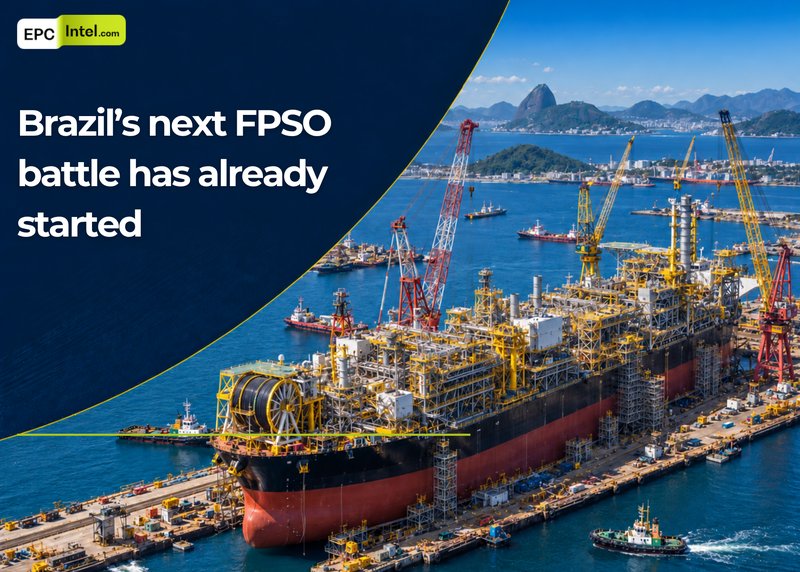
And it tells suppliers something important: the next Brazilian FPSO contest has already started.
The queue is getting longer
Petrobras executed the P-81 and P-87 contracts in May, but these are only two units in a much larger construction programme.
P-80, P-82 and P-83 are already progressing for Búzios, with production targeted from 2027. Future developments across Búzios, Atapu, Sépia, Sergipe and other pre-salt assets could require additional high-capacity units.
MODEC wants more of that work. Yinson Production is strengthening its Brazilian position. Other international players will examine the opportunities, particularly if Petrobras continues testing different ownership and contracting structures.
But every new award enters the same crowded system.
The projects compete for process engineers, module yards, commissioning specialists, compressors, gas turbines, electrical equipment, automation systems, mooring components and project finance. They also compete for the relatively small group of contractors capable of coordinating everything without losing control of cost or schedule.
Brazil may not run out of projects. It could run out of delivery capacity.
SBM is buying time
The real advantage of Fast4Ward is not simply standardization. It is time.
By starting a multipurpose hull before assigning it to a specific field, SBM can move part of the construction schedule ahead of the final award. Standard engineering also reduces redesign, supports repeat procurement and gives equipment suppliers better visibility across multiple projects.
That model is difficult to copy.
It requires capital strong enough to order without a guaranteed contract, confidence that another project will materialize and enough operating income to support the investment. SBM’s US$35.6 billion backlog provides precisely that foundation.
Its long-term lease and operate model then completes the cycle. Operating cash flow from the existing fleet helps finance new units, while every new unit adds decades of potential revenue.
SBM is not merely bidding for FPSOs. It is building an industrial production line for them.
MODEC brings a different threat
MODEC remains deeply embedded in Brazil and is one of the few companies able to challenge SBM at scale.
Its first-half 2026 EPCI revenue reached approximately US$1.62 billion, supported by major projects under construction and a growing operations business. Its installed base, technical experience and relationships across the Brazilian offshore sector make it a natural contender for upcoming developments.
But success creates its own problem.
Every simultaneous FPSO absorbs engineering hours, procurement resources and senior project management. Taking another order is attractive only if the company can deliver it without damaging the projects already in execution.
Yinson faces the same calculation as it expands its Brazilian position. Its financing and lease capabilities make it credible, but the next step is proving that its delivery platform can scale across multiple large projects.
The competition is therefore not simply SBM versus MODEC versus Yinson.
It is each contractor versus its own capacity.
Follow the money beyond the hull
A large Brazilian pre-salt FPSO can require investment of roughly US$2.5 billion to US$4 billion. EPCIntel estimates that the opportunity could typically be divided into:
- US$900 million to US$1.4 billion for topsides process modules
- US$500 million to US$800 million for the hull, marine systems and accommodation
- US$300 million to US$550 million for compression and power generation
- US$200 million to US$350 million for mooring, riser and offloading systems
- US$150 million to US$250 million for electrical, instrumentation and automation
- US$300 million to US$500 million for integration, commissioning and project management
These are indicative ranges, not disclosed values for P-81 or P-87. They show, however, why the battle will reach far beyond the headline FPSO contractors.
The next awards are being decided now
The winners of Brazil’s next FPSO cycle may be determined before Petrobras issues the next major contract.
They will be the companies that reserve manufacturing slots, standardize equipment, qualify Brazilian suppliers, secure integration capacity and keep experienced engineering teams together between projects.
By the time the formal tender arrives, the most valuable commodity may no longer be technology or even price.
It may simply be room in the queue.