
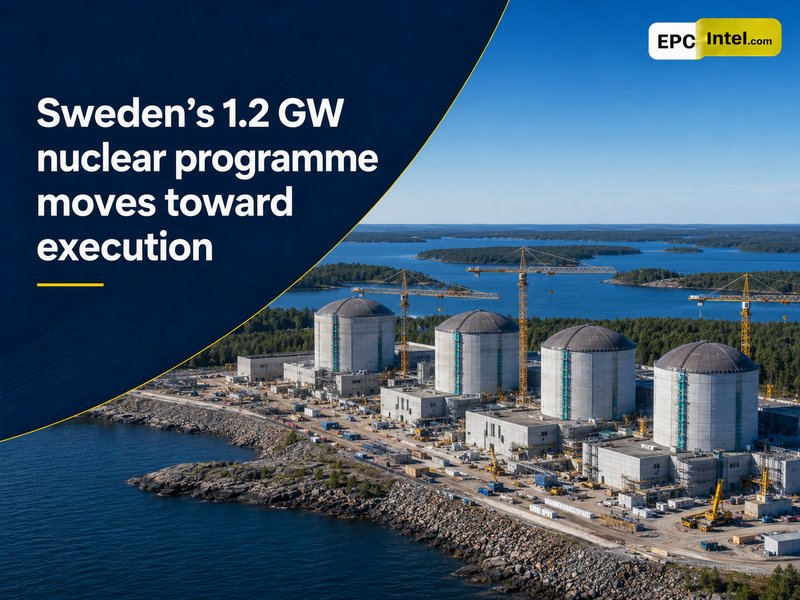
Sweden’s push to expand nuclear generation has produced another potentially significant construction opportunity, with Studsvik assembling an international consortium to develop the first project under its ReFirm programme.
Studsvik has selected GE Vernova Hitachi Nuclear Energy and Samsung C&T as strategic partners for a four-unit BWRX-300 development with approximately 1,200 MW of combined capacity. GE Vernova Financial Services and South Korea’s DS Investment Partners will support financing and investment activities.
The first project could be built at Studsvik’s existing licensed nuclear site in Nyköping or at the proposed Målma site in Valdemarsvik. Development work will determine which location provides the stronger combination of permitting, grid access, construction conditions and community support.
No final investment decision has been taken, and the agreement does not authorise construction. Nevertheless, the formation of a defined technology, execution and financing team moves ReFirm beyond the early concept stage.
A credible delivery structure
The consortium already divides the main development responsibilities.
Studsvik will lead permitting, environmental assessment, site rights, community engagement and discussions with the Swedish government. GE Vernova Hitachi will provide the BWRX-300 reactor design, licensing support and cost estimation while acting as design authority.
Samsung C&T will work alongside GE Vernova Hitachi as part of the execution team, providing single-point responsibility for design and construction delivery. DS Investment Partners will lead investment activities during the exclusivity period, while GE Vernova Financial Services will advise on financing and commercial structuring.
The parties also intend to establish a joint project company responsible for development, financing, construction, ownership and operation.
This structure matters. Many proposed European SMR projects remain agreements between a developer and technology vendor. ReFirm already brings together the site owner, reactor supplier, EPC capability and financial partners needed to move toward an investable project.
Four units change the economics
The proposed plant would comprise four 300 MW BWRX-300 reactors rather than a single demonstration unit.
That approach should create opportunities to reuse engineering, construction systems and supplier qualifications across consecutive units. Lessons from the first reactor could be transferred to later units, reducing installation hours and limiting repeated design work.
As Studsvik CEO Karl Thedéen put it, one reactor is a project, but four represents the beginning of an industry.
The BWRX-300 is also moving beyond paper development. GE Vernova Hitachi is gaining first-of-a-kind experience through Ontario Power Generation’s Darlington New Nuclear Project in Canada. Sweden could therefore benefit from an increasingly standardised design, established procurement specifications and practical construction lessons.
Even so, deploying four units would still represent one of Sweden’s largest prospective energy investments.
Based on comparable nuclear developments and the cost ambitions associated with fleet-based SMR deployment, EPCIntel estimates that total capital expenditure could initially fall within a broad range of $4 billion to $7 billion. Actual costs will depend heavily on site selection, financing, localisation, infrastructure requirements and the construction sequence.
Indicative capital allocation could include:
- Nuclear islands and reactor equipment: $1.4 billion to $2.2 billion
- Civil works and buildings: $900 million to $1.5 billion
- Turbine islands and balance of plant: $700 million to $1.1 billion
- Electrical systems and grid connection: $300 million to $600 million
- Cooling water and site infrastructure: $250 million to $500 million
- Engineering, project management and commissioning: $450 million to $800 million
These figures are preliminary market estimates rather than announced project budgets.
Swedish suppliers will be important
The development team has made local industrial participation a central part of the programme.
That creates potential opportunities across civil engineering, structural steel, modular fabrication, electrical systems, mechanical installation, cooling systems, cranes, instrumentation, cybersecurity, radiation protection and commissioning support.
Sweden already has extensive nuclear operating and engineering experience, but a multi-unit construction programme will require a broader and deeper supplier base. Companies entering the programme early could potentially qualify for follow-on ReFirm projects in Sweden and elsewhere in Europe.
Samsung C&T’s involvement is particularly relevant. The South Korean contractor brings experience from large nuclear and infrastructure projects, while Studsvik provides local nuclear expertise and GE Vernova Hitachi controls the reactor technology.
The next milestones
The consortium will now begin technical, commercial, regulatory and financing work under an exclusive agreement.
A key decision will be the selection between Nyköping and Valdemarsvik. Nyköping offers an existing licensed nuclear site, while Valdemarsvik would test Sweden’s new framework allowing reactors beyond the country’s three established nuclear power locations.
The programme will also need government approval, definitive consortium agreements, financing arrangements and a credible construction schedule before reaching FID.
For contractors, the immediate opportunity remains development engineering and supply-chain positioning. The larger EPC packages will only emerge if permitting and financing progress, but the combination of four units, established sites and named execution partners makes ReFirm one of Europe’s more credible new nuclear prospects.