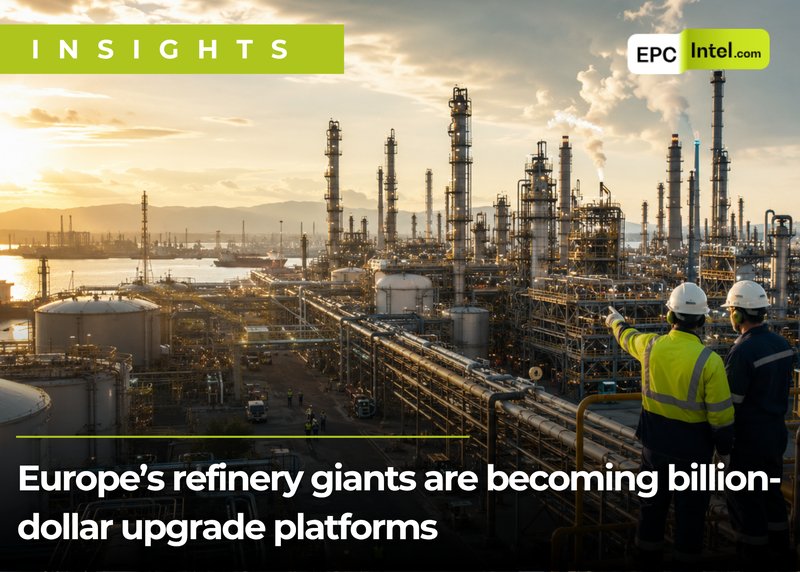
Europe may be closing smaller and less competitive refining assets, but its largest integrated sites are not disappearing. They are becoming more complex.
Shell Pernis and BP Rotterdam remain the two heavyweights, with crude processing capacities of approximately 404,000 barrels per day and 400,000 barrels per day respectively. TotalEnergies’ Antwerp platform follows at around 338,000 barrels per day, while ExxonMobil’s Fawley refinery remains the largest refinery in the UK.
Capacity figures for Fawley vary between sources. ExxonMobil has historically quoted 330,000 barrels per day, although more recent industry references place current crude processing capability closer to 270,000 barrels per day. The picture has also changed at Port-Jérôme-Gravenchon in France. The refinery was acquired by North Atlantic from ExxonMobil and is now generally described as having capacity to process approximately 230,000 barrels per day of crude oil and other feedstocks.
The exact ranking can therefore change depending on whether nameplate capacity, current operating capacity or total feedstock throughput is used.
That does not change the bigger EPC story.
Scale creates continuous work
A 300,000 to 400,000 barrel per day refinery is not one project. It is a city-sized network of crude units, hydrocrackers, cokers, catalytic crackers, reformers, hydrogen plants, sulphur recovery systems, utilities, tank farms, pipelines and marine infrastructure.
Keeping these assets running requires a constant stream of engineering and construction work.
Major refinery turnarounds can mobilise thousands of additional personnel and dozens of specialist contractors. Shell’s 2024 turnaround at Pernis involved approximately 2,500 extra workers from more than 80 service companies, with close to 700,000 working hours completed during the programme.
For contractors, these shutdowns create opportunities across inspection, mechanical maintenance, piping replacement, heat exchanger work, furnace repairs, catalyst handling, scaffolding, insulation, electrical systems and instrumentation.
The contract value of a major turnaround at a refinery of this scale can typically range from US$150 million to more than US$500 million. A particularly complex programme involving multiple process units can move significantly higher.
HSE is the real execution challenge
Refinery work is unforgiving.
Contractors must operate around high-pressure hydrogen, toxic hydrogen sulphide, flammable hydrocarbons, steam systems, rotating equipment and process units running at extreme temperatures. During shutdowns, thousands of workers may be carrying out confined-space entry, lifting, hot work and equipment isolation activities at the same time.
That makes HSE capability a commercial qualification, not a corporate slogan.
Successful contractors need disciplined permit-to-work systems, reliable isolation procedures, detailed simultaneous operations planning and strong control of subcontractors. Asset integrity is equally important. Corrosion under insulation, ageing piping, furnace tube degradation and pressure equipment fatigue can quickly become safety and production risks.
The strongest refinery contractors are therefore not always those offering the lowest price. They are the companies that can shorten shutdown duration without compromising process safety.
Capital spending is changing
Europe’s large refineries are also becoming energy-transition construction platforms.
Traditional spending on crude distillation and fuel production is increasingly being combined with hydrogen, carbon capture, electrification, renewable fuels and energy-efficiency investments. TotalEnergies is adapting Antwerp to produce sustainable aviation fuel and integrate lower-carbon hydrogen, even as it prepares to close an older steam cracker by the end of 2027.
Typical capital allocation for a US$1 billion refinery modernisation programme would include approximately US$250 million to US$350 million for process units, US$150 million to US$220 million for utilities and offsites, US$100 million to US$180 million for hydrogen and emissions reduction systems, and US$80 million to US$150 million for storage, pipelines and loading infrastructure.
Electrical, instrumentation, automation and safety systems can account for another US$80 million to US$120 million. Engineering, construction management, commissioning and contingency normally consume the remaining budget.
The opportunity is not new capacity
Europe is unlikely to build another conventional refinery on the scale of Pernis or Rotterdam.
The opportunity lies inside the fence.
The continent’s largest sites will require billions of dollars in cumulative spending to remain safe, reliable and commercially relevant. Some investments will extend the life of conventional units. Others will replace fossil hydrogen, reduce carbon emissions, improve energy efficiency or enable the production of renewable fuels.
For EPC contractors, equipment suppliers and specialist maintenance companies, Europe’s refinery market is not simply shrinking.
It is concentrating around fewer, larger and more technically demanding industrial platforms.