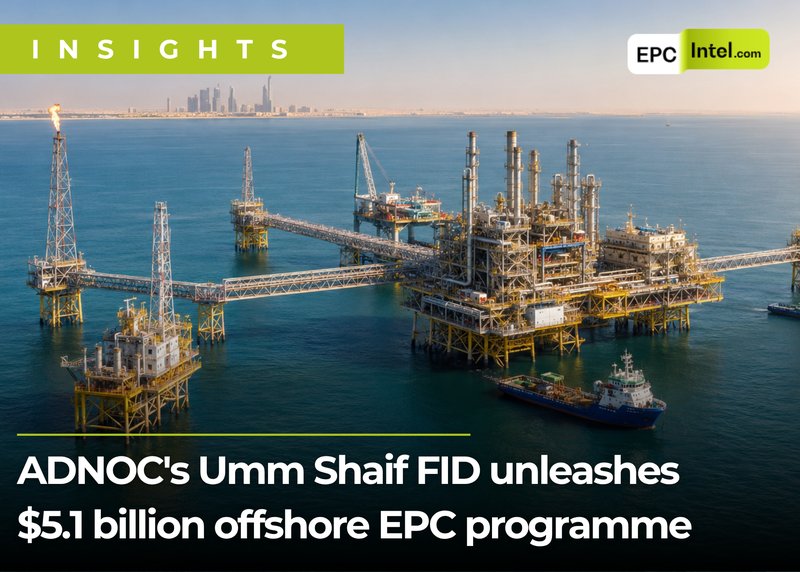
ADNOC and its international partners have committed $6.2 billion to develop the Umm Shaif Gas Cap, turning one of Abu Dhabi’s oldest producing fields into a major new offshore gas construction programme.
The final investment decision covers a development designed to produce more than 600 million standard cubic feet per day of gas by 2030 while maximizing condensate recovery. The facilities could later support an expansion to as much as 1.5 billion cubic feet per day, potentially creating a second wave of offshore investment after the initial development enters production.
A $5.1 billion EPC programme
The headline number for the supply chain is not the full $6.2 billion investment. ADNOC has officially confirmed the award of three engineering, procurement and construction packages with a combined value of $5.1 billion.
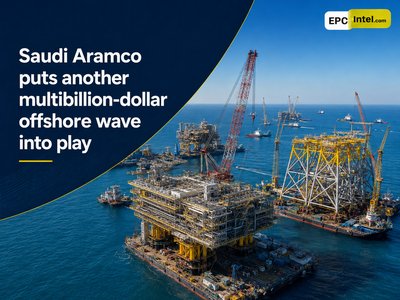
The packages cover the development of large-scale offshore infrastructure required to unlock the gas cap resources. ADNOC said the contracts were awarded to consortiums comprising major UAE and international contractors, but it has not publicly disclosed the names of the contractors, the individual package values or their detailed scopes.
The project also includes an officially confirmed $365 million drilling programme covering 14 wells and integrated drilling services. ADNOC Drilling will execute the programme over approximately 18 months using three existing drilling rigs.
ADNOC Offshore is the operator of the Umm Shaif and Nasr concession. ADNOC holds a 60% interest, TotalEnergies owns 20%, while CNPC and Eni each hold 10%. The concession was awarded in 2018 for a period of 40 years.
Complex brownfield execution
The development will extract gas from the gas cap located above Umm Shaif’s producing oil reservoirs. This means the project is not simply a collection of standalone new platforms.
The EPC contractors will need to integrate new gas production, compression, condensate recovery, electrical and transportation systems with infrastructure at a field that has been producing since 1962.
Maintaining existing oil production while installing and commissioning new facilities will make brownfield engineering a central part of the programme. Shutdown planning, offshore tie-ins, structural modifications and production-interface management are likely to be as important as new platform fabrication.
The use of existing offshore infrastructure should reduce the amount of entirely new processing and export capacity required. However, connecting high-capacity gas facilities to an operating field introduces execution risks that contractors and subcontractors will need to manage carefully.
Where the money could go
Although ADNOC has not published the values of the individual EPC packages, the $5.1 billion programme points to substantial opportunities across the offshore supply chain.
Based on comparable offshore developments tracked by EPCIntel, wellhead facilities, production platforms, jackets and topsides could represent approximately $1.5 billion to $1.8 billion of capital expenditure.
Compression facilities and associated large rotating equipment could account for another $1.0 billion to $1.3 billion. Offshore pipelines, cables, subsea systems and marine installation could absorb approximately $700 million to $900 million.
Condensate handling, utilities, brownfield modifications and tie-ins could require between $600 million and $800 million. Electrical equipment, instrumentation, telecommunications, control systems and grid connections could represent another $250 million to $400 million.
These are EPCIntel estimates rather than officially disclosed package values. Nevertheless, they highlight the likely scale of subcontracting opportunities for UAE fabrication yards, compressor manufacturers, module suppliers, pipeline companies, cable manufacturers, valve suppliers and offshore installation contractors.
More than another gas project
Umm Shaif matters because it combines new gas production with an existing offshore production system. The development is designed to leverage established facilities and electricity supplied from the UAE grid, helping control costs and reduce operational emissions.
For the supply chain, lower emissions do not mean lower technical complexity. Electrified offshore equipment, subsea power distribution, wet-gas compression, brownfield integration and high-pressure gas handling will require specialized engineering and equipment.
Long-lead procurement is likely to focus on compression trains, high-pressure vessels, electrical systems, transformers, subsea cables, valves and major structural steel components.
With production targeted for 2030, the three unnamed EPC consortiums now face a demanding engineering, procurement, fabrication and offshore installation schedule.
Umm Shaif may be Abu Dhabi’s oldest offshore producing field, but its gas cap is set to become one of the UAE’s largest offshore EPC programmes of the decade.