
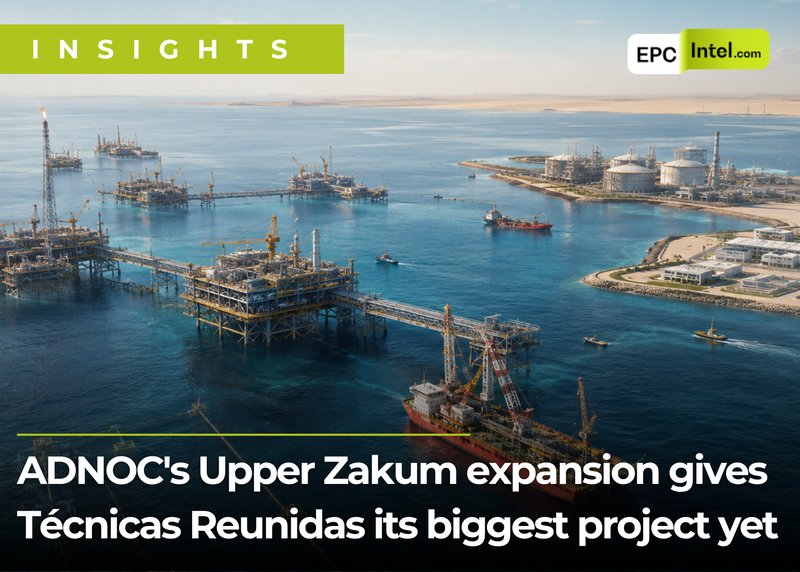
Técnicas Reunidas has landed the biggest solo contracting win in its history, securing two packages worth more than €5 billion, or approximately $5.75 billion, for ADNOC Offshore’s Upper Zakum expansion in Abu Dhabi.
The contracts cover engineering, procurement, construction and installation work for the next phase of development at one of the world’s largest offshore oilfields. The programme is designed to increase Upper Zakum’s production capacity to 1.5 million barrels per day, creating a substantial pipeline of work across artificial islands, offshore facilities, subsea systems and export infrastructure.
For Técnicas Reunidas, this is more than another Middle East project. The Spanish contractor is taking the leading position on one of ADNOC’s largest upstream construction programmes, while dramatically expanding a backlog that stood at €13.9 billion at the end of June 2026.
A $10 billion offshore programme
The two Técnicas Reunidas packages form part of a broader Upper Zakum development programme understood to be worth more than $10 billion. The remaining major package has been allocated to UAE-based NMDC Energy.
Upper Zakum is operated by ADNOC Offshore on behalf of ADNOC, ExxonMobil and INPEX subsidiary Japan Oil Development Company. The field is located approximately 80 kilometres northwest of Abu Dhabi and is widely described as the world’s second-largest offshore oilfield.
The new expansion phase builds on decades of investment in artificial islands, offshore production platforms and water injection infrastructure. Técnicas Reunidas was previously involved in engineering work for Upper Zakum, giving the company an important advantage as the project moved into full execution.
Its new scope includes facilities on existing artificial islands and Zirku Island, covering compressors, storage tanks, water treatment systems and supporting utilities. Offshore production facilities, subsea infrastructure, pipelines and brownfield modifications are also included.
That combination makes the contracts closer to several integrated megaprojects bundled together than a conventional oilfield EPC package.
Where the money will go
Based on the typical cost distribution for comparable ADNOC offshore developments in EPCIntel’s contracts database, approximately 30% to 35% of the Técnicas Reunidas contract value could be directed toward island-based processing and utility facilities.
That represents potential spending of between $1.7 billion and $2 billion across compression systems, separation equipment, water treatment units, power distribution, storage tanks and associated civil works.
Offshore production facilities and subsea infrastructure could account for another 20% to 25%, equivalent to approximately $1.15 billion to $1.45 billion. This portion should create opportunities for platform fabricators, subsea structure suppliers, marine contractors and installation vessel operators.
Pipelines, flowlines and export infrastructure could absorb around 15% to 20%, potentially creating a market worth between $860 million and $1.15 billion for line pipe manufacturers, coating companies, valve suppliers, welding contractors and offshore installation specialists.
Brownfield modifications, tie-ins and shutdown-related works could represent another 10% to 15%. These activities are often among the most technically demanding parts of a project because contractors must work around operating facilities while minimising interruptions to production.
The remaining capital is likely to cover engineering, project management, commissioning, temporary construction facilities and contingency.
These figures are EPCIntel estimates rather than disclosed package allocations, but they illustrate how quickly the headline contract value will filter into major subcontracting and equipment opportunities.
Spain leads, but Abu Dhabi will build
Técnicas Reunidas may be the sole main contractor for its two packages, but the execution model will inevitably depend heavily on the UAE supply chain.
ADNOC’s localisation requirements should direct a significant share of fabrication, construction and services spending toward Emirati companies. Structural fabrication, modular assembly, piping, electrical and instrumentation installation, heavy lifting, logistics and accommodation services are all likely to be sourced locally.
International suppliers should see the largest opportunities in specialist compressors, pumps, process equipment, subsea systems, control systems and high-specification pipeline materials.
The scale of the programme also means Técnicas Reunidas will need to place orders early. Compressors, large pressure vessels, electrical equipment and specialised valves can carry long manufacturing schedules, making procurement activity one of the first major indicators of project execution.
A contract that changes the backlog
The Upper Zakum packages transform the scale of Técnicas Reunidas’ order book. With more than €5 billion attached to a single development, the contracts are larger than many contractors’ entire annual order intake.
They also reinforce the company’s position in Abu Dhabi, where it already holds major work on ADNOC’s Lower Zakum development. Técnicas Reunidas secured a €3.3 billion Lower Zakum contract in 2025, demonstrating that ADNOC is increasingly comfortable handing the Spanish group responsibility for very large, technically complex upstream programmes.
Upper Zakum is therefore not simply another backlog addition. It is a test of whether Técnicas Reunidas can successfully manage several billion-dollar ADNOC projects simultaneously.
For subcontractors and suppliers, the message is clearer. One of the Middle East’s largest offshore procurement cycles is moving from contractor selection into execution, and billions of dollars of package awards are now waiting to move down the supply chain.