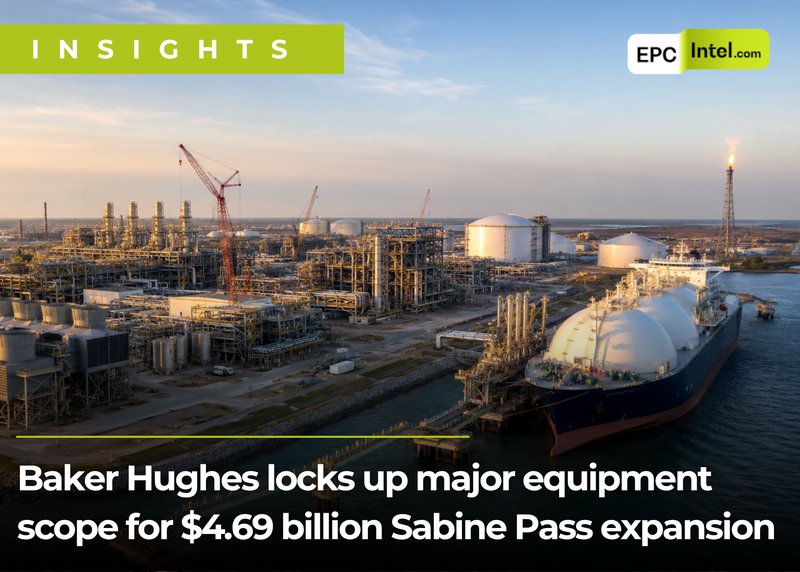
Baker Hughes has secured three substantial awards covering new liquefaction equipment, boil-off gas handling and fleet-wide turbine upgrades at Cheniere Energy’s Sabine Pass LNG terminal in Louisiana.
The awards put Baker Hughes at the centre of both sides of the Sabine Pass growth story: building new production capacity and extracting more output from the six trains already operating.
The orders were booked during the second quarter of 2026 and were placed by Bechtel Energy and Cheniere. Bechtel is executing Phase 1 of the Sabine Pass Expansion under a lump-sum turnkey EPC contract valued at approximately $4.69 billion. The scope covers Train 7, a boil-off gas re-liquefaction unit, associated infrastructure and tie-ins to the existing terminal.
Baker Hughes takes the rotating equipment prize
The headline equipment package includes seven PGT25+ G4 aeroderivative gas turbines driving 15 centrifugal compressors.
This is the machinery that sits at the heart of the liquefaction process. The gas turbines provide the mechanical power needed to drive the refrigeration compressors, which progressively cool natural gas until it becomes LNG.
For Baker Hughes, this is not simply another turbine order. Sabine Pass already operates a large installed fleet of PGT25+ G4 units, giving the supplier an established technology base, operating history and service relationship at the terminal.
Train 7 is expected to provide around 5 million tonnes per annum of new liquefaction capacity. Together with the boil-off gas re-liquefaction unit and debottlenecking opportunities, Phase 1 is expected to add more than 6 million tonnes per annum, lifting output by over 20% from the terminal’s current capacity of approximately 30 million tonnes per annum.
Existing trains get more muscle
The third award covers technology upgrades across the full fleet of aeroderivative PGT25+ G4 gas turbines installed at Sabine Pass.
The work will be performed over four years and is intended to increase turbine power output, improve operating efficiency and support higher LNG production from the existing trains.
That makes the upgrade programme commercially important. Brownfield improvements generally offer faster and less capital-intensive capacity growth than constructing an entirely new train, particularly at a mature terminal where storage tanks, marine infrastructure, pipelines and utilities are already available.
It also creates a long-duration services opportunity for Baker Hughes. The initial hardware sale is only part of the prize. Turbine upgrades typically pull through engineering, replacement components, control-system modifications, field services, testing, commissioning and future maintenance work.
Where the $4.69 billion will be spent
Based on comparable large-scale LNG developments in EPCIntel.com’s contract database, the liquefaction and refrigeration package is likely to represent one of the largest single procurement categories within Bechtel’s EPC scope.
A reasonable capital breakdown for Phase 1 would allocate approximately $850 million to $1.1 billion for liquefaction compressors, gas turbines, drivers, auxiliary systems and related controls.
Civil works, foundations, buildings and site preparation could account for $550 million to $750 million. Piping, valves and mechanical installation may absorb another $650 million to $850 million, while electrical systems, instrumentation and automation could represent $350 million to $500 million.
The boil-off gas re-liquefaction facilities, utilities, flare systems and brownfield tie-ins could collectively generate packages worth $500 million to $750 million. Construction management, commissioning, indirect costs and EPC contingency would make up much of the remaining contract value.
These figures are indicative rather than disclosed contract values, but they show why Baker Hughes securing the primary turbomachinery package matters. It has captured one of the most technically critical and potentially highest-value equipment scopes before full construction begins.
Supplier opportunities are moving forward
Bechtel received a limited notice to proceed in May 2026, allowing early engineering, procurement and site activities to begin. Full construction is expected to start in early 2027, subject to Cheniere reaching a positive final investment decision.
With the main rotating equipment now selected, procurement attention should move toward air coolers, heat exchangers, pressure vessels, cryogenic valves, modular pipe racks, electrical substations, control systems, structural steel and construction services.
Baker Hughes has taken the glamorous package. The next wave of awards will be less visible, but for subcontractors and equipment manufacturers, it could be just as valuable.