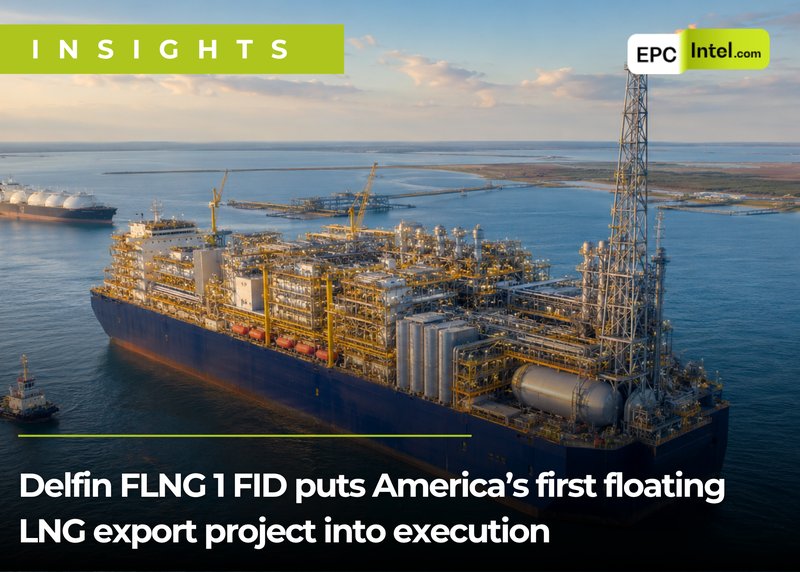
Delfin Midstream has finally moved Delfin FLNG 1 from a long-running development story into a real execution project, taking FID on the first floating LNG vessel for its Louisiana and Gulf of America export scheme.
This is not just another LNG sanction. It is the first floating liquefaction facility in the United States, a 4.4 mtpa vessel backed by long-term LNG sales agreements with Vitol, Expand Energy, Centrica and Gunvor. It also gives the U.S. LNG sector a new export model, one built around offshore floating infrastructure rather than another large onshore liquefaction complex on the Gulf Coast.
The investor group is equally important. Global Infrastructure Partners, now part of BlackRock, is leading the investment group, alongside MOL, Vitol and Diameter Capital Partners. For Delfin, this gives the project both capital strength and strategic alignment across LNG shipping, trading, infrastructure finance and long-term offtake.
Why this matters
Delfin FLNG 1 is scheduled to begin LNG production in 2030. The vessel will form the first phase of a wider floating LNG development that is permitted to export up to 13.2 mtpa. Delfin also said it is advancing toward FIDs for FLNG vessels two and three over the coming year, which means this first vessel could quickly become the platform for a broader multi-unit offshore LNG buildout.
The project sits in an interesting space for contractors. Floating LNG combines upstream gas handling, liquefaction, marine systems, offshore installation, storage, loading and subsea or pipeline interfaces into one highly integrated capital package. That means the opportunity is not limited to the main vessel yard and liquefaction contractor. It stretches across topsides modules, cryogenic equipment, rotating equipment, marine systems, controls, power generation, commissioning support, logistics and offshore hook-up.
Samsung Heavy Industries and Black & Veatch are already named as construction partners for the first vessel. Samsung brings the shipyard and floating facility execution platform, while Black & Veatch brings LNG process and liquefaction engineering capability. For the wider supply chain, the sanction unlocks a sizeable procurement runway tied to a 2030 start-up target.
EPC and supplier opportunity
Based on EPCIntel.com’s floating LNG and large LNG module benchmarks, a 4.4 mtpa FLNG vessel of this scale could represent a capital program in the multi-billion-dollar range. The exact contract value has not been disclosed, but typical floating LNG cost intensity suggests Delfin FLNG 1 could sit around USD 3.5 billion to USD 5.0 billion, depending on final vessel configuration, liquefaction technology, storage capacity, marine systems, contingency and owner’s costs.
A typical package split for a project of this kind could look broadly as follows:
Liquefaction topsides, process modules and integration could account for around 35% to 45% of spend, or roughly USD 1.4 billion to USD 2.0 billion on a USD 4.5 billion reference case. This is where major opportunities sit for heat exchangers, cryogenic equipment, compressors, turbines, piping, valves, structural steel, E&I systems and module fabrication.
Hull, marine systems and storage could represent 20% to 30%, or around USD 900 million to USD 1.3 billion. This supports yard work, LNG containment systems, marine equipment, accommodation, safety systems, power distribution and vessel integration.
Rotating equipment and power generation could make up 10% to 15%, or around USD 450 million to USD 675 million. Large compressor trains, drivers, gas turbines, generators, utility compressors and related control systems will be among the most critical supplier packages.
Offshore infrastructure, mooring, pipeline interfaces and loading systems may represent 10% to 15%, or around USD 450 million to USD 675 million. This area could create opportunities for subsea, offshore installation, mooring, marine loading arms or offloading systems, metering and commissioning specialists.
Engineering, project management, commissioning and start-up support could account for 5% to 10%, or around USD 225 million to USD 450 million.
Market signal
The bigger message is that floating LNG is no longer just a stranded gas solution for remote offshore fields. Delfin is using FLNG as a U.S. export platform, pairing Gulf Coast gas access with offshore liquefaction infrastructure. If successful, it could offer a repeatable development route that avoids some of the congestion, land constraints and permitting complexity associated with large onshore terminals.
For Samsung Heavy Industries and Black & Veatch, Delfin FLNG 1 is a flagship U.S. LNG reference. For suppliers, it is a major procurement opportunity. For the wider LNG market, it is another signal that buyers are still prepared to support long-term U.S. LNG supply, especially when backed by credible offtakers and infrastructure capital.
Delfin has talked about floating LNG for years. With FID now secured, the story changes from concept to execution. The next question is not whether Delfin can sanction its first vessel. It is whether FLNG 2 and FLNG 3 follow quickly enough to turn Delfin from a single breakthrough project into one of the most important new LNG export platforms in the United States.