Hail and Ghasha is one of the biggest active gas EPC stories in the Middle East, and it is now less about concept and more about execution.
ADNOC took FID on the Hail and Ghasha Offshore Development project in October 2023 and awarded EPC contracts worth around $17 billion, making it one of the largest sour gas project awards in the region. The project forms part of Abu Dhabi’s wider Ghasha concession, which ADNOC says is expected to produce 1.8 billion standard cubic feet per day of gas.
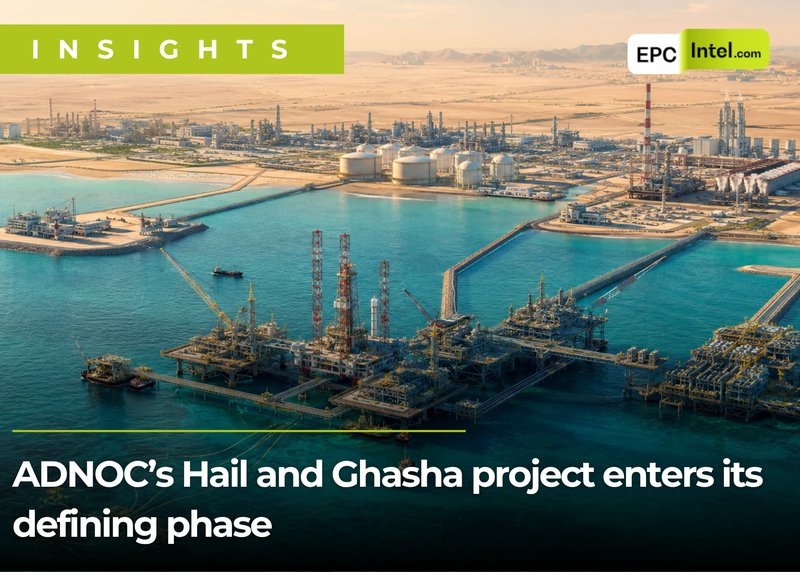
This is not a simple offshore gas tieback. It is a full sour gas development covering artificial islands, offshore structures, subsea pipelines, onshore gas processing, sulphur recovery, utilities, export systems and carbon capture. That combination makes Hail and Ghasha a major test of ADNOC’s ability to deliver complex upstream infrastructure while keeping emissions control at the centre of the design.
EPC structure
The project’s EPC structure is split into two major packages.
The offshore package was awarded to a joint venture of National Petroleum Construction Company, now part of NMDC Group, and Saipem. Saipem said its share of the contract is worth around $4.1 billion. The scope includes EPC work for four drilling centres, one processing plant on artificial islands, offshore structures and more than 300 kilometres of subsea pipelines.
The onshore package was awarded to Tecnimont, part of MAIRE, with a value of around $8.7 billion. This scope covers gas processing units, sulphur recovery sections, utilities, offsites and export pipelines. Tecnimont described it as the largest award in the group’s history.
That split matters. ADNOC has effectively created two large execution fronts, one offshore and island based, the other onshore and process heavy. The interface between those scopes will be one of the most important risk points as the project moves deeper into construction.
Package spend
Based on EPCIntel.com’s typical sour gas capital spend benchmarks, Hail and Ghasha’s disclosed EPC value breaks down into several major opportunity areas.
The offshore package, at roughly $8.2 billion to $8.3 billion, is likely to carry the largest spend in artificial island facilities, drilling centres, offshore structures, subsea pipelines, marine installation, heavy fabrication, corrosion resistant materials and offshore electrical and control systems.
The onshore package, at $8.7 billion, is concentrated in gas treatment, acid gas handling, sulphur recovery, utilities, offsites, export pipelines, compressors, pressure vessels, heat exchangers, electrical systems, instrumentation and construction services.
For suppliers and subcontractors, the project is attractive because sour gas developments are equipment dense and technically demanding. Materials selection, corrosion management, sulphur handling and process reliability all carry high value. This is where the project creates opportunities well beyond the headline EPC contractors.
Financing angle
The financing milestone in December 2025 added another layer to the project.
ADNOC, together with Eni and PTTEP, signed a structured financing transaction of up to $11 billion to monetize Hail and Ghasha’s future midstream gas production. ADNOC said the deal involved more than 20 global and regional financial institutions.
That is important because it confirms that Hail and Ghasha is not only an EPC megaproject. It is also becoming a financing model for future ADNOC gas developments. The transaction allows ADNOC and its partners to unlock value from future production while continuing to push ahead with one of the UAE’s largest domestic gas supply projects.
Low carbon angle
ADNOC has positioned Hail and Ghasha as a lower carbon sour gas development. The project is designed to capture around 1.5 million tonnes per year of CO2, while ADNOC has said it aims for the development to operate with net zero emissions.
That claim will be watched closely. Sour gas projects are difficult by nature. They require large processing systems, sulphur recovery, acid gas management and reliable emissions control. If ADNOC delivers the project as planned, Hail and Ghasha could become a reference case for how future high complexity gas resources are developed in a carbon constrained market.
What to watch
The real story now is execution.
The onshore package gives Tecnimont one of the largest sour gas references in the world. The offshore package gives NMDC and Saipem a major artificial island, pipeline and offshore facilities workload. For the UAE supply chain, ADNOC has also said more than 60 percent of the project’s investment value will flow back into the local economy through its in country value programme.
Hail and Ghasha is therefore not just about adding gas volumes. It is about proving that a technically difficult sour gas resource can be delivered at scale, financed creatively, integrated with carbon capture and executed with major local content.
For EPC contractors, subcontractors and suppliers, it remains one of the most important active project opportunities in the Middle East.