Texas LNG gives Kiewit the early green light as Brownsville’s next LNG project edges toward FID
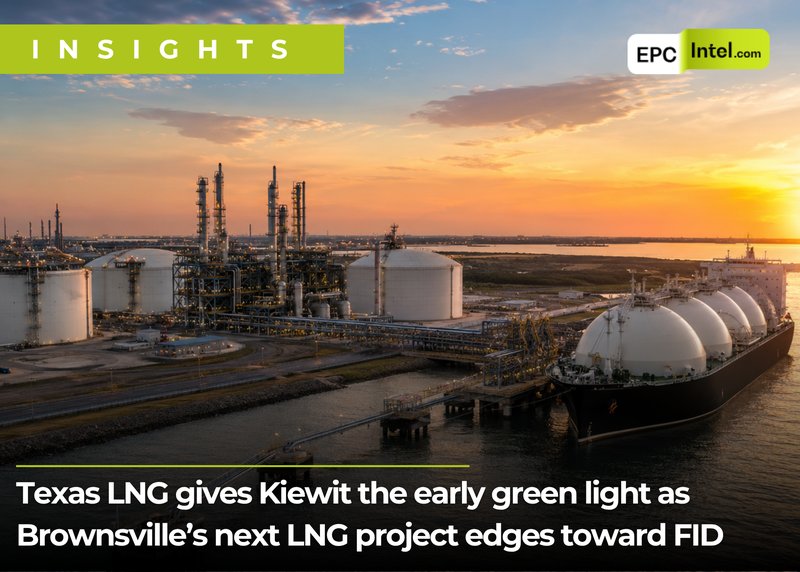
Kiewit Energy Group has now moved deeper into the execution lane at Texas LNG, after Glenfarne issued a Limited Notice to Proceed for the planned export terminal at the Port of Brownsville.
This is not yet the big ceremonial FID moment, but in EPC terms, it is the step that matters before the step that matters. The LNTP covers long-lead equipment purchase orders, EPC-phase engineering, and geotechnical work needed to ready the project for full construction. Texas LNG has already executed a lump-sum turnkey EPC agreement with Kiewit and has received FERC authorization for construction and operation.
For Kiewit, the message is simple. The contractor is no longer just sitting on an EPC agreement waiting for financial close. It is now being paid to lock down equipment, advance design maturity, and reduce execution risk before the project crosses the FID line.
That is usually where serious projects separate themselves from brochure projects.
A smaller LNG project, but not a small contract
Texas LNG is designed as a 4 mtpa LNG export terminal at Brownsville, making it smaller than the mega-train developments elsewhere on the Gulf Coast, but still large enough to generate a meaningful EPC and supplier opportunity.
The project has been reported with an overall cost around $4 billion, while Glenfarne has also assembled an initial bank group to lead a $5.7 billion bank debt financing package. The difference matters. The first figure is closer to project capital cost, while the financing package can include wider funding, contingencies, interest, fees, and liquidity requirements.
For EPCIntel, the more useful lens is the physical capital spend. Based on comparable Gulf Coast LNG developments in EPCIntel’s contract database, a 4 mtpa liquefaction project of this type would typically break down across several major packages.
Estimated capital allocation could look roughly like this:
Liquefaction trains and process units, including refrigeration systems, compressors, cryogenic exchangers and associated process equipment, could represent 35 percent to 40 percent of installed cost, or around $1.5 billion to $1.8 billion.
Storage tanks, boil-off gas systems and loading infrastructure could account for 15 percent to 20 percent, or around $600 million to $900 million, depending on final tank configuration and marine scope.
Utilities, power generation, flare, control systems, electrical distribution and balance-of-plant facilities could take another 15 percent to 18 percent, or around $600 million to $800 million.
Civil works, marine works, piling, site preparation and geotechnical-related execution could represent 10 percent to 15 percent, or around $400 million to $650 million.
Engineering, construction management, indirects, commissioning, temporary facilities and EPC contingency would likely absorb the remainder, often 15 percent to 20 percent of total installed cost.
That does not mean every dollar is going to Kiewit directly. LNG EPC contracts are huge procurement machines. The main contractor’s role is to orchestrate the supply chain, secure long-lead items, manage interfaces, and carry the lump-sum execution risk. The value then flows down into compressor packages, heat exchangers, modular fabrication, electrical systems, cryogenic valves, marine equipment, tanks, steel, construction labor and commissioning services.
Why the LNTP matters
The LNTP is especially important because LNG projects are supply-chain driven. A developer can announce offtake, financing progress and permits, but without early procurement the schedule still slips.
Long-lead equipment is the first stress test. Refrigeration compressors, gas turbines or electric drive systems, cryogenic equipment, LNG loading arms, high-spec valves, electrical equipment and control systems can all shape the final construction schedule. By issuing purchase orders now, Glenfarne is trying to preserve schedule optionality before full FID.
This is also a risk-transfer move. Kiewit’s lump-sum turnkey EPC structure gives Texas LNG a clearer execution framework, but that only becomes valuable if the cost estimate is backed by real vendor pricing, mature engineering and site data. Geotechnical work may sound boring, but in coastal LNG construction it can decide piling scope, civil cost, drainage approach and construction sequencing.
Brownsville is getting crowded
Texas LNG is not advancing in isolation. Brownsville has become one of the most competitive LNG construction corridors in the United States, with NextDecade’s Rio Grande LNG already transforming the local contractor and labor environment.
That creates both advantages and problems for Texas LNG. The advantage is infrastructure familiarity, local supply chain development and growing LNG workforce depth. The problem is competition for craft labor, marine contractors, heavy transport capacity, accommodation, port logistics and specialist subcontractors.
This is where Kiewit’s early involvement matters. If Texas LNG waits until FID to secure the project execution ecosystem, it risks arriving late to a busy party. The LNTP gives Kiewit a head start in the queue.
The EPC signal
For EPC markets, this is a clean signal. Texas LNG is not just keeping the project alive. It is spending money to make it executable.
The project still needs FID, and LNG developers know better than anyone that offtake, financing, regulatory certainty and construction readiness all have to line up. But issuing LNTP to a major EPC contractor is one of the more credible signs that a project is moving from commercial development into delivery preparation.
For Kiewit, this is another strategic Gulf Coast LNG position. For suppliers, the window is opening around long-lead equipment, civil and marine subcontracting, modular fabrication, electrical systems, bulk materials and commissioning support.
Texas LNG may not be the biggest LNG project on the U.S. Gulf Coast, but that is exactly why it is worth watching. Smaller, fully subscribed, tightly contracted LNG projects can sometimes move faster than the giants.
And with Kiewit now under LNTP, Brownsville has another LNG development trying to turn momentum into purchase orders.