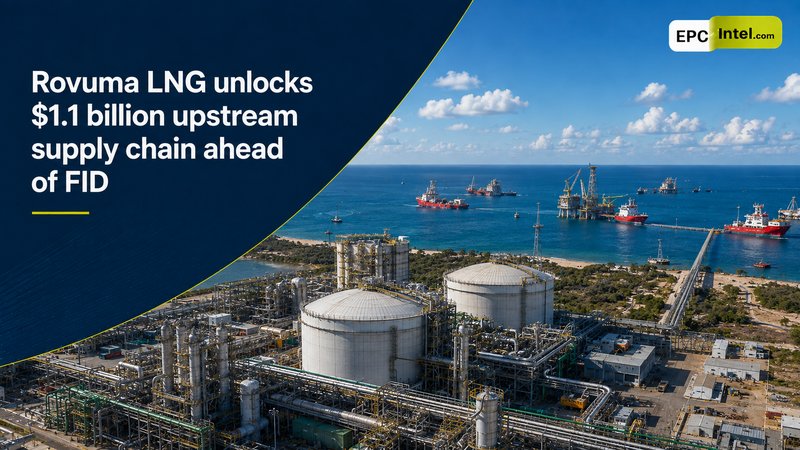
ExxonMobil and the Area 4 partners have committed approximately $1.1 billion to critical subsea equipment and pipeline materials for Rovuma LNG Phase 1, giving major suppliers permission to begin work before the project reaches final investment decision.
Rovuma LNG is no longer simply preparing for execution. It is beginning to spend like a project that expects execution to happen.
ExxonMobil Moçambique, acting for the Area 4 co-venturers, has awarded approximately $1.1 billion in pre-investment contracts covering subsea production systems, large-bore valves and offshore pipeline materials.
The partners include Mozambique’s ENH, CNPC, Eni, KOGAS and XRG, alongside ExxonMobil as operator of the onshore liquefaction facilities.
The awards remain subject to the wider project moving forward, but the scale of the commitment is significant. More than $1 billion is now being directed toward equipment that typically sits on the critical path of a deepwater gas development.
For contractors and manufacturers, Rovuma LNG is moving beyond engineering studies and into the early stages of physical execution.
Subsea systems take the largest share
The largest package has been awarded to OneSubsea UK and OneSubsea AS, with Aker Solutions Mozambique supporting the in-country scope.
The package covers engineering, procurement, fabrication and manufacturing services for subsea production systems, controls and umbilicals. These systems will connect the offshore wells to the wider gas gathering infrastructure required to supply the planned liquefaction complex.
ExxonMobil has not disclosed the individual value of each package. Based on comparable deepwater developments, EPCIntel estimates that the subsea production systems, controls and umbilicals package could account for approximately 55% to 70% of the combined $1.1 billion commitment.
That would indicate a possible value of between $600 million and $770 million for the OneSubsea-led scope, although the final figure will depend on the number of wells, subsea trees, manifolds, control modules and umbilical lengths included.
The award is also important for Mozambique’s local supply chain. Aker Solutions Mozambique will support the in-country work, creating an early route for local engineering, fabrication support, logistics and workforce participation.
Pipeline materials enter production
The remaining awards establish the material supply chain for Rovuma LNG’s offshore gathering and production system.
Advanced Technology Valve will engineer, fabricate, test and deliver large-bore production valves. These are technically demanding components designed to manage high-pressure gas flows across the offshore production infrastructure.
Corinth Pipeworks will manufacture submerged arc welded line pipe, including coating, testing, preservation and storage.
Sumitomo Corporation of America has been selected for seamless line pipe, while Zhejiang Jiuli Hi-Tech Metals will supply mechanically lined pipe, induction bends, weld overlay products and associated systems.
EPCIntel estimates that the various line pipe packages could collectively represent approximately 20% to 30% of the announced value, equivalent to around $220 million to $330 million. Valves, specialist components, testing, coating, preservation and storage could account for much of the remaining expenditure.
These are indicative estimates, not disclosed award values, but they illustrate where capital is beginning to move across the project.
Why spend before FID?
The answer is schedule.
Subsea systems, specialist valves and corrosion-resistant pipeline products can require lengthy engineering, qualification and manufacturing periods. Waiting until after FID to place every order could delay the offshore installation programme and, ultimately, the first LNG production date.
By committing funds now, the Area 4 partners can reserve manufacturing capacity, begin detailed engineering and move critical materials into production.
The approach also reduces exposure to capacity constraints across a global subsea supply chain already serving major developments in Guyana, Brazil, the Gulf of Mexico and West Africa.
This does not replace FID. It does, however, make Rovuma LNG increasingly difficult to view as a project sitting passively in the development queue.
Two execution fronts are forming
The upstream awards follow separate progress on the planned onshore LNG facilities.
Rovuma LNG Phase 1 is designed to develop offshore gas resources in Area 4 and supply an onshore liquefaction complex with capacity of 18.6 million tonnes per year.
This creates two major execution fronts.
The first covers offshore wells, subsea production systems, flowlines, umbilicals and supporting marine infrastructure. The second covers the LNG trains, gas treatment facilities, utilities, storage, marine export infrastructure and associated construction works at Afungi.
With $1.1 billion now committed to upstream equipment, Rovuma LNG is building an execution base before the main investment decision is taken.
FID remains the decisive milestone, but suppliers no longer need to wait for it to see where the project is heading. The first substantial wave of procurement is already underway.