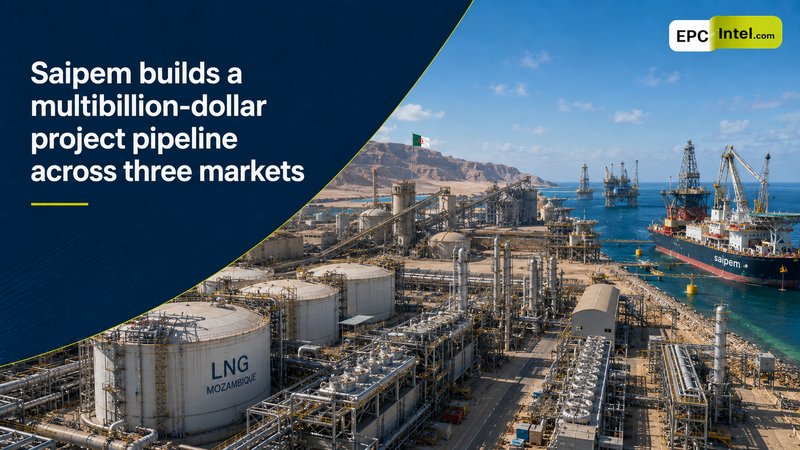
Three announcements in less than a week have put Saipem at the centre of three very different project markets: LNG in Mozambique, fertilizers in Algeria and offshore infrastructure in the Middle East.
Taken separately, they are significant. Taken together, they show something more interesting.
Saipem is building exposure across the full EPC cycle, from early procurement and limited notices to proceed through to a fully awarded $1.8 billion offshore EPCI package. For suppliers and subcontractors, that means the company could be feeding several sizeable procurement programmes at the same time.
Rovuma moves closer to execution
The biggest future opportunity is Rovuma LNG in Mozambique.
On August 7, Saipem confirmed that the SMDC joint venture had signed a Letter of Intent with ExxonMobil Moçambique for limited preliminary engineering and procurement work on Rovuma LNG Phase 1. Saipem is leading the venture alongside McDermott Energy Solutions, Daewoo E&C and China Petroleum Engineering & Construction Corporation.
The initial value is only $32 million, but that number is almost irrelevant compared with what sits behind it.
Rovuma LNG is planned around two LNG trains incorporating 12 modular liquefaction modules and approximately 18.6 million tonnes per annum of LNG capacity. The final EPC award remains subject to FID and regulatory approvals expected during 2026.
If the project reaches full execution, this becomes a multibillion-dollar procurement programme covering liquefaction modules, compressors, cryogenic equipment, heat exchangers, storage, power generation, utilities, electrical systems and major civil works.
For Saipem, the importance is getting into procurement before full EPC mobilization.
Long-lead equipment can start moving while the project team continues to close out engineering and execution planning.
Algeria brings another fast-track programme
Five days later, Saipem confirmed another project moving from engineering into early execution.
The company signed a Limited Notice to Proceed worth approximately €500 million with Sonatrach for Phase 1 of Algeria’s Projet Phosphates Intégré. The project includes phosphate mining infrastructure at Bled El Hadba, fertilizer production facilities at Oued El-Kebrit and associated logistics and service infrastructure.
Saipem had already been selected as EPC contractor following competitive FEED work.
The LNTP allows it to complete FEED, move into detailed engineering, procure long-lead equipment and begin preliminary mobilization while the full EPC agreement is finalized.
That structure matters.
Instead of waiting for every commercial detail to be closed before spending begins, Sonatrach and Saipem are pulling critical activities forward. For vendors, that typically means procurement opportunities can emerge considerably earlier than the full construction programme might suggest.
Process equipment, fertilizer technology packages, rotating equipment, electrical systems, structural steel, piping and logistics infrastructure should all form substantial parts of the eventual supply chain.
Saipem also intends to involve Algerian construction companies, giving the project a significant local subcontracting component.
Middle East offshore adds $1.8 billion
Then came the third announcement.
Saipem secured an offshore EPCI project in the Middle East valued at approximately $1.8 billion. The client and project were not disclosed, but the scope covers engineering, procurement, construction and installation of offshore and subsea facilities.
Unlike Rovuma and Algeria, this is already a full execution award.
For EPCIntel.com‘s supply-chain view, a $1.8 billion offshore package of this type could typically place around $300 million to $450 million into offshore fabrication and structural work, depending on the facility configuration.
Subsea equipment, pipelines and installation could absorb another $350 million to $500 million, while process equipment, piping, valves, electrical and instrumentation packages could account for several hundred million dollars more.
Marine operations, heavy lifting, logistics, hook-up and commissioning then make up another sizeable portion of the project.
These are EPCIntel estimates based on comparable offshore EPC programmes rather than disclosed package values.
Three projects, three stages
The most interesting part of Saipem’s August announcements is therefore not simply their combined headline value.
They represent three different points in the project cycle.
Rovuma LNG is moving from FEED toward early procurement and potentially one of the world’s largest new LNG EPC programmes.
Algeria has moved into a €500 million early works and procurement phase ahead of a wider EPC execution programme.
The Middle East offshore project is already a $1.8 billion fully awarded EPCI job.
For Saipem’s supply chain, those three projects could therefore generate overlapping purchasing cycles across LNG equipment, fertilizer process systems, fabrication, subsea infrastructure, rotating equipment, piping, electrical systems and construction services.
That is the bigger story.
Saipem is not just adding isolated awards. It is building a pipeline where early-stage megaprojects are beginning to convert into procurement at the same time as large offshore projects move directly into execution.