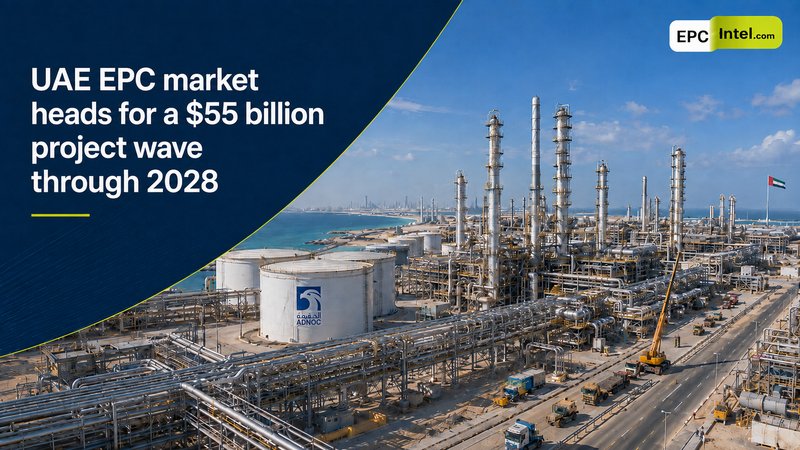
ADNOC is preparing to place around AED 200 billion, equivalent to approximately $55 billion, of new project awards between 2026 and 2028, setting up one of the strongest EPC pipelines the UAE energy sector has seen in years.
For contractors, suppliers and engineering companies, the important point is that this is not one isolated megaproject. The spending is spread across offshore oil and gas, gas processing, LNG, petrochemicals, pipelines and supporting infrastructure, which means the opportunity extends through almost every part of the EPC supply chain.
Recent activity already gives a good indication of where the money is going.
Gas leads the next investment cycle
ADNOC Gas has become one of the most active buyers of large EPC capacity in the region.
Its Rich Gas Development programme alone has generated around $8.2 billion of major EPC work, including the latest $4.3 billion Ruwais NGL expansion being delivered by Tecnimont.
That project will add a fifth natural gas liquids fractionation train together with gas treatment, sweetening, propane refrigeration, storage and associated facilities. Completion is targeted for 2030, with the expanded facility designed to produce around 23,000 tonnes per day of NGLs.
This is exactly the type of development that creates a deep supplier market beneath the headline EPC contractor.
On a project of this scale, EPCIntel benchmarking suggests process equipment, columns, vessels and heat exchangers could account for roughly 15% to 20% of total EPC spend. Rotating equipment, including compressors, pumps and refrigeration systems, can represent another 10% to 15%.
Piping, valves and bulk materials typically absorb 12% to 16%, while electrical, instrumentation and control systems can take 7% to 10%. Civil works, structural steel and construction subcontracting can easily represent 15% or more.
That puts hundreds of millions of dollars of potential work into individual equipment and subcontracting categories.
Offshore spending remains huge
The other major area to watch is ADNOC Offshore.
The $6.2 billion Umm Shaif Gas Cap development has moved forward as one of Abu Dhabi’s biggest offshore gas investments, with around $5.1 billion associated with major EPC packages.
The development is targeting more than 600 million standard cubic feet per day of gas and associated liquids by 2030, with potential for later expansion.
Offshore developments of this size generate a different procurement mix from onshore gas plants.
Fabrication of offshore structures, modules and topsides can represent 20% to 30% of EPC value. Subsea equipment, pipelines, cables and installation can absorb another 15% to 25%, while compressors, process equipment, electrical systems and brownfield modifications create substantial additional packages.
For UAE fabrication yards and offshore contractors, this is where companies such as NMDC Energy, L&T, McDermott, Lamprell, Saipem and others remain central to the market.
LNG adds another layer
Ruwais LNG is also approaching a critical construction period.
The project will add 9.6 million tonnes per annum of LNG production capacity, taking ADNOC Gas’ operated LNG capacity to around 15 mtpa once the facility enters service.
The importance of Ruwais LNG extends beyond the liquefaction trains themselves.
Large LNG developments require substantial spending on compressors, cryogenic equipment, heat exchangers, storage tanks, utilities, power generation, marine facilities, electrical systems and commissioning.
For suppliers, that creates opportunities across both highly specialised LNG technology packages and more traditional EPC scopes.
Who is positioned for the work
The next wave of UAE projects will involve both international contractors and a growing group of strong regional EPC players.
NMDC Group remains one of the most important names in Abu Dhabi’s offshore and marine market. L&T continues to expand its footprint across offshore and gas developments. McDermott, Saipem, Technip Energies and Petrofac bring major engineering and project execution capabilities, while Tecnimont has strengthened its position through large gas processing and downstream work.
Lamprell remains relevant in fabrication and offshore construction, while Archirodon and CCC continue to compete across infrastructure, civil, marine and energy packages. KBR also remains active across engineering, technology and project management roles.
But the real opportunity extends much further down the contracting chain.
The real $55 billion opportunity
A $55 billion award programme does not mean $55 billion flows directly to a handful of EPC contractors.
Large EPC contractors will themselves place billions of dollars of purchase orders and subcontracts covering fabrication, mechanical equipment, piping, valves, electrical systems, instrumentation, construction, logistics, inspection, commissioning and specialist services.
That is what makes the 2026 to 2028 period particularly important.
For companies already operating in the UAE, the next two years could produce a significant wave of tenders and procurement activity. For international suppliers considering Abu Dhabi, the size of the pipeline makes local qualification, vendor registration and early engagement increasingly important.
The headline may be $55 billion.
The more useful number for the supply chain is how much of that eventually reaches the thousands of contractors and suppliers underneath the main EPC awards.