Fluor and JGC line up for LNG Canada’s next big step
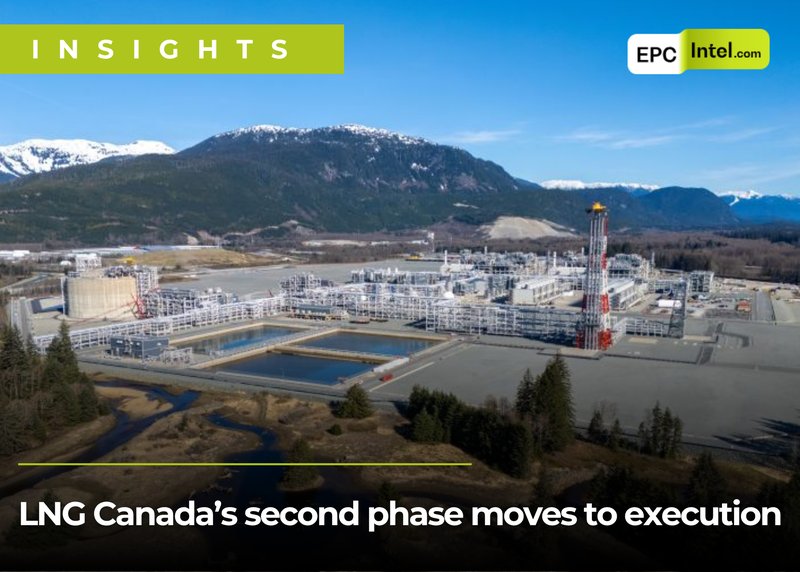
Fluor and JGC are back in familiar territory at Kitimat, and LNG Canada Phase 2 is starting to look less like a future option and more like the next major LNG contracting prize in North America.
The JGC Fluor BC LNG II joint venture, known as JFJV2, has received a limited notice to proceed for the proposed Phase 2 expansion of the LNG Canada export facility in Kitimat, British Columbia. For Fluor and JGC, this is not a cold start. The same partnership delivered Phase 1, including two liquefaction trains and supporting infrastructure, with the project reaching a major handover milestone in 2025.
That matters. LNG Canada is not just another greenfield LNG scheme trying to prove it can move from slide deck to steel. It already has operating infrastructure, an established construction model, existing owner alignment and a contractor team that knows the site. Phase 2 would double capacity from around 14 million tonnes per year to about 28 million tonnes per year, making it one of the most important LNG expansion opportunities in the global EPC market.
Why this matters
The LNTP does not mean full EPC has been released. It means LNG Canada is paying to keep the project moving toward a final investment decision.
That is still a meaningful signal. Limited notices to proceed are where contractors start turning the concept into an executable job. Early engineering, cost validation, procurement planning, construction sequencing, labor strategy, modularization reviews and interface management all begin to harden. In a market where LNG EPC capacity is tight and qualified execution teams are not sitting idle, this kind of early commitment gives the owner a better shot at preserving schedule and cost control.
The bigger story is that LNG Canada Phase 2 sits in a stronger position than many competing LNG projects. It benefits from an existing site, west coast access to Asian markets, an ice-free harbor and a feedgas position linked to Canada’s low-cost natural gas base. It also has a heavyweight sponsor group: Shell, PETRONAS, PetroChina, Mitsubishi and KOGAS.
That is about as bankable as LNG ownership gets.
The EPC opportunity
For JFJV2, the immediate LNTP scope is likely a modest but strategic package compared with the full buildout. EPCIntel estimates the early works and pre-FID services value at USD 150 million to USD 300 million, depending on the depth of engineering, procurement readiness, site planning and long-lead preparation included.
The real prize is the full Phase 2 EPC scope.
A two-train LNG expansion of this size could create an EPC opportunity in the USD 8 billion to USD 12 billion range. That estimate reflects a brownfield expansion with major liquefaction train additions, utilities, storage and export infrastructure interfaces, site works, construction labor, bulk materials, modules, electrical systems, controls and commissioning support.
A typical EPC capital spend split for a project of this type could look roughly like this:
Liquefaction trains and process systems: USD 3.5 billion to USD 5.0 billion
Modules, fabrication and structural steel: USD 1.5 billion to USD 2.2 billion
Utilities, offsites and balance of plant: USD 1.0 billion to USD 1.6 billion
Electrical, instrumentation and control systems: USD 700 million to USD 1.1 billion
Civil, site works and construction infrastructure: USD 600 million to USD 1.0 billion
Storage, marine and export interface works: USD 700 million to USD 1.1 billion
Commissioning, completions and project management: USD 400 million to USD 800 million
That is the kind of package that does not just feed one EPC joint venture. It creates years of opportunities for module yards, rotating equipment suppliers, cryogenic equipment vendors, electrical contractors, automation providers, tank specialists, construction camps, logistics providers and marine contractors.
Who stands to benefit
Fluor and JGC are the obvious front-runners because they have already delivered Phase 1. In LNG, continuity matters. Owners do not casually swap out an execution team after a successful first phase unless there is a compelling reason.
For major subcontractors and suppliers, the most attractive opportunities will likely sit in four areas.
First, modular fabrication. LNG Canada has already relied heavily on modular execution, and Phase 2 will almost certainly require large-scale module fabrication capacity again.
Second, LNG process and cryogenic systems. Main cryogenic heat exchangers, refrigerant compression, air coolers, valves, pumps and specialized piping will form a major procurement pool.
Third, electrical and controls. Expansion work at a live or near-live LNG site increases the importance of power distribution, instrumentation, control systems, safety systems and integration planning.
Fourth, construction logistics. Kitimat is a remote, high-specification execution environment. Labor, accommodation, heavy transport, marine logistics and site productivity will be just as important as engineering.
What comes next
The key milestone is still FID. Until LNG Canada’s owners formally sanction Phase 2, JFJV2 is working under a limited authorization rather than a full EPC award.
But this is exactly how serious LNG expansions usually begin. The owners reduce execution risk before making the larger capital commitment. The contractor locks in planning momentum. Suppliers begin positioning for long-lead packages. Everyone quietly gets ready for the bigger decision.
LNG Canada Phase 2 is not guaranteed yet, but the project has moved into a more serious lane. For the EPC market, that is enough to pay attention.