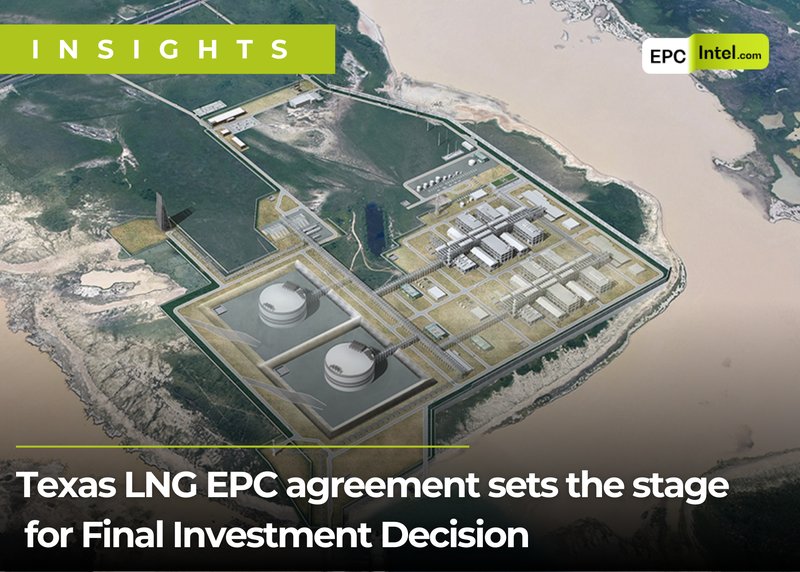
Texas LNG is moving closer to a long anticipated final investment decision after signing a full engineering, procurement and construction agreement with Kiewit. The project, planned at the Port of Brownsville in South Texas, is one of the smaller scale U.S. LNG export concepts but could still unlock several billion dollars of EPC and equipment supply opportunities if it proceeds to construction.
Developer Glenfarne has spent the past year working closely with Kiewit to complete pre FID engineering, effectively embedding the contractor within the project team to de risk execution before committing to construction. The resulting agreement is structured as a lump sum turnkey EPC contract, placing Kiewit in charge of delivering the entire facility from detailed engineering through commissioning.
This structure is increasingly common for LNG export projects seeking financial closure, as lenders and equity partners typically require strong EPC certainty before approving final investment decisions.
Project overview
Texas LNG is designed as a modular liquefaction export facility located in the Port of Brownsville, on the U.S. Gulf Coast near the Mexican border. The terminal has been under development for several years and has already secured key federal approvals, including authorization from the Federal Energy Regulatory Commission and the U.S. Department of Energy.
The project concept targets a liquefaction capacity of around 4 million tonnes per year, positioning it well below the scale of mega projects such as Golden Pass or Plaquemines LNG but still large enough to support global LNG supply growth.
Smaller LNG export terminals have become increasingly attractive in the current market environment. They typically require lower capital investment, offer faster construction timelines and can be developed with modular construction strategies that reduce on site complexity.
For Glenfarne, the project represents a strategic entry into LNG infrastructure development in the United States, complementing its broader portfolio of energy infrastructure investments.
EPC scope and contractor positioning
Under the newly signed EPC agreement, Kiewit Energy Group will perform full engineering, procurement, module fabrication, construction and commissioning of the entire liquefaction facility.
The contractor has built a strong reputation across North America for executing large scale energy infrastructure projects, particularly in the LNG, petrochemical and power sectors. Its experience in Gulf Coast construction logistics and modularization is a key advantage for projects located in Texas and Louisiana.
For EPC contractors active in the LNG supply chain, Texas LNG represents a typical mid scale project that can generate significant subcontracting opportunities even though the headline EPC contractor is already in place.
Estimated EPC capital distribution
Based on EPCIntel.com database benchmarks for LNG export terminals in the 3 to 5 MTPA range, the total capital expenditure for Texas LNG is likely to fall between 2.5 billion and 3.5 billion dollars depending on final configuration and contractor pricing.
Within that envelope, the EPC contract typically distributes spending across several major equipment and construction packages.
Liquefaction process systems and cryogenic equipment normally account for around 30 to 35 percent of total project costs. This includes compressors, refrigerant systems, cold boxes and major rotating equipment.
Tank construction and LNG storage infrastructure generally represents around 10 to 15 percent of project capex. A single full containment LNG tank can easily exceed 200 million dollars depending on size and specification.
Marine facilities and export loading systems typically account for another 10 percent of project value, covering the jetty, loading arms, berth infrastructure and dredging work required to handle LNG carriers.
Utilities and balance of plant systems normally absorb around 20 percent of total capital spending. This includes power generation, flare systems, water treatment and plant utilities.
The remaining 20 to 25 percent typically falls under civil construction, modular fabrication, structural steel, electrical and instrumentation packages.
For subcontractors and suppliers, these categories represent the main entry points into the supply chain once detailed engineering begins.
Supply chain opportunities
Although Kiewit holds the overall EPC responsibility, LNG projects of this size still rely heavily on specialized suppliers and fabrication yards.
Major opportunities will likely emerge across cryogenic equipment manufacturing, modular steel fabrication, compressor supply, LNG storage tank construction and marine loading infrastructure.
Fabrication yards along the U.S. Gulf Coast and in Mexico could also benefit if the project adopts a modular construction strategy, which is common for LNG plants targeting accelerated schedules.
If Texas LNG proceeds to FID in the coming months, procurement activity would likely begin shortly thereafter, creating a wave of equipment and subcontracting awards across the LNG supply chain.
For the EPC market, the project highlights how mid scale LNG developments are increasingly filling the gap between mega LNG export terminals and small scale modular plants, offering contractors a steady pipeline of engineering and construction work across North America.