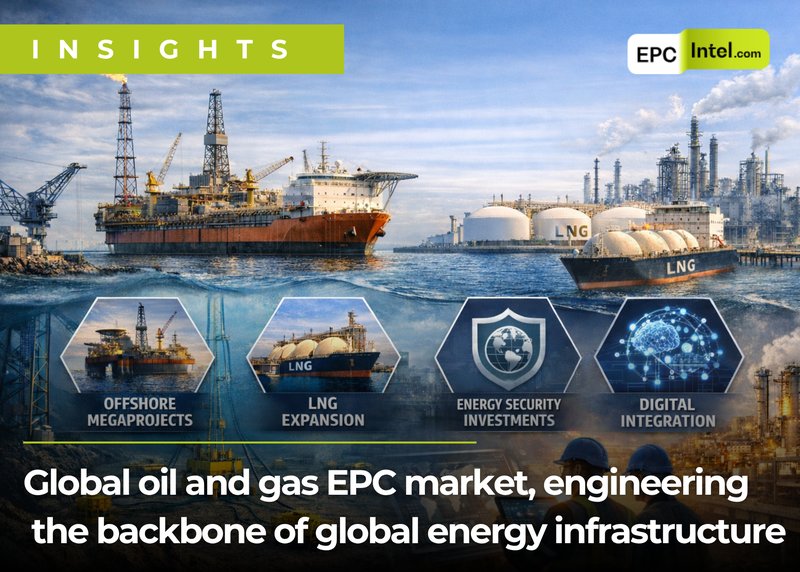
The global oil and gas EPC market is growing, but not in a way that rewards everyone equally. Moving from $50.75 billion in 2025 to $70.82 billion by 2031 at a 5.71 percent CAGR sounds steady on paper. In reality, this is a selective growth cycle where only contractors with strong execution capability, supply chain control, and balance sheet discipline will capture the upside.
The key shift is not demand, it is project complexity. The market today is defined by deeper water, larger LNG trains, more integrated petrochemical hubs, and increasingly hybrid energy systems. EPC contractors are no longer just builders, they are risk managers, financiers, and digital integrators.
Offshore dominance is driving high value EPC packages
Offshore continues to dominate for a simple reason, that is where the remaining scale sits. Deepwater Brazil, Guyana, and West Africa, along with selective Middle East offshore gas developments, are driving the next wave of EPC awards.
Typical capital allocation for a deepwater FPSO-based development illustrates where value sits:
Subsea umbilicals, risers, and flowlines: 20 to 30 percent
FPSO hull and topsides: 35 to 45 percent
Drilling and wells: 20 to 25 percent
Installation and logistics: 10 to 15 percent
For EPC contractors, the highest margin opportunities remain in subsea integration and topsides processing modules. However, these are also the most execution-sensitive packages, where delays or cost overruns can erase margins quickly.
The next five years will see a surge in SURF and floating production awards, particularly tied to multi-phase developments rather than standalone projects.
LNG and downstream integration reshaping the pipeline
LNG and petrochemicals are the second major growth engine, and arguably the more stable one. Unlike upstream cycles, LNG projects are driven by long-term offtake agreements and energy security strategies.
A typical greenfield LNG project allocates capital roughly as follows:
Liquefaction trains and process units: 40 to 50 percent
Storage tanks and marine facilities: 15 to 20 percent
Utilities and power generation: 10 to 15 percent
Pipeline and feed gas infrastructure: 10 to 15 percent
Balance of plant and site works: 10 percent
The scale here is where EPC contractors thrive. A single LNG train can support multi-billion-dollar EPC packages, often split across consortia. The real opportunity is not just in building trains, but in integrating upstream gas supply, power, and downstream export infrastructure into a single delivery model.
This is where contractors like Technip, Bechtel, and Saipem are positioning aggressively.
Asia pacific is not just growth, it is volume
Asia Pacific is often labeled the fastest growing region, but the more important point is volume concentration. China, India, and Southeast Asia are driving simultaneous investments across refining, petrochemicals, LNG import terminals, and gas infrastructure.
These are not frontier projects, they are repeatable, scalable developments. That favors contractors with strong local partnerships and modular execution strategies.
Modularization is becoming critical here. Fabrication yards in China, Indonesia, and the Middle East are increasingly supplying preassembled units, reducing site risk and compressing schedules. For EPC players, this shifts value toward procurement and supply chain orchestration rather than pure construction.
Digitalization is finally impacting margins
Digital transformation has been discussed for years, but it is now starting to impact actual project economics.
Digital twins, AI-driven scheduling, and IoT-based monitoring are reducing rework and improving commissioning timelines. On large EPC projects, even a 2 to 3 percent efficiency gain can translate into tens of millions in margin protection.
The contractors that are embedding digital into execution, not just design, are gaining a measurable advantage. This is particularly relevant in offshore and LNG projects where complexity multiplies risk.
Energy security is driving parallel investments
Geopolitical uncertainty is accelerating parallel infrastructure builds. Countries are no longer optimizing for lowest cost, they are optimizing for redundancy and control.
This means:
More LNG import terminals in Europe and Asia
Expanded storage and regasification capacity
New pipeline corridors and interconnections
Increased domestic refining and petrochemical capacity
For EPC contractors, this creates a broader pipeline of mid-sized projects rather than just mega projects. While individually smaller, these projects often carry faster timelines and lower execution risk.
The quiet shift toward low carbon EPC
EPC firms are also expanding into low carbon segments, but this is still an extension rather than a replacement of oil and gas.
Carbon capture, hydrogen, and electrification projects are entering the EPC pipeline, often as add-ons to existing assets. For example, integrating carbon capture into LNG or refining facilities.
Typical capital splits for these projects are still evolving, but early trends show:
Process technology and capture systems: 30 to 40 percent
Compression and transport: 20 to 30 percent
Storage infrastructure: 20 to 30 percent
Integration and utilities: 10 to 20 percent
The opportunity here is real, but margins are still uncertain due to technology risk and policy dependence.
Competitive landscape is tightening
The list of major EPC players has not changed dramatically, Bechtel, TechnipFMC, McDermott, Saipem, Fluor, Petrofac, Larsen and Toubro, and Halliburton. What has changed is how they compete.
Balance sheet strength, consortium strategy, and supply chain access are now as important as engineering capability. Contractors are increasingly selective, focusing on projects where risk allocation is manageable.
Outlook: steady growth, selective winners
The headline growth numbers suggest stability, but the underlying market is becoming more competitive and execution-driven.
The next cycle will reward:
Contractors with offshore and LNG specialization
Players with strong procurement and fabrication networks
Firms that can integrate digital into execution
Companies willing to take disciplined risk, not just chase volume
The EPC market is not just growing, it is maturing. And in a maturing market, execution is everything.