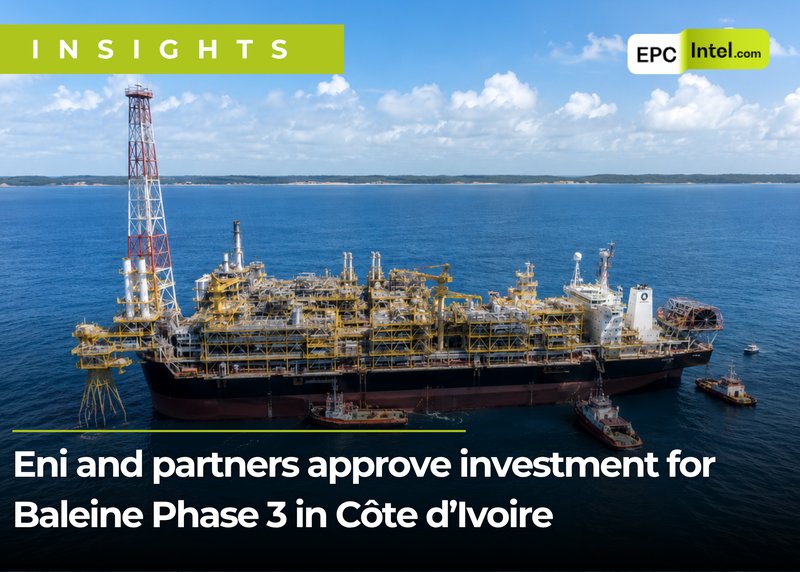
Eni, Petroci and Vitol have moved Baleine Phase 3 from ambition to execution with approval of the final investment decision in Abidjan. For Côte d’Ivoire, this is not just another offshore sanction. It is the full-field development step for the country’s largest hydrocarbon discovery, and it moves Baleine into a production class that starts to look regional rather than merely domestic.
Phase 3 is designed to lift Baleine oil output from 60,000 barrels per day to 150,000 barrels per day, while gas production will rise from 80 million cubic feet per day to 200 million cubic feet per day. Eni says all produced gas will be directed into Côte d’Ivoire’s domestic market, supporting power generation and industrial growth.
Opportunity
The big contracting signal is the new floating production, storage and offloading unit. Eni has not yet disclosed the FPSO contractor, contract value, schedule or yard execution model, but the project scope points to a large offshore package environment: FPSO conversion or newbuild, subsea production systems, risers, umbilicals, flowlines, offshore installation, controls, marine systems, gas handling and tie-back integration.
Baleine has already been developed through a fast-track phased model, with Phase 1 production starting in 2023 and Phase 2 starting in late 2024. That matters because Phase 3 will likely lean on existing field knowledge, operating data and infrastructure interfaces, but it will still require a major step-up in processing capacity.
Package split
Based on EPCIntel.com’s database of offshore oil and gas projects with FPSO-led developments, a Baleine Phase 3 execution package could reasonably sit in the $2.5 billion to $4.0 billion capital expenditure range, depending on whether the FPSO is a conversion or newbuild, the scale of subsea expansion, local content requirements and installation complexity.
A typical capital split would look like this:
Package Estimated share Indicative value
FPSO hull, topsides, integration and marine systems 45 percent $1.1B to $1.8B
Subsea production systems and controls 15 percent $375M to $600M
SURF, flowlines, risers and umbilicals 18 percent $450M to $720M
Offshore installation and heavy lift 10 percent $250M to $400M
Drilling, completions and well tie-ins 8 percent $200M to $320M
Project management, commissioning and contingencies 4 percent $100M to $160M
The FPSO package is the one to watch. At 150,000 barrels per day and 200 MMcfd of gas, this is no small floater. The gas handling requirement also makes the topsides story more interesting than a simple oil export vessel. Compression, dehydration, power generation, utilities and emissions management will all be part of the procurement chain.
Contractors
The project should attract the usual FPSO heavyweights, including SBM Offshore, MODEC, BW Offshore, Yinson Production and Saipem, depending on commercial model, vessel availability and Eni’s preferred contracting route. Subsea and SURF opportunities would naturally interest TechnipFMC, OneSubsea, Baker Hughes, Aker Solutions, Subsea7, Saipem and McDermott.
For Côte d’Ivoire, the local content angle should not be underestimated. Petroci’s role and the government’s domestic gas priority mean the project is not only about barrels. It is also about building a service base around Abidjan, logistics, fabrication support, training, operations and maintenance.
Market read
Baleine Phase 3 comes at a good time for the offshore supply chain. FPSO capacity remains tight, subsea order books are healthy, and West Africa is back in the frame after years of stop-start investment. The project also fits Eni’s preferred playbook: discover, fast-track, produce early, then scale with partners.
Vitol’s presence adds another commercial layer. Reuters reported in 2025 that the Baleine project ownership stood at Eni 47.25 percent, Vitol 30 percent and Petroci 22.75 percent after Vitol acquired a 30 percent stake. That structure gives the project a mix of operator discipline, state alignment and commodity trading firepower.
Outlook
Baleine Phase 3 is now the next major offshore contracting event to watch in Côte d’Ivoire. The FID confirms the development case, but the real market signal will come when Eni starts naming the FPSO, subsea and installation contractors.
For EPC and major suppliers, this is the moment to track procurement closely. A new FPSO-led phase, rising production targets, domestic gas commitments and a fast-growing Ivorian offshore basin make Baleine one of West Africa’s most attractive near-term offshore project opportunities.