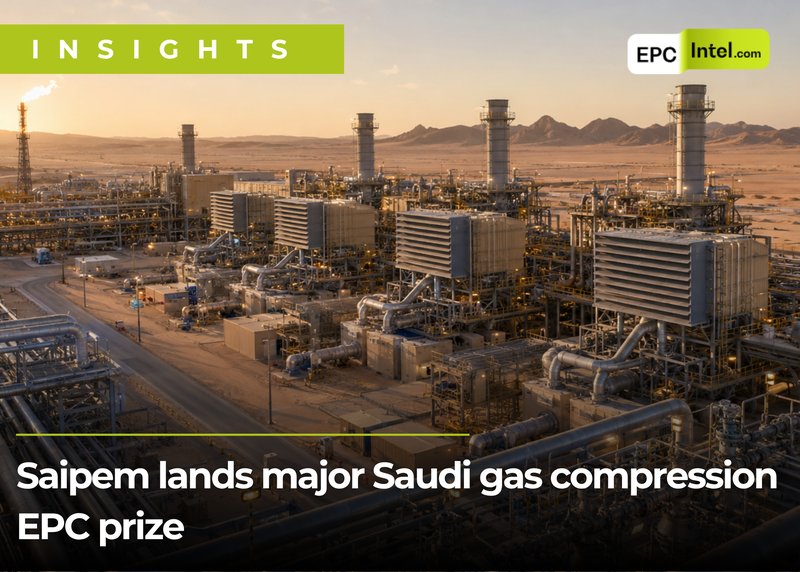
Saipem has added another heavyweight Saudi gas job to its backlog, and this one comes with more than just a large contract value.
The Italian contractor, through Saipem Nasser Saeed Al-Hajri Contracting Company, has secured the EPC contract for the Uthmaniyah Gas Compression Plant project in Saudi Arabia. Saipem’s share of the contract is worth approximately €900 million, equal to around US$970 million, with a duration of about 42 months.
The project covers engineering, procurement and construction of a new gas compression plant serving the non-associated gas field of Uthmaniyah. The new facility is intended to extend the production life of the field and support Saudi Arabia’s rising domestic energy demand.
But the more interesting part is the execution structure. This is the first EPC project awarded under Saudi Arabia’s National EPC Champion Program, a framework designed to build in-country EPC capability while maximizing local resources and expertise.
Why this matters
Uthmaniyah is not just another gas compression award. It is a signal of how Saudi Aramco-linked infrastructure spending is being reshaped.
Rather than relying only on international EPC giants, Saudi Arabia is pushing a hybrid model. International engineering, project management and technology expertise is being paired with strong local construction capability.
That is exactly what Saipem and Nasser Saeed Al-Hajri are doing through SNSH. Saipem brings process, engineering, procurement and project controls strength. NSH brings Saudi construction capacity, local labor access and execution knowledge.
For Saudi Arabia, this model keeps more value inside the Kingdom. For Saipem, it strengthens access to one of the world’s most important energy EPC markets.
Scope breakdown
The Uthmaniyah Gas Compression Plant will likely involve a broad onshore gas infrastructure scope, including compression systems, process units, utilities, electrical systems, control systems, buildings, civil works and site integration.
Based on EPCIntel.com’s database of comparable onshore gas compression and processing EPC contracts, a typical package split for a project of this size would likely look like this:
| Package | Estimated share | Estimated value |
|---|---|---|
| Compression equipment and mechanical systems | 25% to 30% | US$240m to US$290m |
| Civil works and site development | 12% to 16% | US$115m to US$155m |
| Piping, valves and bulk materials | 12% to 15% | US$115m to US$145m |
| Electrical and power systems | 8% to 12% | US$75m to US$115m |
| Instrumentation, control and automation | 6% to 9% | US$60m to US$90m |
| Utilities and offsites | 8% to 12% | US$75m to US$115m |
| Engineering, project management and commissioning | 10% to 14% | US$95m to US$135m |
| Logistics, temporary facilities and indirects | 5% to 8% | US$50m to US$80m |
The biggest opportunity will likely sit around rotating equipment, especially gas compressors, drivers, auxiliaries and associated mechanical systems. These packages often define the schedule and technical performance of gas compression projects.
Major supplier opportunities may also emerge in high-pressure piping, valves, E&I systems, DCS and safety systems, transformers, switchgear, analyzers, metering, cooling systems and construction services.
Local content angle
The Saudi localization element is central to this award.
The National EPC Champion Program is designed to create domestic EPC strength across the full range of onshore project delivery. That means more local subcontracting, more local fabrication, more Saudi-based construction management and more in-country engineering capability over time.
For suppliers, this matters because the procurement strategy may favor those with local presence, approved vendor status, Saudi manufacturing capability or partnerships with local service providers.
This is particularly relevant for electrical equipment, construction materials, structural steel, fabrication, field services and bulk procurement. International vendors may still win key packages, but local execution capability will increasingly influence award decisions.
Market signal
Saudi Arabia continues to invest heavily in gas infrastructure as it looks to support industrial growth, power generation and domestic energy demand while freeing more liquids for export and higher-value uses.
Gas compression is a critical part of that strategy. Compression plants help maintain production from mature or long-life fields, improve gas deliverability and extend field economics.
For Saipem, the Uthmaniyah award reinforces a strong Saudi position at a time when the company is targeting major energy infrastructure work across the Middle East. For NSH, the project provides a platform to move further up the EPC value chain through a large, technically demanding project with an international partner.
Epcintel.com view
The Uthmaniyah Gas Compression Plant award is a strong example of where Saudi EPC strategy is heading.
The contract is large, technically important and commercially attractive, but its strategic value sits in the execution model. Saudi Arabia wants major energy infrastructure delivered with more local capability, and this award gives that policy a flagship onshore EPC project.
For contractors and suppliers, the message is clear. The Saudi gas market remains one of the strongest EPC opportunity pools globally, but access will increasingly depend on local partnerships, Saudi execution capacity and alignment with national industrial development goals.
Saipem has secured the headline award. The next layer of opportunity will now move into compressors, mechanical packages, E&I systems, piping, valves, civil works, automation and construction subcontracting.