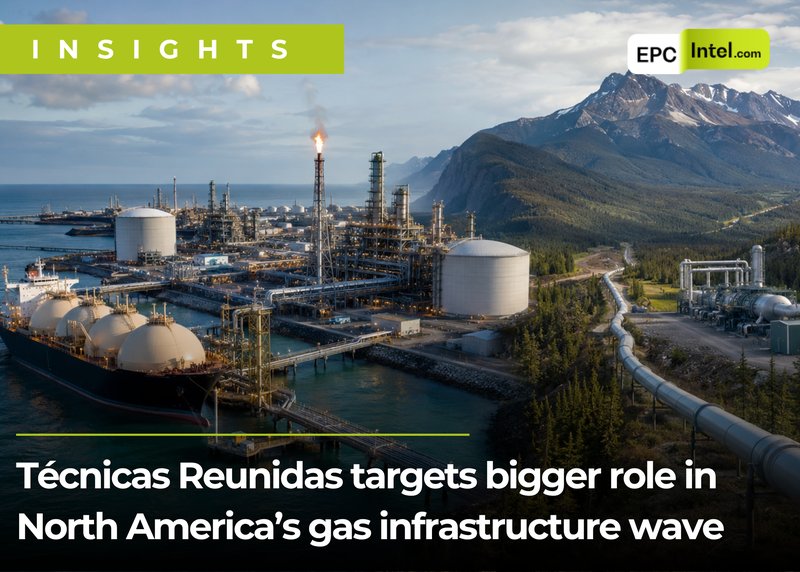
Técnicas Reunidas is not trying to enter North America through the side door. It is walking straight into the two areas where EPC spending is still capable of producing very large contracts: LNG export capacity and gas transportation infrastructure.
The Spanish contractor has now secured two meaningful FEED positions in 2026. The first is Coastal Bend LNG in Texas, where KBR and Técnicas Reunidas were selected for FEED work and potential EPC execution on a proposed LNG export facility. KBR said it will lead the FEED, including the full inside battery limits scope covering liquefaction, nitrogen rejection, gas treatment and heavy hydrocarbon removal, while also supporting Coastal Bend LNG with FERC filings and permitting.
The second is Coastal GasLink Phase 2 in British Columbia, where LNG Canada selected Técnicas Reunidas Canada E&C for FEED services linked to a possible pipeline expansion. The concept would lift capacity from 2.1 Bcf/d to 5.0 Bcf/d and add five compressor stations with 30 MW compression turbines, plus modifications to existing and planned facilities along the route.
Why this matters
FEED awards are not EPC awards, but in LNG and midstream they are often where the future EPC field starts to narrow.
Coastal Bend LNG is particularly interesting because it gives Técnicas Reunidas exposure to the US Gulf Coast LNG market, where execution capacity, modularization strategy, permitting support and supply chain control are becoming almost as important as technology selection. The project is expected to use ConocoPhillips’ Optimized Cascade Process, with multiple large-scale trains under development. Trade reports have referenced the proposed capacity at up to 22.5 mtpa, which would place it firmly in the mega-project class if fully sanctioned.
For KBR, this is familiar territory. For Técnicas Reunidas, it is strategic territory.
The company has long been associated with refining, petrochemicals, gas processing and industrial energy infrastructure. What North America offers is a different type of prize: LNG megaprojects, pipeline compression expansions, power demand driven by data centers, and decarbonization-adjacent gas infrastructure. Spanish media has reported that Técnicas Reunidas sees around €28 billion of potential opportunities in the region, much of it linked to LNG, natural gas and power demand growth.
Package breakdown
For EPCIntel.com, the real story is the likely future package flow.
On Coastal Bend LNG, assuming a full-scale liquefaction development, total EPC opportunity could easily move into the multi-billion-dollar range. Based on EPCIntel’s LNG project benchmarks, a large Gulf Coast liquefaction development typically breaks down across several major capital packages:
Liquefaction trains and process units could account for 35% to 45% of EPC value, covering cryogenic heat exchangers, refrigerant systems, gas treatment, nitrogen rejection, heavy hydrocarbon removal, flare systems and process integration.
Rotating equipment may represent 15% to 25%, led by gas turbines or electric motor drives, refrigerant compressors, boil-off gas compressors, feed gas compressors, pumps and auxiliary machinery.
Storage and marine facilities could take 15% to 20%, including LNG tanks, loading arms, berth infrastructure, jetties, marine utilities and custody transfer systems.
Utilities, power and balance of plant may absorb another 15% to 20%, including substations, cooling, water treatment, instrument air, buildings, roads, pipe racks and control systems.
For Coastal GasLink Phase 2, the package profile is different but still attractive. Compressor station expansions are not small civil jobs. Five new compressor stations with 30 MW turbines point to material opportunities for gas turbine OEMs, compressor suppliers, electrical contractors, automation vendors, pipeline contractors, civil works providers and module fabricators.
A typical compressor station expansion of this scale can divide capital spend roughly as follows: 30% to 40% for compression equipment and turbine packages, 20% to 30% for mechanical and piping works, 15% to 20% for electrical, controls and substations, 10% to 15% for civil and structural works, and the balance for logistics, installation, commissioning and owner interfaces.
Contractors to watch
The obvious companies to watch are Técnicas Reunidas and KBR on Coastal Bend LNG. ConocoPhillips remains important through its liquefaction technology, while Honeywell UOP technologies are referenced in KBR’s scope for gas treatment and heavy hydrocarbon removal.
For Coastal GasLink Phase 2, LNG Canada is driving the expansion planning with Coastal GasLink under an integrated commercial model, while TC Energy and its partners remain central to the pipeline asset. The future EPC and construction landscape could involve Canadian pipeline contractors, compressor station specialists, turbine OEMs, electrical and instrumentation contractors, and Indigenous and local construction partners.
The EPCIntel view
This is not yet the contract award moment that moves billions into backlog.
But it is the moment that decides who gets close to those contracts.
Técnicas Reunidas has inserted itself into two large North American gas development tracks before FID. One is LNG export capacity on the Texas Gulf Coast. The other is Canadian gas transportation capacity feeding LNG export growth from British Columbia.
That combination matters.
LNG projects need feed gas. Pipeline projects need anchor demand. Contractors that can position across both sides of the chain, liquefaction and gas delivery, will have more chances to convert early engineering into EPC, procurement support, site execution, and long-term brownfield work.
For Técnicas Reunidas, North America is no longer just a target market. It is becoming a live bidding arena.