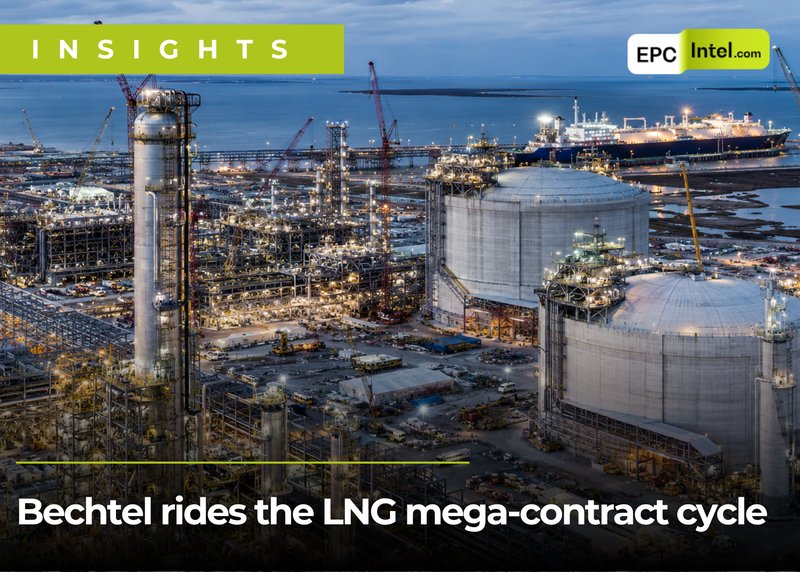
Bechtel’s latest LNG win at Sabine Pass is not just another construction award. It is a clear signal that the LNG EPC market has entered a new mega-contract cycle, and the contractors with proven execution records are taking the largest share of the work.
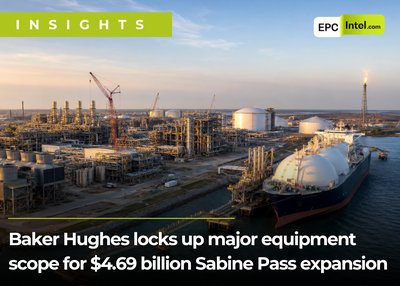
The company has secured a US$4.69 billion contract from Cheniere Energy for Train 7 at the Sabine Pass Liquefaction Expansion Project in Cameron Parish, Louisiana. The new train is expected to add around 5 million tonnes per annum of LNG production capacity, with work scheduled to begin in early 2027.
For Bechtel, this is familiar ground. The contractor built the original Sabine Pass terminal between 2005 and 2009, then delivered six liquefaction trains from 2016 to 2022, adding around 30 million tonnes per annum of export capacity. Train 7 extends one of the most important LNG EPC relationships in the United States.
Why this matters
The Sabine Pass award lands at a time when LNG infrastructure is again moving from boardroom ambition into real construction spending.
Energy security has become a board-level and government-level priority since the disruption of Russian pipeline gas supplies to Europe. At the same time, growing electricity demand from data centres, industrial electrification and broader power consumption is reinforcing the role of gas-fired generation in many markets.
That creates a simple equation for project developers. More gas demand means more LNG supply chains. More LNG supply chains mean more liquefaction trains, storage tanks, marine facilities, utilities, cryogenic systems and export infrastructure.
This is where the real EPC opportunity sits.
Bechtel’s LNG position
Bechtel is now one of the dominant contractors in the global LNG buildout.
The company has 17 liquefaction trains under construction across five sites in two countries and has already handed over five midscale trains. Once complete, these projects are expected to represent around 90 million tonnes per annum of LNG production capacity.
The scale of its current LNG order book is striking. At Rio Grande LNG in Brownsville, Texas, Bechtel has finalised contracts worth around US$9 billion across Trains 4 and 5 for NextDecade. At Woodside Louisiana LNG in Sulphur, Louisiana, the total contract value is around US$27 billion. Sabine Pass Train 7 now adds another US$4.69 billion to the contractor’s US LNG backlog.
This is no longer a run of isolated awards. It is a sustained LNG construction cycle.
Contracting opportunities
For EPCIntel.com, the key point is not only the Bechtel award itself, but the subcontracting and supplier pull-through that follows.
A US$4.69 billion LNG train typically creates major package opportunities across:
Civil works and site preparation, around 10% to 15% of project spend, equal to approximately US$470 million to US$700 million.
Structural steel, buildings and modular fabrication, around 8% to 12%, equal to approximately US$375 million to US$560 million.
Mechanical equipment, including compressors, pumps, heat exchangers and cryogenic systems, around 25% to 35%, equal to approximately US$1.2 billion to US$1.6 billion.
Electrical, instrumentation and control systems, around 10% to 15%, equal to approximately US$470 million to US$700 million.
Piping, valves and process modules, around 15% to 20%, equal to approximately US$700 million to US$940 million.
Marine, storage, utilities and balance of plant works, around 10% to 15%, equal to approximately US$470 million to US$700 million.
Construction labour, commissioning and indirects will absorb a significant share of the remaining spend.
For suppliers, this is where the LNG supercycle becomes tangible. The big EPC name wins the headline contract, but the real market spreads across turbomachinery, cryogenic valves, control systems, pipe, steel, tanks, electrical systems, instrumentation, insulation, coatings, logistics and specialist commissioning services.
The bigger picture
The reason Bechtel keeps winning is not complicated. LNG owners want certainty, and certainty in LNG usually means previous delivery experience.
Liquefaction projects are expensive, technically demanding and politically important. Delays can affect long-term offtake commitments, national energy strategies and billions of dollars in financing. For clients such as Cheniere, NextDecade and Woodside, contractor selection is not only about price. It is about execution credibility.
That limits the field. Only a small group of EPC contractors can credibly deliver multi-billion dollar LNG trains at this scale. Bechtel is one of them, and its recent awards show how much value clients place on repeatability.
Sabine Pass Train 7 therefore fits into a wider pattern. US LNG is expanding again, global buyers are locking in long-term supply, and project developers are converting that demand into construction contracts.
For the EPC supply chain, this is not a short-term spike. LNG infrastructure built today is likely to operate for 30 to 40 years. Construction relationships formed now can lead to future expansion, maintenance, turnaround, brownfield upgrade and debottlenecking work.
Bechtel’s US$4.69 billion Sabine Pass award is another reminder that the LNG boom is not theoretical. It is already being converted into some of the largest EPC contracts in the global energy market.