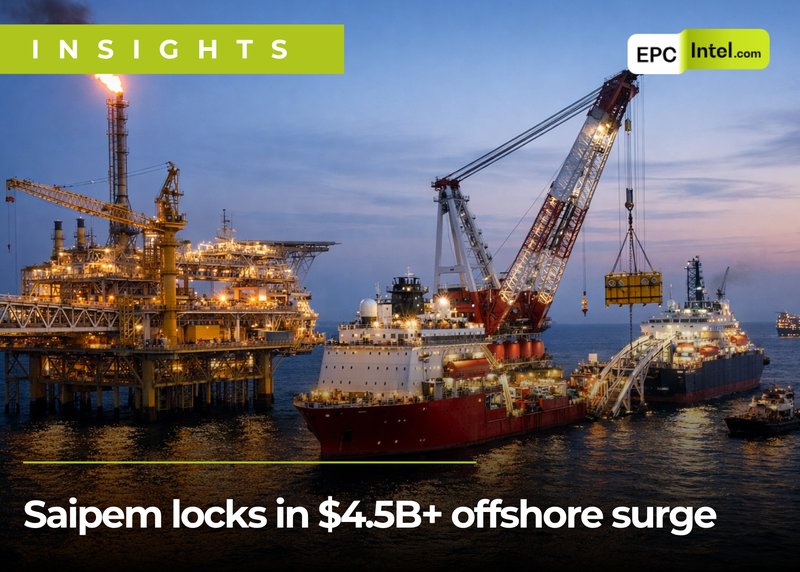
Saipem is not just back in the game, it is actively reshaping its offshore order book with a string of high-value awards that point to a sustained upcycle rather than a short-term spike. The contractor’s 2026 momentum, anchored in the Middle East and supported by selective international wins, is building a level of backlog visibility not seen since the last major offshore investment cycle.
The centerpiece is Qatar’s North Field expansion. Saipem’s roughly $3.1 billion share of the COMP5 offshore compression package is not just a headline number, it is a complex, multi-platform EPCI scope that will stretch engineering, fabrication, and offshore installation capacity well into 2029–2030. These are the kinds of contracts that define fleet utilization for years, particularly for heavy lift vessels and offshore installation assets.
Saudi Arabia is reinforcing that trajectory. A steady flow of Saudi Aramco awards, including a $500 million trunkline project followed by approximately $400 million in additional offshore CRPOs, highlights a consistent pipeline rather than one-off wins. Safaniya, already one of the world’s largest offshore oil fields, continues to generate repeat work across subsea infrastructure, pipelines, and platform installations. For contractors like Saipem, this type of repeatable scope is often more valuable than a single mega project, as it builds execution continuity and local presence.
Türkiye adds a third leg to the strategy. The $425 million Sakarya Phase 3 pipeline package is smaller in absolute terms but strategically aligned with Europe’s push to diversify gas supply. It also demonstrates Saipem’s ability to stay competitive in technically demanding offshore gas developments outside its Middle East core.
Where the real value sits
From an EPC perspective, these awards follow a familiar offshore value distribution, but the scale is what stands out.
- Offshore platforms and topsides fabrication, typically 30 to 40 percent of total contract value, driven by steel-intensive compression facilities and living quarters
- Subsea pipelines, risers, and umbilicals, around 25 to 35 percent, particularly relevant in Saudi and Türkiye scopes
- Offshore installation and marine operations, 15 to 25 percent, where vessel availability becomes a key constraint
- Engineering, project management, and commissioning, 10 to 15 percent, often underestimated but critical for schedule delivery
In Qatar’s case, the compression platforms alone represent a massive fabrication and integration effort, likely absorbing the largest share of contract value. Meanwhile, Saudi awards are more balanced between pipelines, subsea tie-ins, and platform works, creating multiple entry points for subcontractors and suppliers.
Supply chain implications
This wave of awards is not just positive for tier-one EPC players. It unlocks significant downstream opportunities across fabrication yards, subsea equipment suppliers, and installation specialists.
Middle East fabrication capacity, particularly in Saudi Arabia and the UAE, is set to remain tight as national oil companies push localization strategies. Subsea equipment, including valves, umbilicals, and control systems, will see sustained demand as offshore developments become more complex and tie-back distances increase. Marine contractors, especially those with heavy lift and pipelay vessels, are also positioned to benefit from extended offshore campaigns stretching toward the end of the decade.
For suppliers, the key takeaway is timing. These projects are not immediate revenue events. They move through engineering, procurement, and fabrication phases over several years, meaning procurement packages will continue to be released in waves through 2026–2028.
The bigger picture
What makes Saipem’s recent run particularly notable is where it is happening. Qatar and Saudi Arabia are not cyclical frontier markets, they are core, low-cost producers with long-term production strategies. That translates into more resilient capital spending, even in volatile price environments.
At the same time, geopolitical shifts are quietly reinforcing offshore investment. Energy security concerns, rerouting of gas supply chains, and the need for stable baseload production are all pushing operators back toward large-scale offshore developments. Contractors with proven offshore execution capabilities are naturally first in line.
Saipem is positioning itself squarely in that category again. After a period of restructuring and portfolio realignment, the company is now locking in long-duration offshore work that extends revenue visibility into the next decade. The mix of mega projects in Qatar and repeatable work in Saudi Arabia provides both scale and stability.
This is not just a comeback story. It is a strategic re-entry into the core of global offshore EPC, where contract values are measured in billions and execution timelines span years. If current award momentum holds, Saipem is set to remain one of the defining contractors of the offshore cycle through 2030.