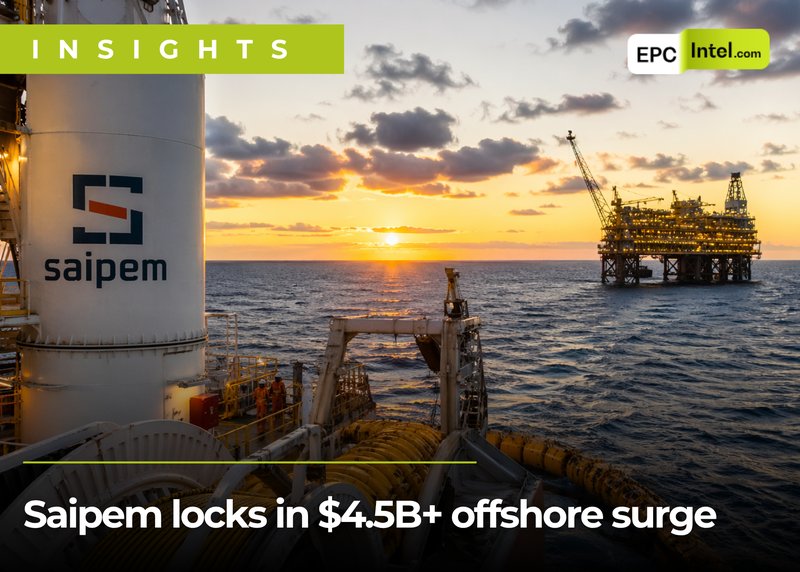
Saipem is once again positioning itself at the center of ExxonMobil’s Guyana growth story, this time through a Limited Notice to Proceed for the Longtail subsea system. While the initial award sits at a modest $150 million, the real signal here is the potential conversion into a $750 million to $1.5 billion full EPCI contract once FID is secured. This is classic pre-FID positioning, and Saipem is playing it well.
Early works signal strong contractor alignment
The LNTP covers preliminary detailed engineering and procurement for the SURF package, effectively locking Saipem into the project before the final investment decision. This approach is increasingly common in deepwater developments, where operators want to compress timelines and secure critical supply chain capacity early.
For ExxonMobil Guyana Limited, the strategy is clear. By advancing early engineering, the Longtail project can move quickly into execution once approvals are in place. For Saipem, it strengthens incumbency advantage in one of the most active offshore basins globally.
Longtail is located in the prolific Stabroek Block, at around 1,750 metres water depth. This places it firmly in the ultra deepwater category, where subsea complexity drives significant EPC value, particularly for SURF systems.
EPC value breakdown highlights subsea intensity
Assuming a midpoint contract value of around $1.1 billion, typical SURF EPCI cost allocation from EPCIntel.com data would break down as follows:
- Engineering and project management, 8 to 10 percent, approximately $90 million to $110 million
- Procurement of subsea hardware, 35 to 40 percent, approximately $385 million to $440 million
- Fabrication of flowlines, risers, and umbilicals, 25 to 30 percent, approximately $275 million to $330 million
-Offshore installation and vessels, 20 to 25 percent, approximately $220 million to $275 million - Contingency and commissioning, 5 to 10 percent, approximately $55 million to $110 million
This structure underlines where subcontracting opportunities will concentrate. Subsea equipment suppliers, umbilical manufacturers, and fabrication yards will capture a large portion of the value chain, while installation contractors and vessel owners remain critical for execution.
Supply chain opportunities emerging early
Even at LNTP stage, the procurement window is already opening. Key packages likely to be tendered or negotiated include subsea trees and manifolds interfaces, umbilical systems, flexible and rigid risers, and installation support services.
Given Saipem’s integrated model, some fabrication and installation scopes will be retained in house, particularly leveraging its offshore fleet. However, the scale of the development means significant subcontracting will still flow to specialist suppliers.
For companies in the subsea ecosystem, early engagement will be critical. LNTP phases often determine vendor lists and lock in long lead items well before FID.
Guyana remains one of the hottest offshore markets
This award reinforces the Stabroek Block as one of the most competitive EPC battlegrounds globally. ExxonMobil and its partners continue to push an aggressive multi project development strategy, with each phase building on existing infrastructure and contractor relationships.
Saipem’s track record in the block is a decisive factor. The company has already delivered on Liza Phase 1, Liza Phase 2, Payara, and Yellowtail, creating a strong execution narrative that operators are reluctant to disrupt.
From an EPC perspective, this continuity reduces interface risk and accelerates project timelines. It also raises barriers to entry for new contractors trying to break into the basin.
Strategic implications for saipem
This LNTP is less about the immediate $150 million and more about securing a pathway to a billion dollar contract. It signals that Saipem remains a preferred subsea contractor for ExxonMobil in Guyana, despite increasing competition from other global players.
If the Longtail project reaches FID, which appears highly likely given the basin’s economics, Saipem could further expand its backlog with a high margin, technically complex deepwater project.
More broadly, the award highlights a continuing trend. Major operators are moving faster, locking in contractors earlier, and prioritizing execution certainty over aggressive cost competition.
For EPC players, that means relationships, track record, and delivery capability are becoming just as important as price.
And in Guyana, few contractors currently tick all those boxes as convincingly as Saipem.