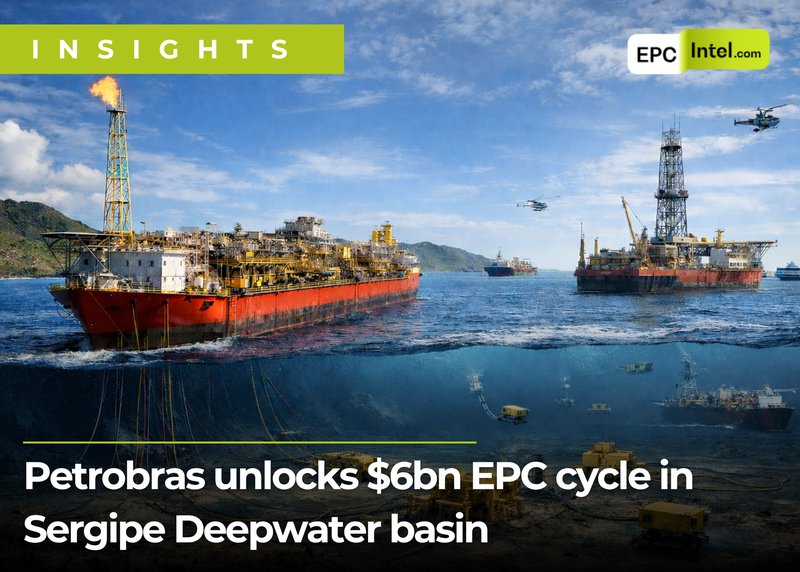
Petrobras is doubling down on Brazil’s next offshore frontier, with final investment decision now secured for Sergipe Deepwater Project Module 1, better known as SEAP I. Coming on the heels of SEAP II, the move signals something more deliberate than incremental growth. This is Petrobras building a new basin from the ground up.
The Sergipe-Alagoas Basin has long sat in the shadow of Brazil’s pre-salt giants. That is changing fast. By pushing forward multiple modules in parallel, Petrobras is not just developing fields, it is establishing a long-life deepwater production hub with integrated oil and gas output.
SEAP I targets light oil accumulations across BM-SEAL-10 and BM-SEAL-11, with Petrobras carrying full operatorship and the bulk of financial exposure. The strategy is clear. Control the assets, control the timeline, and most importantly, control the floating production infrastructure that underpins everything.
FPSOs drive the contracting wave
The real story for the EPC market is not the FID itself, but what comes next. Petrobras is preparing to sign six FPSO construction contracts across 2026 and 2027, with SEAP I requiring one dedicated unit.
Each FPSO in Brazil’s deepwater environment typically commands a capital cost in the range of $2.5 billion to $3.5 billion depending on capacity and complexity. That places SEAP I’s floating unit firmly in the multi-billion-dollar bracket, with a total project value likely in the $4 billion to $6 billion range once subsea and installation scopes are included.
Typical capital split for a project like SEAP I breaks down as follows:
- FPSO EPC and topsides, 45 to 55 percent
- Subsea SURF systems, 20 to 25 percent
- Drilling and completions, 15 to 20 percent
- Installation and marine operations, 5 to 10 percent
- Engineering, project management, and contingencies, balance
This creates a wide contractor ecosystem. While SBM Offshore is positioned as the frontrunner for the FPSO, the subsea packages will likely attract players such as Subsea7, TechnipFMC, and McDermott. Drilling campaigns will remain dominated by established offshore rig contractors, while Brazilian yards and module fabricators will compete for local content scopes.
Timeline hinges on one key deal
Despite the scale of ambition, the near-term execution path is surprisingly narrow. Everything hinges on finalizing the FPSO contract.
Petrobras is targeting conclusion of negotiations with SBM Offshore in the first half of 2026. This is the gating item. Without it, there is no fabrication start, no module integration, and no path to first oil.
Assuming contract award proceeds on schedule, first production from SEAP I is expected around 2028. That places it slightly ahead of SEAP II, which is targeting 2030 startup.
The timeline highlights a structural reality in offshore development. Even after FID, there is a two to three year gap before tangible production impact. For Brazil’s domestic gas balance, that means SEAP I is strategic, but not a near-term solution.
Building a new production basin
SEAP I is not a standalone project. It is part of a coordinated basin-wide development strategy.
Fields including Agulhinha, Agulhinha Oeste, Cavala, and Palombeta form the resource base. While individual reserve figures remain undisclosed, Petrobras has indicated combined gas potential from SEAP I and II of up to 18 million cubic meters per day.
The real value lies in aggregation. By developing multiple modules, Petrobras can justify shared infrastructure, optimize logistics, and create economies of scale across subsea systems and export routes.
This is the same playbook that transformed the Santos Basin. The difference is that Sergipe is earlier in the lifecycle, meaning higher risk, but also higher upside for contractors entering at this stage.
Capital intensity meets market constraints
Petrobras is effectively funding this expansion alone. It holds 100 percent of BM-SEAL-10 and 60 percent of BM-SEAL-11, placing the majority of capital burden on its balance sheet.
At the same time, the company is launching one of the largest FPSO procurement cycles globally. Six units in two years is not just aggressive, it is market-moving.
The implications are clear. Shipyard capacity will tighten. Engineering resources will be stretched. Module fabrication slots will become scarce. Pricing pressure is inevitable.
For EPC contractors and suppliers, this is a rare window. The scale of Petrobras’ demand will ripple across global supply chains, from Korean and Chinese yards to Brazilian fabrication hubs and European subsea specialists.
Risks sit in execution, not geology
From a resource perspective, SEAP I is relatively low risk. The challenge is execution.
Ultra-deepwater conditions, with depths approaching 3,000 meters, introduce technical complexity across drilling, installation, and subsea integration. Any delays in FPSO delivery or subsea readiness could push back first oil and erode project economics.
Cost escalation is the other major watchpoint. With multiple FPSOs competing for the same supply chain, inflationary pressure could quickly build across steel, fabrication, and engineering services.
Finally, capital discipline will be critical. Petrobras is balancing this expansion against other deepwater commitments and its broader portfolio. SEAP I must compete internally for funding as much as it competes externally for resources.
EPC opportunity opens in phases
For the EPC market, SEAP I represents a multi-year opportunity pipeline rather than a single contract event.
Near-term focus sits on the FPSO award and early engineering. This will be followed by subsea contract awards, drilling campaigns, and installation scopes through the late 2020s.
Contractors that position early, particularly in subsea and fabrication, will benefit most from repeat work as additional modules in the basin move toward FID.
Sergipe is no longer a frontier in waiting. With SEAP I approved and contracting imminent, it is becoming one of the most important deepwater growth stories globally.