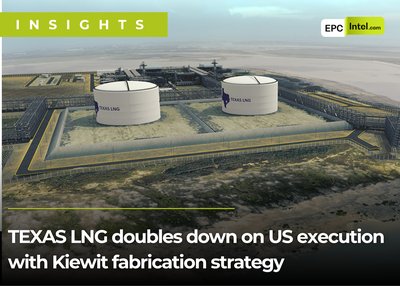
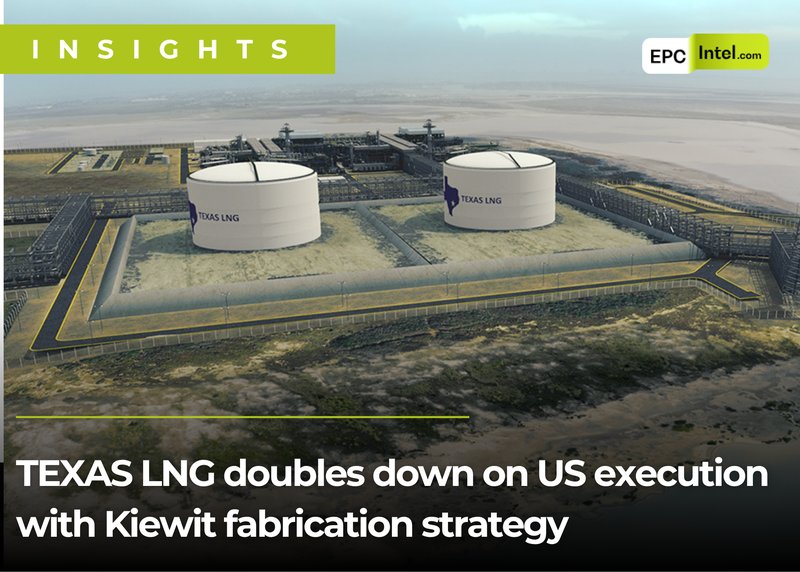
Glenfarne is quietly shaping one of the most interesting execution models in the US LNG wave. The Texas LNG project in Brownsville is not just another Gulf Coast export terminal, it is becoming a case study in how developers are rethinking risk, supply chains and EPC structuring.
The latest move, assigning module fabrication to Kiewit Offshore Services in Texas, builds directly on the recently signed full EPC contract with Kiewit Energy Group. Together, these awards effectively lock in a vertically integrated execution strategy where engineering, construction and fabrication are tightly aligned under one contractor ecosystem.
This is a deliberate shift away from the traditional globally distributed LNG supply chain.
A two layer EPC strategy taking shape
The EPC contract between Glenfarne and Kiewit Energy Group, signed earlier this month, is understood to cover the full scope of the Texas LNG facility. Based on comparable US Gulf Coast projects, the total EPC value is estimated at around $5.5 billion to $6.0 billion.
Within this structure, the module fabrication award to Kiewit Offshore Services represents a critical sub package. The scope includes liquefaction modules, pretreatment systems and pipe rack modules, all to be fabricated at the Ingleside yard in Texas.
From an EPCIntel.com benchmark perspective, modular fabrication packages of this scale typically account for 12% to 16% of total EPC value. This places the KOS fabrication scope in the range of $700 million to $900 million.
More importantly, the decision to localize fabrication in Texas is not just about cost, it is about schedule certainty and risk reduction. Avoiding offshore module yards removes exposure to shipping bottlenecks, Panama Canal constraints and geopolitical disruptions, all of which have impacted recent LNG builds.
Baker Hughes secures critical technology position
Alongside the civil and modular scope, Glenfarne has also moved early on core process technology. Baker Hughes has been selected as the supplier of liquefaction technology and key rotating equipment.
In LNG projects, this package is one of the most critical and value dense scopes. It typically includes gas turbines, compressors and the liquefaction process design itself.
For a project of this size, the Baker Hughes package is likely in the range of $1.0 billion to $1.3 billion, representing roughly 18% to 22% of total EPC spend. This positions Baker Hughes not just as a vendor, but as a central technical anchor for the project.
Early alignment between the technology provider and the EPC contractor is a key enabler for modular execution, particularly when fabrication is localized.
Technip Energies and Samsung E&A bring global LNG DNA
Before the Kiewit EPC award, Glenfarne had already engaged a joint venture between Technip Energies and Samsung E&A for earlier phase engineering work.
This FEED level involvement is significant. Both companies bring deep LNG experience from projects in Qatar, the US and Asia, and their early design input likely shaped the modularization strategy now being executed by Kiewit.
Typical FEED and pre EPC engineering packages for LNG projects of this scale range between $50 million and $100 million, but their real value lies in defining execution philosophy, layout and modular breakdown.
In this case, the transition from a global FEED consortium to a domestic EPC contractor highlights a hybrid model, combining international LNG expertise with US based execution.
Breaking down the EPC spend
Looking at the broader capital allocation for Texas LNG, a typical breakdown based on EPCIntel data would be:
- Liquefaction technology and rotating equipment: $1.0 billion to $1.3 billion
- Module fabrication (Kiewit Offshore Services): $0.7 billion to $0.9 billion
- Civil works, tanks and site infrastructure: $1.2 billion to $1.5 billion
- Piping, electrical and instrumentation: $0.8 billion to $1.0 billion
- Utilities, balance of plant and integration: $1.0 billion to $1.2 billion
This structure reinforces how critical the fabrication and technology packages are, together representing nearly half of total EPC value.
A different kind of LNG execution model
What makes Texas LNG stand out is not just the contractor lineup, but how the pieces fit together.
Glenfarne is effectively combining:
- Global LNG design expertise from Technip Energies and Samsung E&A
- Tier one technology from Baker Hughes
- Fully localized EPC and fabrication through Kiewit
This creates a tightly controlled execution chain within the US, a model that directly addresses the cost overruns and delays seen in earlier LNG megaprojects.
With FID targeted for Q2 2026, much of the project risk has already been engineered out before the final investment decision. That alone signals a more disciplined, developer led approach to LNG project delivery.
For EPC contractors and suppliers, Texas LNG is a clear signal. The next wave of US LNG may not be about chasing the lowest cost globally, but about delivering certainty, speed and control closer to home.