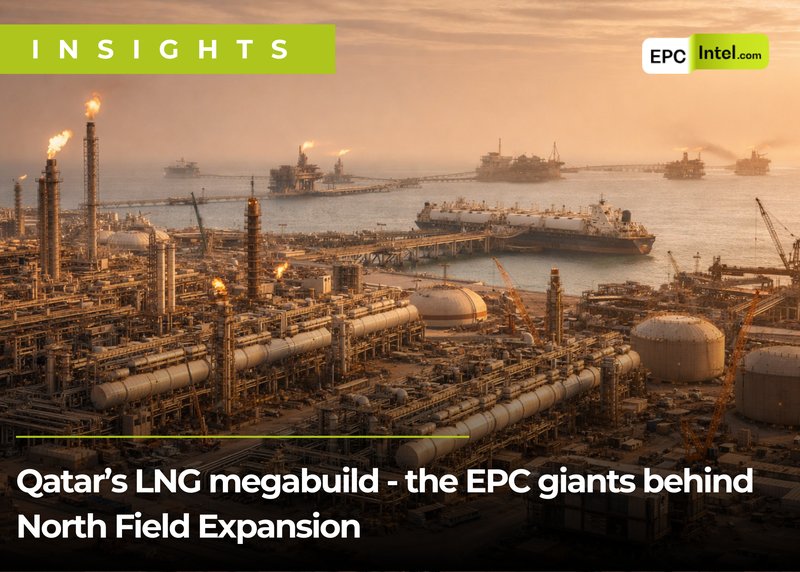
QatarEnergy LNG’s North Field expansion is not just the world’s largest LNG buildout, it is a masterclass in how to structure multi-billion EPC execution across parallel mega-trains, with a contractor lineup that reads like a who’s who of global LNG delivery.
The scale is rewriting LNG project playbooks
At Ras Laffan, the North Field East, South, and West developments are not standalone projects. They are effectively a synchronized industrial expansion program pushing Qatar’s liquefaction capacity from 77 MTPA to around 142 MTPA by 2030.
What makes this particularly interesting is not just the scale, but how QatarEnergy LNG has deliberately diversified execution risk across multiple Tier 1 EPC contractors.
Chiyoda Corporation and Technip Energies anchor North Field East, bringing decades of LNG train delivery experience. On North Field South, McDermott, Tecnicas Reunidas, and CNCEC16 introduce a mix of Western and Chinese execution capacity. North Field West then doubles down on repeat players, with Technip Energies, McDermott, and Saipem taking key roles.
This is not redundancy. It is strategic parallelization.
A deliberate contractor stacking strategy
QatarEnergy LNG is effectively running multiple LNG megaprojects at once, but with overlapping contractor ecosystems. That creates several advantages.
First, knowledge transfer between phases becomes almost immediate. Contractors already mobilized on NFE can replicate engineering standards, procurement strategies, and modularization approaches on NFS and NFW.
Second, supply chain leverage increases dramatically. Long-lead equipment such as liquefaction compressors, cryogenic heat exchangers, and turbines can be bulk ordered across phases, locking in pricing and delivery slots.
Third, it reduces execution bottlenecks. Instead of a single EPC consortium becoming a critical path risk, workload is distributed across multiple global players.
For EPCIntel.com tracking, this is where the real opportunity sits, not in the headline contracts, but in the cascading subcontract awards beneath them.
Where the money is actually going
While headline EPC contract values are rarely disclosed in full, EPCIntel database benchmarks suggest each LNG mega-train package sits in the range of $10 billion to $15 billion.
Across the full North Field program, this translates into well over $70 billion in EPC spend when including upstream, offshore, and infrastructure scope.
A typical breakdown per LNG train cluster looks like this:
-
Liquefaction process units and main cryogenic equipment, 30 to 35 percent
-
Utilities and offsites, including power generation and water systems, 20 to 25 percent
-
Tanks and storage, 10 to 15 percent
-
Marine facilities and loading berths, 10 to 15 percent
-
Piping, structural steel, and modularization, 15 to 20 percent
What stands out is how much value is pushed down into fabrication yards and module assembly. Contractors like McDermott and Saipem are heavily exposed here, particularly through offshore and heavy module integration scopes.
Offshore and infrastructure, the silent giant
Beyond the liquefaction trains, the offshore and infrastructure packages are equally critical and often underappreciated.
Saipem has been particularly active in offshore pipeline and subsea infrastructure, supporting the feed gas supply from the North Field reservoirs. These packages typically run into the multi-billion dollar range on their own, covering pipelines, platforms, and compression systems.
Onshore infrastructure at Ras Laffan, including utilities, port expansions, and accommodation facilities, adds another layer of EPC opportunity. These are often split into smaller packages, creating entry points for regional contractors and specialist suppliers.
The subcontracting wave is still building
For the supply chain, the story is far from over.
Each major EPC contractor is still actively awarding subcontracts across:
-
Modular fabrication yards in Asia and the Middle East
-
Electrical and instrumentation packages
-
Rotating equipment supply, including compressors and turbines
-
Tank construction and cryogenic storage systems
-
Digital and control systems integration
This is where smaller EPC players and suppliers can plug into the world’s largest LNG expansion without being prime contractors.
And importantly, North Field West is still in earlier execution phases compared to NFE, meaning a significant portion of procurement and subcontract awards is still ahead.
Who will dominate the next phase
If there is a pattern emerging, it is the increasing dominance of repeat contractors.
Technip Energies and McDermott, both heavily involved across multiple phases, are positioning themselves as long-term partners rather than one-off contractors. Saipem’s offshore strength also keeps it central to future upstream expansions.
But the real wildcard is the growing role of Chinese contractors like CNCEC16. Their cost competitiveness and scaling capability could shift how future LNG expansions are awarded, particularly if QatarEnergy continues to balance cost, schedule, and geopolitical diversification.
The bigger picture
Qatar is not just expanding LNG capacity. It is industrializing LNG delivery at scale.
By running multiple EPC tracks in parallel, leveraging a global contractor pool, and continuously feeding the subcontracting ecosystem, the North Field expansion is setting a new benchmark for how mega energy projects are executed.
For EPC players, the message is clear. The biggest opportunities are no longer just in winning the top-tier EPC contracts, but in positioning within the layers beneath them, where billions in value are still being unlocked.