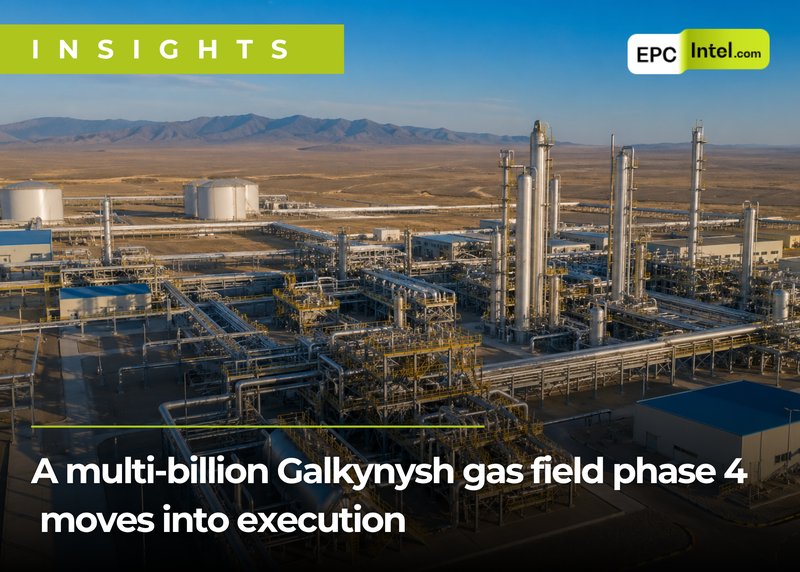
China and Turkmenistan have just put serious money behind the next expansion of Galkynysh, one of the world’s largest gas fields.
CPECC has secured a multi billion turnkey contract for Phase 4 surface facilities, covering detailed design, procurement, construction and commissioning. The wider phase is valued at around $5.1 billion and will add 10 bcm per year of processing capacity in eastern Turkmenistan.
Why it matters
This is not just another gas plant. Galkynysh is the backbone of Turkmenistan’s export strategy to China, and Phase 4 strengthens the Central Asia to China gas corridor at a time when Beijing continues to lock in long-term pipeline gas supply.
The EPC scope is substantial. Based on typical gas processing project spend, the contract could break down roughly as:
- Process gas plant: $1.6 billion to $2.0 billion
- Pipelines and gathering systems: $700 million to $900 million
- Utilities, power and water systems: $500 million to $700 million
- Civil works, camps, roads and rail links: $400 million to $600 million
- Engineering, commissioning and project management: $300 million to $500 million
- Equipment, valves, compressors and bulk materials: $800 million to $1.1 billion
The opportunity
CPECC gets the headline EPC role, but the supply chain opportunity underneath is the real story. A 10 bcm per year gas processing expansion creates demand for compressors, pressure vessels, separators, dehydration units, sulfur handling systems, process modules, pipe, valves, electrical systems, automation, camps and logistics.
For Chinese suppliers, this is a strategic win. For international vendors, it may still create selective openings where specialist equipment, controls, rotating machinery or high-spec materials are required.
Strategic read
Turkmenistan is using Galkynysh to deepen its China export route, while China is using EPC execution, financing relationships and pipeline offtake to secure another layer of long-term gas supply.
Phase 4 is therefore more than a gas processing plant. It is a $5.1 billion signal that Central Asian gas remains firmly inside China’s energy security map.