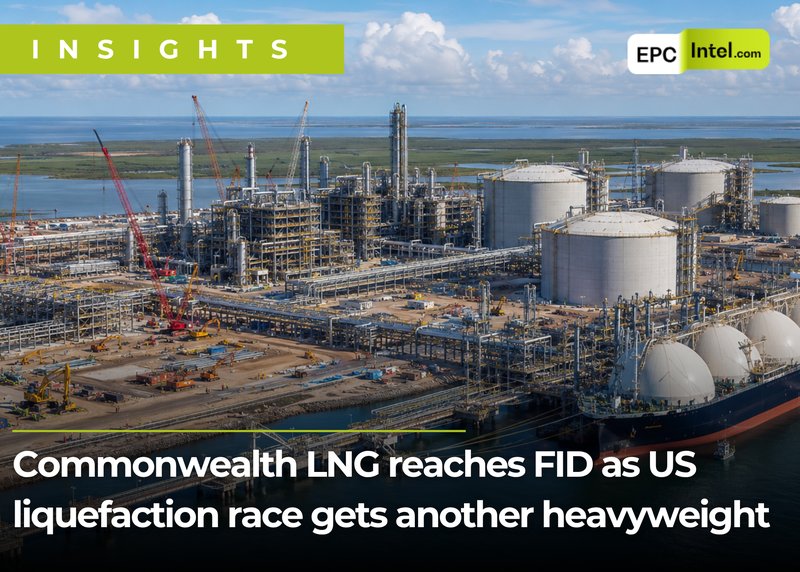
Commonwealth LNG has finally moved from development story to execution story, and that matters for the EPC market.
Caturus, the Kimmeridge-backed integrated gas platform behind Commonwealth LNG, has taken a positive Final Investment Decision on the 9.5 mtpa LNG export project in Cameron Parish, Louisiana. The project has also closed $9.75 billion in project financing, formally clearing the way for full construction. Total commitments reached $21.25 billion, showing that investors still have plenty of appetite for US LNG when the project is structured properly.
For EPCIntel, the headline is not just another LNG FID. It is that Commonwealth is now one of the next major US LNG schemes entering the heavy construction cycle, with Technip Energies already positioned as EPC partner and key long-lead equipment already moving through the procurement chain.
Why this project matters
Commonwealth LNG is designed as a 9.5 mtpa export facility, with first operations expected in 2030. The project sits in Cameron Parish, Louisiana, one of the most active LNG corridors in the world and a location where Gulf Coast construction capability, marine access, pipeline connectivity, and modular execution all come together.
The project is also part of a wider “wellhead-to-water” strategy. Caturus is not just building liquefaction capacity, it is tying LNG exports to an expanding upstream gas platform. In the weeks before FID, Caturus expanded its upstream position through the Galvan Ranch natural gas asset acquisition from SM Energy, lifting production above 1 bcfe/d on a net basis. That upstream growth gives the project a different profile from pure liquefaction developers, because feedgas control is becoming one of the defining risks in US LNG execution.
Long-term offtake has already been secured with counterparties including EQT, Glencore, Mercuria, PETRONAS, and Aramco Trading. Phase 1 is expected to generate more than $3 billion in annual export revenue once operations begin.
The EPC picture
Technip Energies is the name to watch. The company had already been authorized to order major long-lead equipment before FID, which suggests Commonwealth LNG wanted to compress the execution schedule and avoid procurement bottlenecks after sanction.
The facility will use a modular approach, with major equipment packages including six Baker Hughes mixed-refrigerant compressors powered by LM9000 gas turbines, six Honeywell main cryogenic heat exchangers, and four Titan 350 gas turbine-generators from Solar Turbines. The terminal will also be capable of loading LNG carriers up to 216,000 cubic meters.
This is where the opportunity starts spreading beyond the headline EPC contractor. A project of this size will pull in major subcontracting and supplier demand across site preparation, piling, civil works, steel, modular fabrication, tanks, cryogenic systems, rotating equipment, electrical systems, controls, marine works, utilities, logistics, and commissioning support.
Capital spend breakdown
Based on EPCIntel’s LNG project benchmarks, a 9.5 mtpa Gulf Coast LNG export facility with $9.75 billion in project financing could translate into the following indicative package values:
Package estimated value:
- LNG process trains and liquefaction modules $3.2 billion to $3.8 billion
- Major rotating equipment and drivers $900 million to $1.2 billion
- Cryogenic heat exchangers and cold box systems $450 million to $700 million
- Power generation and electrical systems $650 million to $900 million
- LNG storage, loading, and marine facilities $1.1 billion to $1.5 billion
- Civil works, foundations, buildings, and site infrastructure $900 million to $1.2 billion
- Utilities, flare, water, air, nitrogen, and balance of plant $700 million to $1 billion
- Instrumentation, automation, telecoms, and safety systems $350 million to $550 million
- Construction management, logistics, commissioning, and contingency $1 billion to $1.4 billion
The most competitive packages will likely be liquefaction modules, mechanical installation, cryogenic systems, power island integration, and marine terminal works. LNG projects are procurement-heavy by nature, but the real pressure usually lands in interface management: module delivery, site sequencing, heavy lifts, commissioning readiness, and workforce availability.
Who is backing it
Mubadala Energy already holds a 24.1% stake in the Caturus platform, which includes Commonwealth LNG and upstream operations, and is also participating in the project financing. CPP Investments will contribute $1.2 billion, increasing its total stake in Caturus to 31%. Other major financial participants include EOC Partners, BlackRock-managed funds and accounts, and an Ares Infrastructure Opportunities fund.
That is a deep investor bench, and it matters. LNG megaprojects do not fail because the drawings look bad. They fail when financing, feedgas, offtake, permitting, procurement, and construction timing do not line up. Commonwealth now appears to have lined up enough of those pieces to enter execution with real momentum.
What comes next
For contractors and suppliers, Commonwealth LNG now moves into the phase where procurement visibility should improve quickly. Long-lead equipment is already identified, but the broader downstream opportunity is still substantial. Expect attention to shift toward module fabrication, site works, tankage, power systems, electrical and instrumentation packages, marine works, commissioning services, and local construction labor.
The timing is also important. With global LNG demand continuing to rise and buyers looking for flexible US supply, Commonwealth LNG adds another major project to the Gulf Coast queue. But it also lands in a market where contractor capacity is not unlimited, equipment slots are precious, and cost discipline will decide who actually delivers.
Commonwealth LNG is now sanctioned. For Technip Energies and the wider LNG supply chain, the real race starts here.