
Turning EPC and FEED Contract Intelligence into Commercial Performance
For many companies in the energy project value chain, the challenge is not a lack of ambition. It is a lack of timely, structured market visibility.
Commercial teams know there are projects moving somewhere. They know EPC contractors, FEED contractors, operators, developers and major project owners are making decisions. They know procurement activity will eventually flow down to suppliers, fabricators, OEMs, engineering firms, subcontractors, consultants and specialist service companies.
The problem is timing.
By the time an opportunity becomes obvious, it may already be late. Preferred vendors may already be known. Budget conversations may already have happened. Technical influence may already be limited. The companies that win work consistently are often the ones that identify project activity earlier, understand who is involved, and start positioning before the formal enquiry lands.
That is where better energy project data makes a real commercial difference.
EPCIntel.com was built around a simple idea: fragmented EPC and FEED contract information can be turned into practical commercial intelligence. Not just news. Not just project headlines. But structured contract award data that helps commercial and business development teams decide where to focus their time, which accounts to prioritise, and where future demand may emerge.
The problem with fragmented project information
Energy project information is everywhere, but rarely in one clean place.
A contract award may be announced by an operator. Another detail may appear in a contractor press release. A project update may surface on LinkedIn. Scope may be described in one source, value in another, and timing in another. Sometimes the contractor is named clearly. Sometimes the consortium structure is hard to follow. Sometimes the project is referred to by several different names.
For suppliers and service companies, this creates a familiar problem. The market is active, but the useful signal is buried inside noise.
A business development manager might spend hours checking company websites, industry news, tender portals, LinkedIn posts, investor updates and conference announcements. Some of that effort produces useful intelligence. Much of it does not. Even when relevant information is found, it often needs to be copied, cleaned, interpreted and tracked manually.
That is expensive in time, attention and opportunity cost.
Commercial teams should be selling, qualifying, building relationships and shaping opportunities. They should not spend most of their week trying to piece together basic project intelligence from scattered sources.
Why EPC and FEED contract awards matter
EPC and FEED contract awards are important because they are often the point where a project becomes commercially actionable for the wider supply chain.
A FEED award can show that a project is moving into a more defined engineering phase. It can indicate which engineering contractor is influencing technical decisions, specifications, procurement strategy and future execution planning.
An EPC award can be even more significant. It often identifies the contractor or consortium that will manage engineering, procurement, construction, fabrication, installation or commissioning activity. For companies downstream from the headline award, this can point toward future packages, subcontracting opportunities, equipment needs, manpower demand and specialist service requirements.
Not every EPC or FEED award becomes a direct lead for every supplier. Companies providing valves, coatings, inspection services, modular fabrication support, engineering manpower, or any of the many other products and services required across the project supply chain, may not be named in the headline contract. But the headline contract still matters because it tells them where future demand is likely to concentrate.
The value is not always “call this buyer today.” Often, the value is “this project is moving, this contractor is involved, this geography is active, this sector is worth tracking, and this account should be on our radar.”
That is commercially useful intelligence.
From information to action
Good data should help teams act, not just understand.
For EPCIntel.com users, the workflow is typically straightforward.
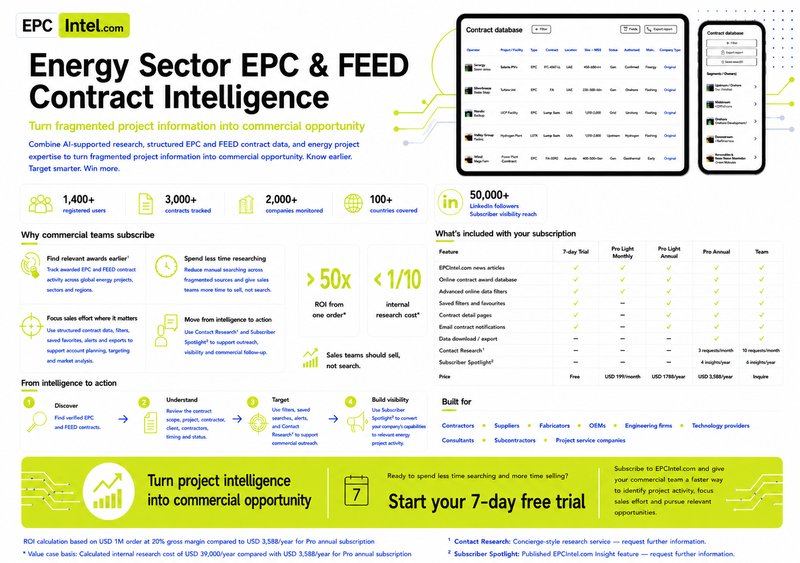
First, they discover verified EPC and FEED contract awards across sectors and regions. This helps them see where activity is happening.
Second, they understand the project context. That includes the operator or developer, project name, location, sector, contract type, contractor, estimated value, scope and status where available.
Third, they target more intelligently. Teams can filter by geography, sector, client, contractor, contract type and other useful criteria. That supports account planning, market mapping, regional strategy and competitor monitoring.
Fourth, they move from intelligence to commercial follow up. This may include internal planning, sales outreach, supplier positioning, market analysis, partner discussions or content marketing.
That last step is important. Data is only valuable when it changes behaviour. A database that is never used is just a library. A structured contract intelligence platform should help teams decide who to speak to, what to track and where to spend commercial effort.
Why different customer types need project data
The need for energy project data is not limited to large EPC contractors.
In fact, many of the companies that benefit most are further down the value chain.
Suppliers and OEMs need to understand where demand may emerge for equipment, components and systems. If a hydrogen project, LNG development, offshore wind project, refinery upgrade or carbon capture scheme moves forward, that can create opportunities long before formal procurement reaches the wider market.
Fabricators and construction companies need visibility of project awards that may lead to fabrication, module assembly, steelwork, pipework, installation support or construction packages.
Engineering firms and consultants need to track clients, sectors and regions where future studies, technical support, project management or specialist advisory work may be required.
Manpower and project service companies need to identify projects that may require large execution teams, specialist inspectors, commissioning personnel, planners, contract managers, HSE professionals and site support.
Subcontractors and specialist service companies need to know which EPC contractors are winning work, where packages may flow, and which accounts deserve early relationship building.
Commercial leaders and strategy teams need a broader picture. They want to know which sectors are active, which countries are attracting investment, which contractors are gaining share, and where their own business should focus.
For all of these users, project data supports better decisions. It helps teams move from general market awareness to targeted commercial action.
The cost of not knowing early enough
Missing an opportunity is rarely a dramatic event. More often, it is invisible.
A competitor hears about a project earlier. A supplier meets the EPC contractor before the procurement phase. A specialist service company maps the client and contractor structure before others notice the award. A regional sales team adds the right project to its pipeline while another team is still waiting for an enquiry.
Over time, those small timing advantages matter.
Being early does not guarantee success. But being late often reduces the chance of success. Early visibility allows a company to prepare, qualify, build relationships, position capability and understand whether the project fits its target market.
This is especially important in energy projects because procurement chains can be complex. A single EPC or FEED award may eventually create opportunities across engineering, equipment, fabrication, logistics, installation, inspection, commissioning, maintenance and specialist advisory services.
The earlier a company understands the project landscape, the better prepared it is to participate.
Better data supports better business performance
Energy project data can improve business performance in several practical ways.
It can improve sales focus. Instead of chasing every rumour or reacting to every late stage enquiry, teams can prioritise projects, clients and contractors that match their capability.
It can improve account planning. If a contractor is winning repeated work in a region or sector, that contractor may deserve more structured engagement.
It can support market entry decisions. A company considering a new geography or sector can use contract award activity to assess whether the market is active enough to justify investment.
It can improve internal alignment. Sales, leadership, operations and strategy teams can work from the same view of project activity, rather than relying on scattered updates and individual knowledge.
It can reduce wasted research time. Manual searching has a cost, even when no invoice is attached. Time spent gathering basic market intelligence is time not spent converting opportunities.
It can also improve confidence. Commercial decisions are rarely perfect, but better structured intelligence helps teams make decisions based on evidence rather than assumption.
According to EPCIntel.com data and market intelligence, the platform now tracks more than 3,000 contracts, more than 2,000 monitored companies and project activity across more than 100 countries. That scale gives users a structured way to monitor energy project activity without starting from scratch each week.
More than a contract database
A useful contract intelligence platform should not stop at listing awards.
The real value comes from helping users interpret and apply the information. That is why EPCIntel.com combines contract data, project context, filters, saved views, alerts and export capability depending on subscription level.
For users, this means they can build a more repeatable process around market intelligence. Instead of relying on ad hoc research, they can create structured searches around target sectors, geographies, contractors, clients and project types.
For example, a supplier focused on offshore wind can track relevant EPC, FEED, export cable, substation, foundation and installation related activity. A company targeting downstream oil and gas can monitor refinery upgrades, petrochemical developments, gas processing plants and terminal projects. A service company focused on hydrogen or carbon capture can watch early awards and contractor involvement as those markets mature.
The benefit is not just finding one opportunity. It is building a clearer view of the market.
Supporting commercial visibility
There is another side to project intelligence: visibility.
Companies do not only need to identify opportunities. They also need to be visible to the market.
That is why EPCIntel.com is developing additional ways to connect project intelligence with commercial action.
Subscriber Spotlight will give eligible annual subscribers the opportunity to feature their product, service or capability in a published EPCIntel.com Insight article, connected to relevant project or market activity.
This can help suppliers, contractors, consultants and specialist service companies turn market intelligence into content they can use in sales outreach, LinkedIn promotion, website updates and client discussions.
Contact Research is another support feature for eligible subscribers. The idea is simple: when a user identifies a relevant contract, they may want help understanding the public contact routes associated with the client, contractor or project organisation.
Further detail on both Subscriber Spotlight and Contact Research will follow in separate EPCIntel.com Insights.
For now, the point is that contract intelligence should lead somewhere. It should help users discover, understand, target and act.
Why this matters now
Energy markets are changing quickly.
Investment is flowing across traditional oil and gas, LNG, refining, petrochemicals, offshore wind, power, hydrogen, carbon capture, transmission, energy storage and industrial decarbonisation. Some projects move quickly. Others take years. Some are delayed, restructured or rescoped. Contractors change. Project names change. Priorities shift.
For suppliers and service companies, it is difficult to keep track.
At the same time, commercial teams are expected to do more with less. They need to cover more markets, find better leads, support strategy, monitor competitors and justify where they spend their time.
That makes structured project intelligence more valuable.
A well organised contract database helps teams see patterns that are easy to miss in daily news flow. Which contractors are active in a sector? Which countries are seeing new awards? Which operators are moving projects forward? Which project types are generating EPC and FEED activity? Which opportunities may justify early engagement?
Those questions matter because they shape business development priorities.
Turning project intelligence into commercial opportunity
The companies that benefit most from EPCIntel.com are usually those that treat market intelligence as part of their sales process, not as background reading.
They search regularly. They save filters. They track target accounts. They monitor sectors and regions. They use data in sales meetings, planning sessions, management reports and outreach campaigns.
They also understand that the value of early intelligence is cumulative. One contract award may be useful. Hundreds or thousands of structured awards create a much richer picture of market direction.
According to EPCIntel.com data and market intelligence, users are not only looking for headline awards. They are using contract intelligence to support market analysis, commercial planning, sales targeting, competitor monitoring and early stage opportunity identification across the energy project value chain.
That is the real purpose of the platform.
Not just to know what happened.
To know earlier, target smarter and win more.
Final thought
Energy project information will always be fragmented. Major projects involve too many companies, sources, locations and moving parts for the market to be simple.
But fragmented information does not have to stay fragmented.
With structured EPC and FEED contract intelligence, commercial teams can spend less time searching and more time selling. They can focus on the projects, clients, contractors and sectors that matter most to their business. They can use data to improve pipeline quality, sharpen account planning and support better strategic decisions.
For companies operating downstream from major energy project awards, that visibility can be the difference between reacting late and positioning early.
Check out EPCIntel.com to explore energy sector EPC and FEED contract intelligence, track relevant project activity, and turn fragmented market information into commercial opportunity.