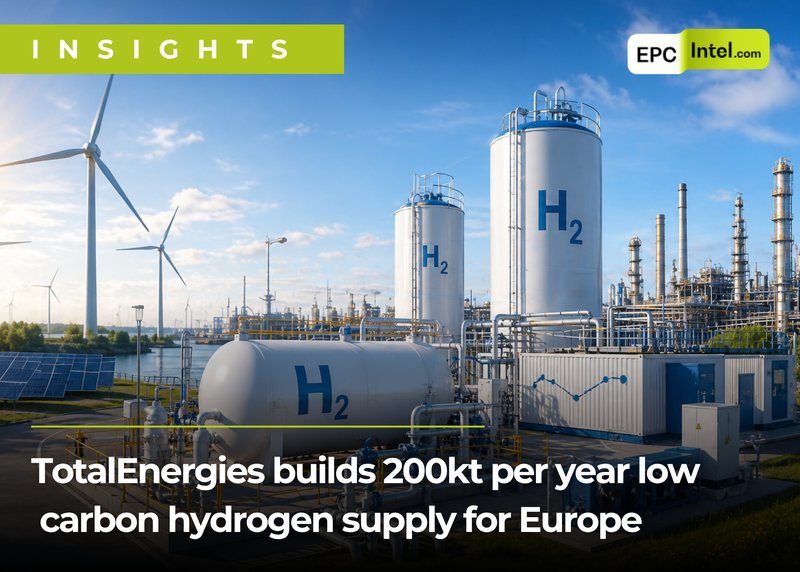
TotalEnergies is moving faster than most of its European peers to industrialize low carbon hydrogen across its refining portfolio. With more than 200 kt per year of supply already secured by the end of Q1 2026, the company is shifting from pilot scale ambition into fully bankable, infrastructure backed execution.
What stands out is not just the volume, but the structure. This is a mix of captive electrolyzer projects, joint ventures tied to renewable power, and long term third party supply contracts. It is a diversified approach that reduces execution risk while accelerating decarbonization timelines across multiple refineries.
Project cluster reveals multi billion euro capex wave
The current portfolio is anchored around three core developments in France and the Netherlands, alongside a large scale import style contract with Air Products.
At La Mède, a 25 kt per year electrolyzer project operated by Air Liquide represents a relatively contained investment of around €150 million. This is a classic refinery integration project, focused on displacing grey hydrogen with a direct onsite solution. EPC scope here is likely already largely locked in, with electrolyzer supply, balance of plant, and integration works forming the bulk of contracts.
Grandpuits follows a similar model, albeit slightly smaller at around 20 kt per year. While no official capex has been disclosed, EPCIntel benchmarking suggests a typical spend in the €120 million to €180 million range. Again, this sits firmly in the modular electrolyzer plus integration category, where packages are split between technology providers, electrical systems, and retrofit works inside an operating refinery.
The real step change comes in Zeeland. The 250 MW electrolyzer project, developed as a joint venture with Air Liquide, carries an estimated investment of €600 million and is directly linked to the 795 MW OranjeWind offshore wind farm. This integration fundamentally changes the EPC landscape.
Here, the breakdown becomes more complex. Electrolyzer supply alone could represent €250 million to €300 million, while grid connection, power infrastructure, and offshore wind linkage add another €150 million to €200 million. Hydrogen compression, storage, and pipeline integration into the refinery system likely account for a further €100 million plus. This is no longer a simple retrofit, it is a full scale energy system build.
Air Products deal signals shift to hydrogen as a commodity
The fourth pillar is the 15 year agreement with Air Products for 70 kt per year of supply starting in 2030. While this sits outside direct refinery capex, it is arguably the most strategic element.
This type of contract effectively outsources hydrogen production risk while locking in long term volumes. Behind the scenes, it will trigger a separate multi billion dollar investment by Air Products in production assets, likely involving large scale electrolysis or blue hydrogen with carbon capture.
From an EPC perspective, this opens an entirely new layer of opportunities, but outside TotalEnergies’ direct balance sheet. Contractors active in hydrogen production, CO2 capture, and export infrastructure will be competing for these packages.
Epc opportunity breakdown across the portfolio
Across the current project set, EPCIntel.com estimates total addressable capital spend in the €1 billion to €1.5 billion range directly tied to TotalEnergies backed projects, excluding the Air Products upstream investment.
Typical package distribution is increasingly consistent across projects:
Electrolyzer systems account for roughly 40 to 50 percent of total capex, dominated by OEM suppliers and their integration partners. Electrical infrastructure, including transformers, substations, and grid connections, takes another 20 to 25 percent. Balance of plant, covering water treatment, cooling, compression, and auxiliaries, represents around 15 to 20 percent. The remaining 10 to 15 percent sits in integration, civil works, and retrofit execution inside live refinery environments.
This structure is creating a repeatable contracting model. Technology providers such as Air Liquide are anchoring early phase awards, while EPC contractors compete on integration, utilities, and supporting infrastructure.
Strategic takeaway for contractors
TotalEnergies is effectively building a template that can be replicated across its European refining system. Once proven at La Mède, Grandpuits, and Zeeland, similar configurations are likely to follow at other sites.
For EPC players, the message is clear. The biggest opportunities are not in single flagship projects, but in repeatable mid scale hydrogen integration packages that can be deployed across multiple refineries.
At the same time, the emergence of long term supply contracts signals a parallel market for large centralized hydrogen production assets, where entirely different contractor groups will compete.
The result is a two track EPC landscape. One focused on refinery decarbonization retrofits, the other on upstream hydrogen production megaprojects.
TotalEnergies is positioning itself at the center of both.