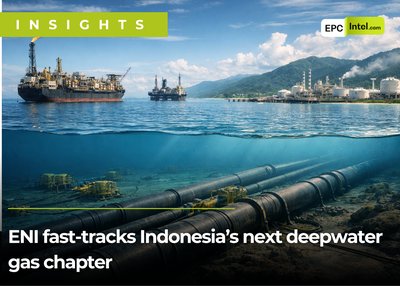
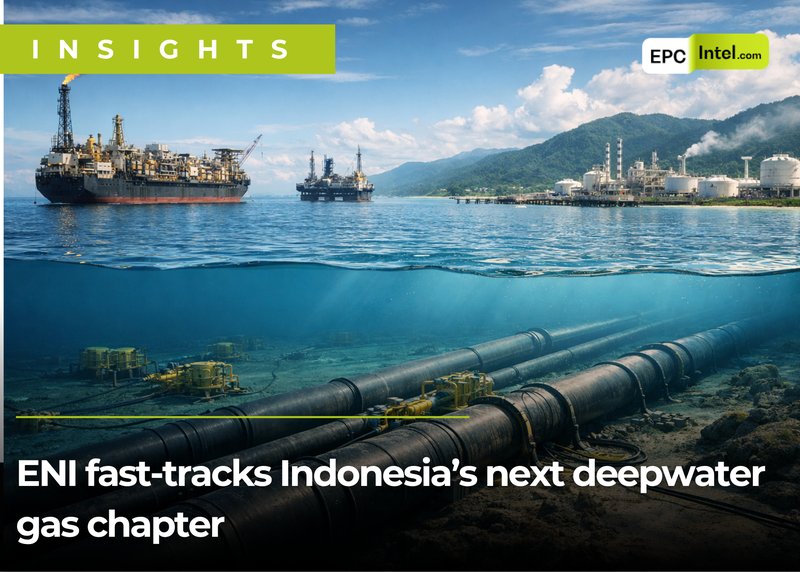
Eni has moved from plan approval to final investment decision in just 18 months on two major offshore gas developments in Indonesia, and that is the real story here. The North Hub and South Hub projects are not just another upstream sanction. They show how quickly a deepwater portfolio can move when exploration success, subsea tie-back strategy, floating production infrastructure and LNG monetization are all lined up in one basin.
The projects cover Gendalo and Gandang in the South Hub, plus Geng North and Gehem in the North Hub, all offshore East Kalimantan. Together they hold nearly 10 Tcf of gas initially in place and around 550 million barrels of associated condensate. Start-up is targeted for 2028, with plateau output of 2 bscfd of gas and 90,000 bpd of condensate expected in 2029.
That is a major addition to Indonesia’s gas supply base, but for the supply chain the bigger angle is this, Eni is not building from scratch. It is leveraging the existing Jangkrik FPU, the Bontang LNG plant and the domestic pipeline network, while adding a major new floating production system and large subsea scope in water depths up to 2,000 metres. That combination creates one of the most interesting offshore EPC opportunity sets in Southeast Asia today.
Why this matters for contractors
South Hub is the lower-risk, faster-cycle development. Gendalo and Gandang will be tied back to the existing Jangkrik FPU through seven production wells and deepwater subsea systems. This is classic brownfield-led deepwater expansion, where the largest value often sits in subsea hardware, umbilicals, risers, flowlines, installation and modifications to host infrastructure.
North Hub is where the real capital concentration sits. Geng North and Gehem will require 16 production wells, a newly built FPSO capable of processing more than 1 bscfd of gas and 90,000 bpd of condensate, plus 1.4 million barrels of storage. On top of that comes an export pipeline to shore, receiving facilities and the reactivation of Train F at Bontang LNG.
In other words, this is not one contract story. It is a multi-package development with room for FPSO contractors, subsea specialists, drilling contractors, SURF players, pipeline installers, brownfield modification houses, LNG revamp specialists and local Indonesian fabrication yards.
Likely capital split
Eni has not disclosed a total project value in the text provided, but based on comparable EPCIntel database benchmarks for deepwater gas hub developments with FPSO, subsea production systems, export pipelines and LNG plant modifications, the combined North Hub and South Hub capital envelope could reasonably land in the $9 billion to $13 billion range.
A typical spend breakdown would look something like this:
FPSO, North Hub: $2.5 billion to $3.5 billion
This should be the single biggest package. It includes hull, topsides gas processing, condensate handling, mooring systems, marine systems, integration and commissioning.
Subsea production systems: $1.8 billion to $2.6 billion
A very large package across both hubs, covering trees, manifolds, control systems, jumpers and subsea distribution infrastructure.
SURF and installation: $1.5 billion to $2.2 billion
Umbilicals, risers and flowlines in deep water, plus offshore installation, typically draw major awards for established subsea installation players.
Drilling and completions: $1.2 billion to $1.8 billion
With 23 producing wells planned across both hubs, drilling spend will be substantial, especially at these water depths.
Export pipeline and onshore receiving facilities: $800 million to $1.3 billion
This includes offshore pipeline scope, landfall, receiving station work and integration into domestic gas and LNG infrastructure.
Jangkrik FPU modifications and brownfield works: $200 million to $400 million
South Hub tie-back success depends on efficient host modifications, controls integration and debottlenecking.
Bontang LNG Train F reactivation and related revamp works: $500 million to $1.0 billion
This could become a highly attractive package for LNG process revamp contractors and rotating equipment suppliers.
Where the awards could go
The North Hub FPSO will be the headline package to watch. Given the gas and condensate processing requirement, this will likely attract leading floating production contractors with a strong record in large gas-capable FPSOs. Topsides modules, gas compression, condensate stabilization, power generation and marine systems each open secondary supplier opportunities below the main award.
Subsea and SURF packages should also be highly competitive. The combination of 23 wells, long tie-backs and deepwater conditions points to sizeable procurement opportunities for trees, manifolds, controls, umbilicals and rigid or flexible flowline systems. Installation vessel demand will be equally important.
Then there is Bontang. Reactivating an idle liquefaction train is not as eye-catching as a new FPSO, but for EPC contractors it can be one of the most attractive scopes in the whole chain. LNG brownfield work often carries high-value engineering, rotating equipment replacement, utilities upgrades, instrumentation, cryogenic systems work and integration with existing site infrastructure.
Indonesia’s next hub story
Eni’s approach here is a reminder that the best offshore projects are rarely the most glamorous standalone developments. They are the ones that make existing infrastructure work harder. By connecting deepwater discoveries to Jangkrik, Bontang and the domestic gas system, Eni is effectively turning East Kalimantan into a more integrated gas and LNG hub with lower unit development costs and faster commercialization.
For Indonesia, that supports domestic supply and export resilience. For contractors, it creates a pipeline of awards across floating production, subsea, drilling, pipelines and LNG revamp. And for Eni, it strengthens the value of the portfolio it plans to fold into its business combination with Petronas.
The FID is done. Now the real race begins, and the contract map behind Indonesia’s next major gas hub is likely to get crowded very quickly.