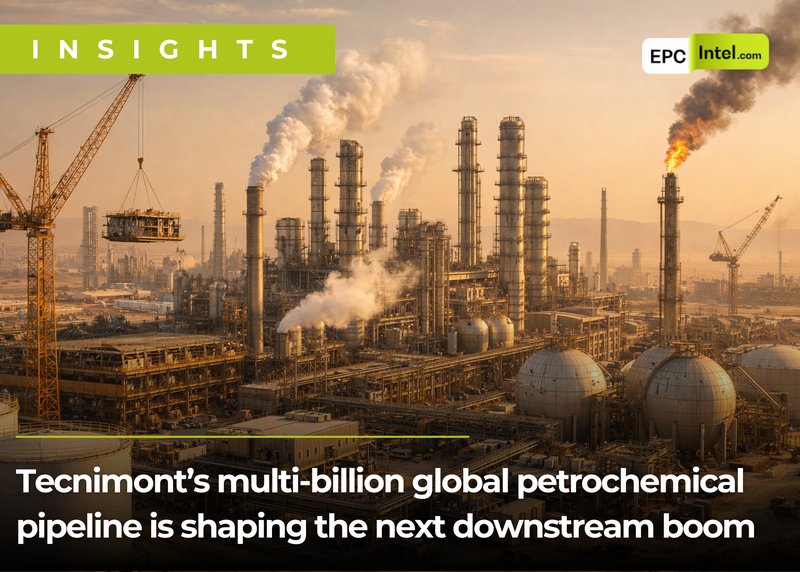
While upstream gas and LNG projects dominate headlines, a parallel wave of downstream investment is accelerating across key markets. At the center of this shift sits MAIRE’s EPC arm, Tecnimont, which is steadily building one of the most diversified petrochemical and gas processing portfolios in the industry.
Across Qatar, the UAE, Saudi Arabia and Kazakhstan, Tecnimont is executing a string of large scale contracts tied to polyolefins, gas monetisation and refinery to chemicals integration. These are not isolated projects, they form part of a broader structural expansion of downstream capacity in regions seeking to capture more value from hydrocarbons.
A multi billion dollar project pipeline
Tecnimont’s current portfolio highlights a consistent presence on projects ranging from $1 billion to over $3 billion in EPC value.
The Ras Laffan Petrochemical Complex in Qatar, developed by QatarEnergy and Chevron Phillips Chemical, represents a typical mid range award at approximately $1.3 billion. The project focuses on HDPE production, reinforcing Qatar’s strategy to extend beyond LNG into higher margin petrochemical derivatives.
In the UAE, the Borouge 4 expansion in Ruwais is one of the largest ongoing petrochemical builds globally. With an estimated EPC value of around $3.5 billion, the project significantly expands polyolefin capacity and underlines ADNOC’s ambition to strengthen its chemicals platform.
Saudi Arabia continues to anchor Tecnimont’s presence through the SATORP expansion in Jubail. With EPC packages collectively valued near $2 billion, the project integrates refining and petrochemical production, a model increasingly adopted across the region to maximise feedstock efficiency.
Further north, the Tengiz Gas Separation Complex in Kazakhstan highlights Tecnimont’s role in gas processing infrastructure. While value is not fully disclosed, comparable facilities suggest an EPC range of $2 billion to $3 billion, with completion targeted toward the end of the decade.
Alongside these, additional hydrocarbon processing awards in the $1 billion plus range continue to feed Tecnimont’s backlog, demonstrating a steady flow of mid to large scale contracts.
Where the money goes, typical EPC spend breakdown
Based on EPCIntel.com database benchmarks for petrochemical and gas processing projects, capital allocation across these developments follows a relatively consistent structure.
Process units and licensed technologies typically account for 30 to 40 percent of total EPC value, covering reactors, cracking or polymerisation units and proprietary systems.
Mechanical equipment and bulk materials, including piping, steel structures and rotating equipment, represent around 25 to 30 percent of spend. This is where major supplier opportunities emerge, particularly for compressors, heat exchangers and modular skids.
Construction and site execution generally take 20 to 25 percent, driven by labour intensity, modularisation strategies and local content requirements.
Utilities, offsites and infrastructure account for the remaining 10 to 15 percent, including power generation, water treatment, storage and export systems.
This distribution highlights the scale of subcontracting opportunities embedded within each award, particularly for equipment vendors and regional construction partners.
Strategic positioning across the downstream value chain
What sets Tecnimont apart is not just volume, but positioning. The company is consistently involved in projects that sit at the intersection of refining, petrochemicals and gas monetisation.
Polyolefins and polymer plants remain a core focus, aligned with rising global demand for plastics and advanced materials. At the same time, gas processing and separation projects are expanding as operators look to unlock value from associated and non associated gas streams.
Through NEXTCHEM, MAIRE is also building exposure to lower carbon technologies, including hydrogen, circular chemicals and sustainable fuels. While still a smaller share of overall revenue, this segment is increasingly integrated into traditional EPC scopes.
A contractor aligned with long term demand
Tecnimont’s current project mix reflects a broader industry reality. As energy markets evolve, downstream investments are becoming a primary channel for value creation, particularly in resource rich regions.
With a portfolio spanning multi billion dollar petrochemical complexes and large scale gas processing facilities, Tecnimont is well positioned to benefit from this trend.
For suppliers and subcontractors, the takeaway is clear. The next wave of EPC opportunities is not limited to LNG terminals or upstream developments. It is increasingly concentrated in complex downstream projects, where contractors like Tecnimont are quietly building the infrastructure of the global chemicals economy.