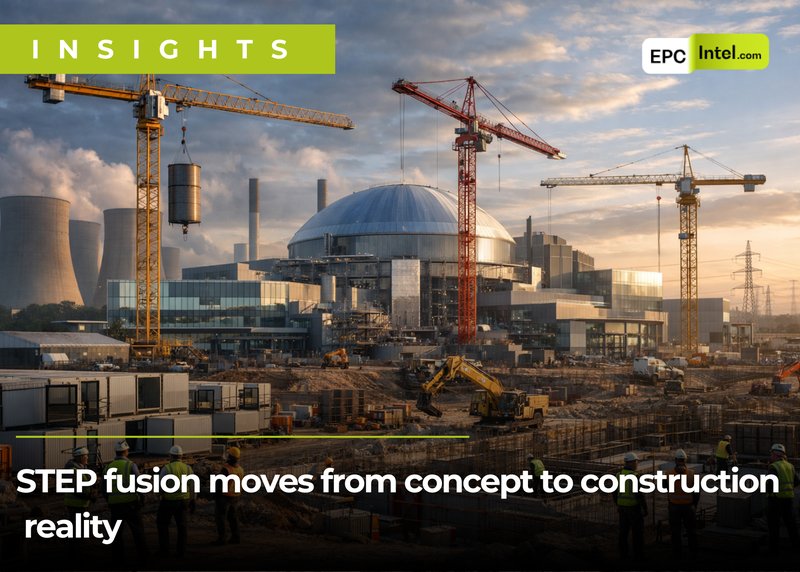
Fusion has spent decades as a promise. Now, at West Burton, it is starting to look like a project.
The appointment of the ILIOS consortium as construction partner for the UK’s STEP fusion programme is not just another contract award. It is the moment fusion begins to adopt the language of EPC, where delivery models, site logistics and supply chains start to matter as much as physics.
At £200 million, the contract itself is relatively small compared to what will ultimately be required to build a functioning prototype plant. But that is exactly the point. This is the transition phase, where vision turns into execution, and where the foundations of a multi billion programme are quietly put in place.
The team behind the first move
What makes this award particularly interesting is the composition of the ILIOS consortium.
The construction partner is led by a joint venture between Kier and Nuvia, combining major UK infrastructure delivery with deep nuclear and safety critical engineering expertise. They are supported by AECOM, bringing global engineering and design capability across complex scientific and energy facilities, AL_A Architects, known for advanced research and innovation environments, and Turner & Townsend, a key player in programme, cost and risk management.
This is not a typical EPC lineup. It is a hybrid team structured more like a nuclear or high tech research campus delivery model, reflecting the complexity and uncertainty still surrounding fusion plant design.
The real shift is in delivery, not technology
What makes this milestone compelling is not the technology itself, which remains complex and unproven at commercial scale, but the structure now forming around it.
By appointing a construction partner early, the UK is effectively building the delivery framework ahead of full technical definition. This approach mirrors nuclear megaprojects, where integration, sequencing and safety governance are established early to manage long term complexity.
With Kier and Nuvia leading execution, supported by AECOM, AL_A Architects and Turner & Townsend, STEP is being positioned as a high hazard, multi decade infrastructure programme rather than a conventional power project. That distinction will shape procurement, contracting models and supplier qualification requirements from the outset.
A new supply chain is being shaped
For contractors and suppliers, this is where the opportunity begins to take shape.
The early phase will focus on enabling works, civil infrastructure, utilities, buildings and site development. These are familiar scopes, but they sit at the front of a much more specialized pipeline that will follow, including advanced materials, heat management systems, containment, remote handling and highly engineered plant components.
Unlike LNG or offshore wind, there is no mature global supply chain for fusion. That creates a first mover advantage for companies willing to engage early with the ILIOS delivery structure.
In many ways, this mirrors the early build out of other new energy sectors, where initial projects defined not just technology pathways, but also contracting strategies and supplier ecosystems.
From coal to fusion, a symbolic transition
There is also a broader narrative embedded in the project.
West Burton, once part of the UK’s coal fired generation fleet, is being repositioned as a hub for next generation energy innovation. It reflects a wider trend of repurposing legacy power infrastructure into platforms for future technologies, leveraging existing grid connections, industrial land and regional workforce capacity.
This is not just a new project. It is a transformation of the energy landscape at both a physical and strategic level.
EPC perspective
From an EPCIntel.com perspective, the importance of this award goes well beyond its £200 million value.
It defines the first layer of the delivery ecosystem and identifies the companies now positioned at the center of the programme, Kier, Nuvia, AECOM, AL_A Architects and Turner & Townsend.
The larger and more technically complex contracts will come later. But by the time they are awarded, the framework for delivery, and the relationships that matter, will already be in place.
Fusion may still be years away from commercial reality. But for the EPC market, it has already begun.