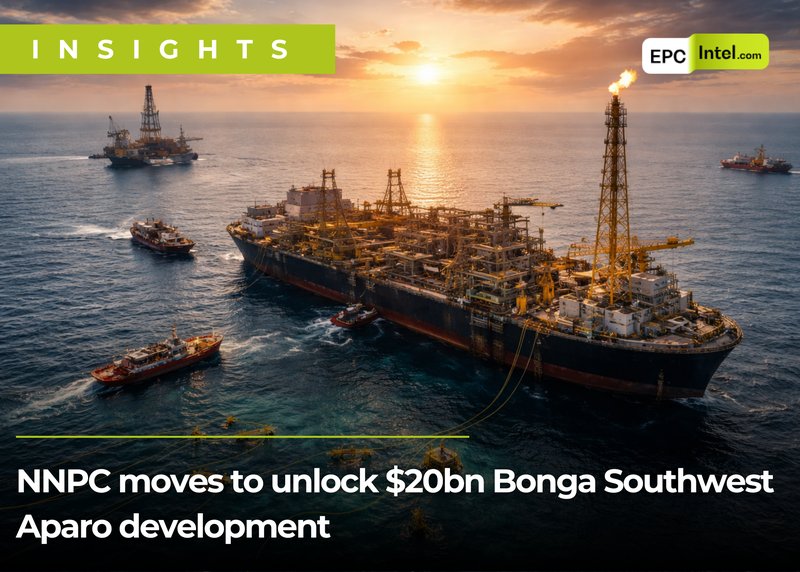
Nigeria’s deepwater sector is edging back into the investment spotlight after presidential approval of fiscal incentives designed to enable the long awaited final investment decision on the Bonga Southwest Aparo project. The development, operated by Shell through the Bonga field partnership with NNPC Limited, is expected to attract roughly $20 billion in capital spending and could become one of the largest offshore investments in West Africa this decade.
The project targets the Bonga Southwest and Aparo discoveries located in the OML 118 block, about 120 kilometers offshore in water depths of around 1,000 meters. Once developed, the field is expected to deliver approximately 150,000 barrels per day of oil production alongside about 140 million standard cubic feet per day of associated gas.
For Nigeria, the approval represents a strategic attempt to revive deepwater investment following several years of delays tied to fiscal uncertainty and project economics. The new incentives are designed to improve project returns and encourage international operators to commit capital to large scale offshore developments that require multi billion dollar investments and long payback periods.
For the EPC and offshore supply chain, the scale of Bonga Southwest Aparo means a wide range of major contracts could be activated once FID is confirmed.
Development concept centered on a new FPSO
The development concept is expected to center on a large floating production storage and offloading unit connected to a network of subsea wells and infrastructure. While the existing Bonga FPSO continues to operate on the original field development, the Southwest Aparo reserves are likely to require a dedicated production system due to the distance from existing facilities and the scale of the reserves.
A new FPSO with capacity in the range of 150,000 to 200,000 barrels per day is widely considered the most likely solution. Such a vessel would rank among the larger FPSOs deployed offshore West Africa and would anchor the entire project execution strategy.
This structure opens the door to a large EPC contract covering topsides engineering, hull conversion or newbuild work, integration and offshore installation. Global FPSO contractors including Modec, SBM Offshore and BW Offshore are typical contenders for developments of this scale in the region.
Major EPC packages expected
Based on comparable deepwater projects in West Africa and Brazil, EPCIntel.com’s database suggests the $20 billion capital investment could be distributed across several major contract packages.
The FPSO engineering, procurement and construction package would likely account for between $4 billion and $6 billion depending on the vessel configuration and storage capacity. This scope would include topsides processing modules, hull work, integration and commissioning.
Subsea production systems and SURF infrastructure represent another major spending category. Subsea trees, manifolds, umbilicals, risers and flowlines could collectively represent $2.5 billion to $3.5 billion of contracts. Companies such as SLB OneSubsea, Baker Hughes, TechnipFMC and Subsea7 typically compete for these integrated subsea packages.
Drilling and completion activities will also represent a significant portion of project expenditure. Development drilling campaigns involving multiple subsea wells could generate contracts worth $3 billion to $4 billion across drilling services, rig charters and well completion equipment.
Offshore installation and marine construction contracts, covering subsea installation, moorings, and pipeline laying, could represent an additional $1.5 billion to $2 billion in value.
Further opportunities will emerge across gas export infrastructure, power generation modules, control systems, offshore support vessels and long term operations and maintenance services.
A test case for Nigeria’s deepwater revival
The approval of fiscal incentives is widely viewed as an attempt to unlock stalled offshore developments that have been awaiting improved investment conditions. Nigeria holds several large undeveloped deepwater discoveries, but many projects have struggled to progress due to high development costs and regulatory uncertainty.
Bonga Southwest Aparo is one of the most advanced of these projects, meaning it could become the first major deepwater FID in Nigeria in several years.
If the project moves forward, it would send a strong signal to global operators and contractors that Nigeria’s offshore sector is once again open for large scale capital investment.
For EPC contractors, subsea suppliers and offshore construction companies, the project represents one of the most significant potential contract pipelines emerging in West Africa. With an investment envelope approaching $20 billion, Bonga Southwest Aparo could quickly become one of the largest offshore engineering programs currently under development anywhere in the world.