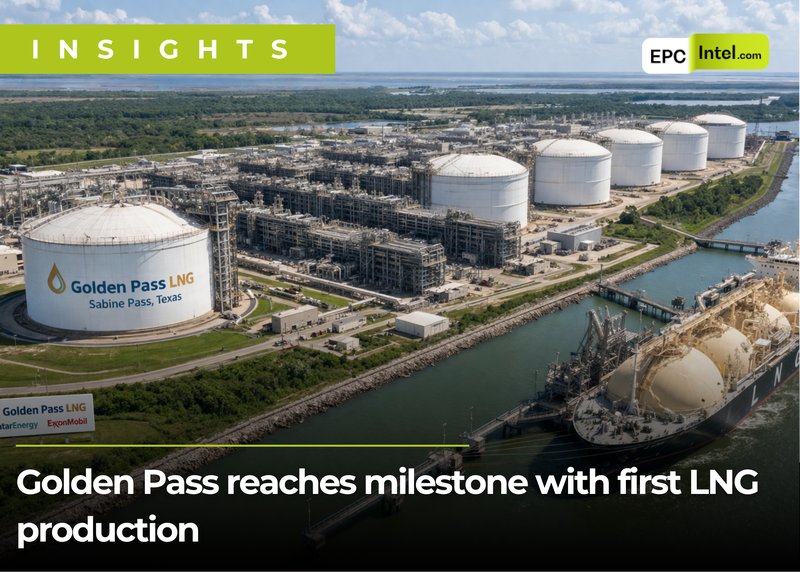
Golden Pass LNG has reached a critical inflection point, with first LNG production achieved from Train 1 at the Sabine Pass facility in Texas. For EPC markets, this milestone signals the transition from peak construction into commissioning and startup, with full project delivery now firmly in sight ahead of first exports expected in Q2 2026.
Backed by QatarEnergy and ExxonMobil, the project represents one of the most significant LNG developments in the US, both in scale and strategic positioning.
A late cycle EPC heavyweight finally turning the corner
A late cycle EPC heavyweight finally turning the corner
Golden Pass LNG has been one of the more complex US LNG projects to execute, shaped by contractor restructuring, schedule delays, and reorganization of execution scope. The project was originally awarded to a joint venture of Chiyoda and McDermott under a lump sum EPC structure, covering the full liquefaction facility including trains, storage, and associated infrastructure.
Execution challenges faced by McDermott, including financial restructuring and project delivery pressures, led to a rebalancing of responsibilities within the joint venture. Chiyoda ultimately took on a more prominent role in driving project completion, particularly across engineering coordination and commissioning readiness.
The project’s trajectory highlights the increasing difficulty of delivering mega LNG facilities under fixed price EPC contracts, especially in high cost and labor constrained environments like the US Gulf Coast.
Now, with Train 1 producing LNG, the focus has shifted toward completing the remaining two trains and ensuring stable ramp up. For EPC contractors and suppliers, this is the final stretch, where commissioning expertise, system integration, and reliability become critical.
Scale and infrastructure drive EPC value
At 18.1 MTPA across three trains, Golden Pass sits firmly in the upper tier of global LNG projects. Based on EPCIntel benchmarking, total EPC and direct contracting value exceeds $10 billion, with capital heavily concentrated across liquefaction systems, utilities and offsites, LNG storage, and marine infrastructure, alongside supporting power and site development works.
The five full containment storage tanks and dual marine berths alone represent a substantial EPC package, typically delivered by specialist tank and marine contractors.
Supply chain lessons from US LNG execution
Golden Pass reinforces several key trends in LNG EPC execution, particularly in the US Gulf Coast environment.
First, labor availability and productivity remain central challenges, with large scale projects competing for skilled workforce across multiple concurrent developments. Second, modularization strategies continue to evolve, balancing overseas fabrication with increasing domestic content requirements.
Third, risk allocation in EPC contracts is shifting. The challenges faced during Golden Pass execution have further strengthened the move away from traditional lump sum EPC toward hybrid or reimbursable models, especially for mega projects.
Strategic importance for QatarEnergy
For QatarEnergy, Golden Pass is more than a US export terminal. It is a cornerstone of its international expansion strategy, complementing its dominant position in Qatar and reinforcing its role as a global LNG supplier.
The project also strengthens ties with ExxonMobil, a long standing partner across multiple LNG developments, including Qatar’s North Field expansion. This alignment of upstream resource holders and downstream liquefaction capacity remains a defining feature of successful LNG projects.
What comes next
With Train 1 online, the immediate focus shifts to commissioning and startup of Trains 2 and 3, alongside achieving stable production and export readiness. First cargoes in Q2 2026 will mark the true commercial entry of Golden Pass into global LNG markets.
From an EPC perspective, the project is entering its final delivery phase, where performance testing, reliability, and operational handover take priority over construction progress.
Golden Pass LNG illustrates both the scale and complexity of modern LNG execution. It confirms that while mega projects remain central to global supply growth, they come with increasing execution risk and evolving contracting models.
For contractors, the lesson is clear, LNG delivery is no longer just about engineering and construction, but about managing risk, labor, and integration at unprecedented scale. For suppliers, the final commissioning phase still offers opportunities in services, optimization, and long term operations support.
As the project moves toward full completion, Golden Pass will stand as a benchmark for the next generation of US LNG developments, both in what worked and what will need to change.