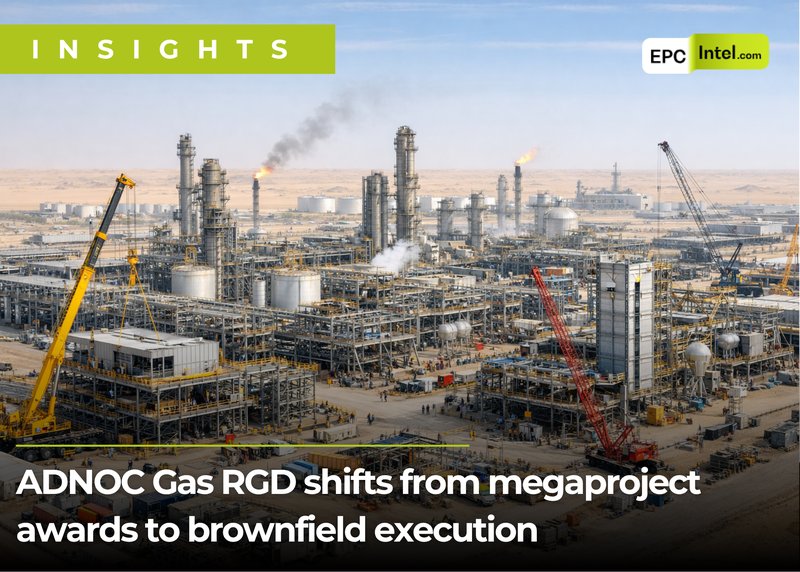
ADNOC Gas has moved decisively into execution on its $5 billion Rich Gas Development Phase 1, marking one of the most significant brownfield gas optimization programs currently underway in the Middle East. Following contract awards, activity is now fully mobilized across multiple sites, with EPC contractors progressing complex upgrades while maintaining uninterrupted operations.
This is not a conventional greenfield expansion, but a multi site brownfield transformation aimed at unlocking additional value from existing infrastructure.
Multi contractor execution defines delivery model
Phase 1 is structured around multiple EPC contractors, each responsible for distinct asset clusters across ADNOC’s gas network.
Wood is leading the largest package at Habshan, focusing on debottlenecking and upgrading processing capacity within one of the UAE’s most critical gas facilities. Petrofac is executing works at Das Island, including new inlet facilities and dehydration trains designed to increase throughput by 840 million standard cubic feet per day. Kent is deployed across Asab and Buhasa, targeting optimization of mature assets to unlock additional gas streams.
This distributed execution model reflects the complexity of the asset base, where parallel upgrades must be delivered without disrupting ongoing production.
Brownfield complexity reshapes EPC scope
Unlike greenfield LNG or gas processing projects, RGD Phase 1 is defined by integration, modification, and operational continuity. EPC scope is heavily weighted toward:
- Tie ins to live processing units
- Debottlenecking of existing trains
- Brownfield piping, instrumentation, and control upgrades
- Compression and dehydration system enhancements
- Shutdown planning and phased execution
These scopes typically carry higher engineering intensity and execution risk, particularly where access, safety, and sequencing constraints limit construction flexibility.
Capital allocation and package structure
Based on EPCIntel.com benchmarking, the $5 billion Phase 1 investment is distributed across a broad set of brownfield packages, with capital concentrated in processing upgrades, compression systems, and utilities integration.
Typical allocation for a program of this nature would include:
- Gas processing upgrades and train modifications, 30 to 35%
- Compression and dehydration systems, 20 to 25%
- Utilities, offsites, and integration works, 15 to 20%
- Brownfield piping, instrumentation, and control systems, 15 to 20%
- Site infrastructure and supporting facilities, 5 to 10%
The debottlenecking focus means a significant share of value is tied to engineering complexity rather than large scale new build equipment.
Supply chain opportunities in brownfield upgrades
RGD Phase 1 creates a different profile of subcontracting opportunity compared to greenfield megaprojects.
Key opportunities are emerging across:
- Specialist brownfield construction contractors
- Compression and dehydration equipment suppliers
- Instrumentation and digital control system providers
- Shutdown and turnaround service providers
- Modular retrofit and skid mounted systems
The requirement to maintain operations while executing upgrades places a premium on contractors with proven brownfield experience and strong safety performance.
Phase 2 and 3 pipeline builds momentum
While Phase 1 execution is underway, ADNOC Gas is already preparing for the next wave of investment. Phases 2 and 3 are expected to add more than $4 billion in additional capital expenditure, with FID targeted in 2026.
These phases are expected to further expand processing capacity and deepen integration across ADNOC’s gas value chain, reinforcing the UAE’s position as a leading gas processing and export hub.
For EPC contractors, this creates a rolling pipeline of brownfield opportunities, with incumbent contractors likely to have a strong advantage in securing follow on work.
EPCIntel.com takeaway
ADNOC Gas RGD is a clear example of how value is shifting toward brownfield optimization in mature energy markets. Rather than building new capacity from scratch, operators are increasingly focused on extracting more from existing assets through targeted EPC interventions.
For contractors, success in this environment depends less on scale and more on precision, integration, and execution discipline. For suppliers, the opportunity lies in specialized systems and services that enable incremental capacity gains without disrupting operations.
As Phase 1 progresses and new phases approach FID, RGD is set to remain one of the most important EPC programs in the region, both in value and in complexity.