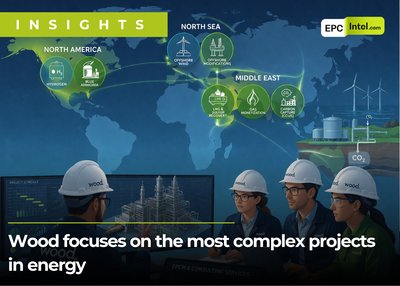
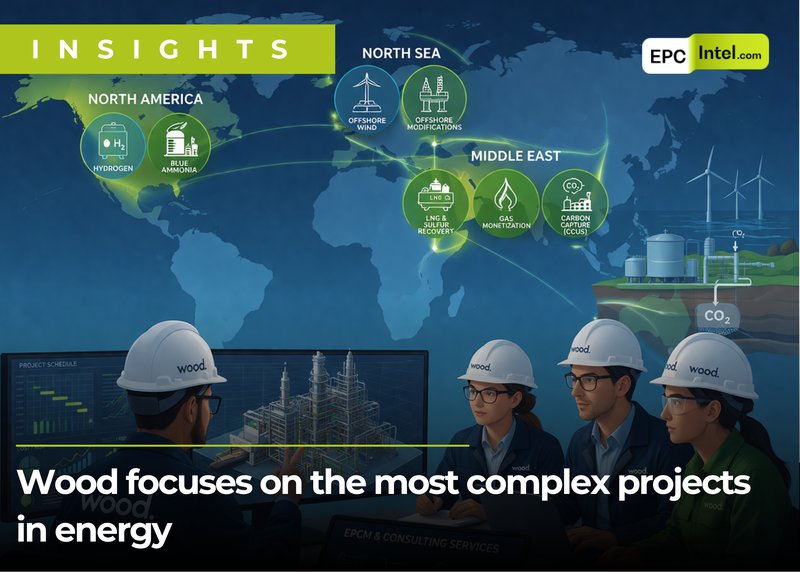
Wood is no longer just the familiar name attached to brownfield modifications, upstream studies, and owner-side engineering support. The company’s current portfolio shows something much more deliberate, a business leaning hard into decarbonization, complex gas monetization, offshore engineering, and long-cycle advisory roles that keep it embedded with clients from concept through execution.
That matters because Wood’s competitive position is no longer defined by sheer construction muscle. It is being defined by where clients need technical depth, integration skills, and the ability to sit at the center of large, messy capital programs. In 2026, that is proving to be a valuable place to be.
A portfolio built around complexity
The standout feature of Wood’s current execution mix is not just scale, it is the type of work. Across Qatar, Saudi Arabia, the UAE, the UK, Norway, the US, and Alaska, Wood is repeatedly showing up on projects where the engineering challenge is high, stakeholder complexity is real, and project risk has to be actively managed long before first steel or first gas.
That is visible in QatarEnergy’s North Field Expansion sulfur recovery scope, where Wood is supporting engineering and procurement on world-scale sulfur recovery units tied to one of the most consequential LNG expansions on the planet. It is visible again in Saudi Arabia, where Wood holds a long-term PMC role on aramco’s Jafurah unconventional gas development, one of the kingdom’s most strategically important gas projects.
Neither role grabs headlines like a lump sum EPC award, but both are exactly the kind of assignments that position a company at the core of multibillion-dollar investment programs.
Middle East remains the earnings anchor
If there is one clear geographic engine in Wood’s portfolio, it is the Middle East. Jafurah, Habshan, and North Field together show how central the region remains to the company’s revenue story.
At ADNOC Gas’ Habshan expansion, Wood’s EPCm role sits in a sweet spot. The company avoids some of the balance sheet exposure associated with full EPC while still retaining meaningful influence over design, procurement, and execution management. For clients pushing capacity growth alongside carbon efficiency improvements, that model has become increasingly attractive.
Typical capital allocation on a gas processing and upgrade package like Habshan often breaks down roughly as follows, process units and mechanical equipment 30 to 35 percent, utilities and offsites 15 to 20 percent, piping and fabrication 15 percent, electrical and instrumentation 10 to 15 percent, civil and structural works 10 to 12 percent, and engineering, project management, and construction management 8 to 12 percent. That distribution helps explain why EPCm contractors can capture strong value even without taking on full construction risk.
Decarbonization is no longer a side bet
Wood’s project list also makes clear that decarbonization is no longer a branding exercise. It is a real pipeline of work.
Blue Point Ammonia in Louisiana stands out as one of the clearest examples. The 1.4 mtpa blue ammonia facility for CF Industries, JERA, and Mitsui places Wood in FEED and EPCm roles on a project tied directly to the growing low-carbon ammonia trade. A typical blue ammonia development of this sort usually allocates 25 to 30 percent of capital to the hydrogen and ammonia process units, 20 to 25 percent to carbon capture systems and compression, 15 to 20 percent to utilities and balance of plant, 10 to 15 percent to storage and loading infrastructure, 10 percent to civil and structural works, and the remainder to engineering, project management, and owner’s costs.
Net Zero Teesside Power pushes that decarbonization profile even further. Wood’s integrated project management role across a full-chain CCUS development puts it close to the nerve center of one of the UK’s most important low-carbon infrastructure schemes. The value here is not in tonnage or fabrication, it is in orchestration. Managing more than nine contractors during peak execution is exactly the kind of task that turns consulting capability into long-duration, sticky revenue.
Offshore and upstream still matter
For all the talk of transition, Wood has not walked away from traditional offshore and upstream work. It has repositioned around the more technical and defensible parts of the value chain.
Shell’s Jackdaw development in the UK North Sea is a good example. The project’s ultra-high pressure, high temperature profile demands specialist engineering, procurement coordination, and execution discipline. These are the kinds of developments where technical credibility still carries real pricing power.
The same logic applies to ConocoPhillips’ Willow project in Alaska, where Wood is delivering detailed engineering for major processing facilities. Arctic logistics, harsh weather construction windows, and remote infrastructure constraints make this exactly the type of project where experienced engineering support is critical.
A business choosing resilience over spectacle
What makes Wood’s portfolio compelling is that it does not depend on one theme. It spans LNG-linked infrastructure, unconventional gas, floating wind, blue ammonia, CCUS, offshore modifications, and giant hydrogen concepts like Hydrogen City in Texas. Some of those projects will move faster than others, and some will inevitably face delays, but the overall portfolio is diversified around sectors that continue to attract capital.
That is the real story. Wood is building a business less exposed to pure commodity cycles and more exposed to complexity itself. In today’s market, that may be the smarter bet.
The company may not always be the loudest name in the room, but across 2026 it is increasingly positioned where the hardest projects are being shaped, managed, and de-risked. For an engineering and consulting house, that is exactly where the money is.