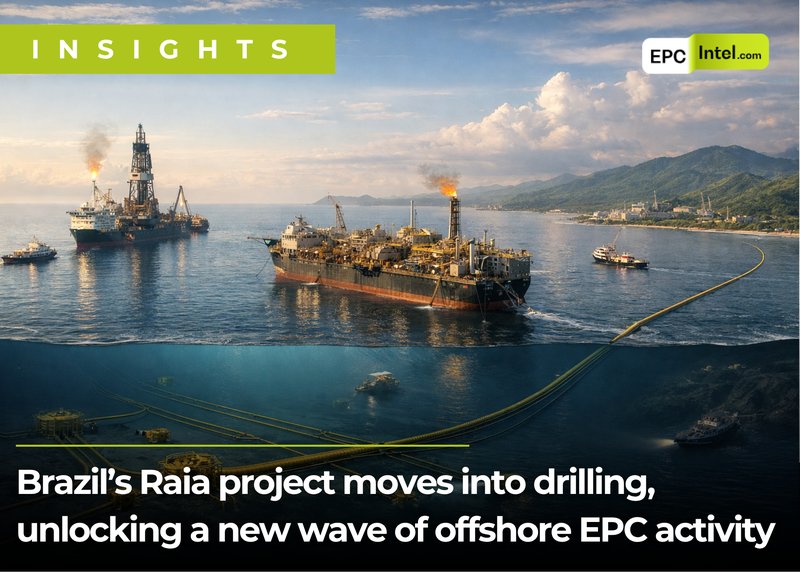
Equinor and its partners are pushing forward with one of Brazil’s most strategically important gas developments, as drilling begins on the Raia project in the pre-salt Campos Basin. With the Valaris DS-17 now on location and a six-well campaign underway, the project is shifting from concept and contracting into full execution mode, where the real EPC value is captured.
This is not just another deepwater project. Raia is shaping up to be one of the largest offshore gas developments globally, with over one billion barrels of oil equivalent in recoverable resources and a planned gas export capacity of 16 million cubic metres per day. That alone could cover around 15 percent of Brazil’s gas demand, putting Raia at the center of the country’s long-term energy security strategy.
A $9 billion offshore development enters execution
At roughly $9 billion in total investment, Raia sits firmly in the tier of mega offshore projects where contractor positioning and package allocation become critical.
Equinor leads the development with a 35 percent stake, alongside Repsol Sinopec Brasil and Petrobras. The partnership structure mirrors other Brazilian deepwater successes, but what stands out here is the scale of gas infrastructure integrated into the development concept.
The project combines subsea wells tied back to a large FPSO, with gas exported via a 200 kilometre pipeline to the Cabiúnas gas hub in Macaé. This integrated offshore to onshore system creates multiple parallel EPC workstreams, each with significant contract value.
Contractors already positioned across key packages
Several major contractors have already secured critical positions across the Raia development, giving early visibility into how the EPC spend is being distributed.
MODEC is leading the FPSO scope, one of the largest single packages in the project. Given the scale and complexity, the FPSO contract is likely in the range of $2.5 billion to $3.5 billion, including topsides processing for both oil and large volumes of gas.
Seatrium is supporting the FPSO construction, reinforcing its position as a key yard for large-scale floating production units. This aligns with a broader trend of Asian yards capturing high-value offshore fabrication scopes for Brazilian developments.
Saipem has secured subsea and pipeline-related work, likely covering SURF and export pipeline installation. For a development of this size, subsea and pipeline packages typically fall in the $1.5 billion to $2.5 billion range, depending on scope split and installation complexity.
EPC spend breakdown reveals subcontracting opportunities
Looking at EPCIntel database benchmarks for similar deepwater gas projects, Raia’s capital allocation is expected to break down across several major packages:
- FPSO engineering, procurement, and construction: ~30 to 40 percent of total capex
- Subsea systems including trees, manifolds, and umbilicals: ~15 to 20 percent
-SURF and offshore installation: ~15 to 20 percent - Gas export pipeline and landfall infrastructure: ~10 to 15 percent
- Drilling and well services: ~10 to 15 percent
This structure highlights a broad supply chain opportunity beyond the headline contractors. Subcontractors in fabrication, subsea equipment, compression systems, and offshore installation support will see significant demand as execution ramps up.
Drilling marks the transition to full project momentum
The start of drilling with Valaris DS-17 is more than a technical milestone. It signals that Raia has moved firmly into the execution phase, where timelines tighten and contractor coordination becomes critical.
The six-well campaign will define reservoir performance and underpin production ramp-up towards the targeted 2028 start-up. At the same time, FPSO integration and commissioning activities are progressing in parallel, reflecting the fast-track nature of the development.
Equinor’s experience on Bacalhau, where the same drillship was deployed, is clearly being leveraged to de-risk execution. This continuity across projects is becoming a key advantage in Brazil’s increasingly competitive offshore market.
Strategic importance extends beyond oil and gas
While Raia is fundamentally a gas project, its strategic relevance goes further. The development is expected to deliver relatively low emissions intensity at around 6 kg CO2 per barrel of oil equivalent, positioning it among the more carbon-efficient offshore assets globally.
For Brazil, the project supports domestic gas supply, industrial growth, and energy transition goals. For Equinor, it reinforces its international portfolio with long-term, cash-generating assets.
Outlook
With drilling now underway and major EPC contractors already embedded, Raia is entering the phase where execution performance will define project success.
More contract awards are likely to follow across subsea equipment, pipeline installation support, and onshore integration scopes. For suppliers and subcontractors, the window to position for follow-on work is open, but narrowing quickly.
Raia is not just another offshore development. It is a full-scale EPC ecosystem in motion, and one of the most important deepwater projects to watch as Brazil continues to expand its role in global gas supply.