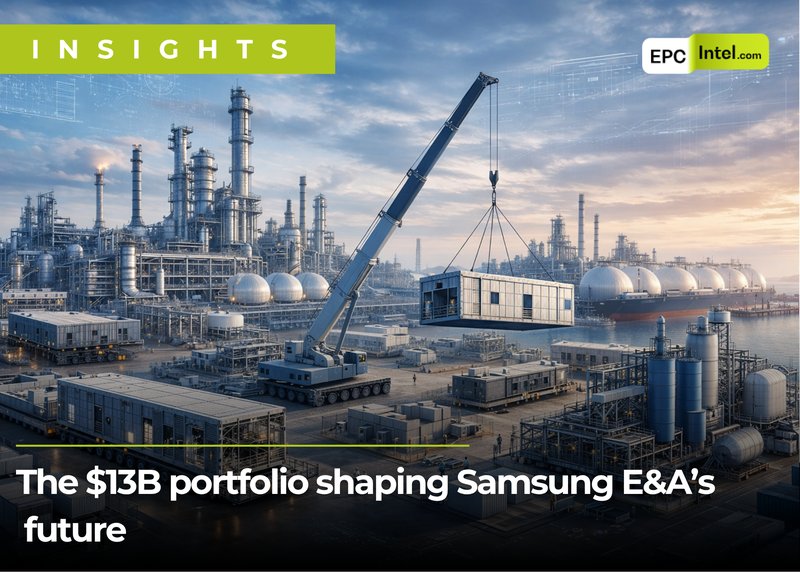
Samsung E&A’s 2026 portfolio is not just large, it is highly selective. In a market where many contractors are struggling with cost overruns and execution risk, Samsung E&A is focusing on the segments where EPC still works, where scope can be controlled early, delivery can be standardized, and margins can be protected.
At roughly $13.2 billion in backlog, the company is heavily concentrated in gas processing, petrochemicals, LNG, and an emerging layer of low carbon ammonia and hydrogen projects. This is not a broad diversification strategy. It is a deliberate positioning in sectors where engineering intensity and modular execution create a competitive edge.
Saudi gas is the anchor
The Fadhili Gas Increment Program, awarded by Saudi Aramco, sits at the core of the portfolio. At around $6 billion, it defines both the scale and the execution model Samsung E&A is pursuing.
Gas processing remains one of the most structured EPC environments. Facilities are increasingly standardized, scopes are repeatable, and procurement strategies are well understood. This allows contractors to shift risk away from site construction and into controlled fabrication environments.
Typical capital distribution on projects of this scale reflects that structure. Around 35 to 40 percent is tied up in process units and gas treatment systems, with another 20 to 25 percent in utilities and offsites. Modular fabrication and construction account for roughly a quarter of total spend, leaving a relatively small portion for EPC management and commissioning. The opportunity lies in controlling fabrication, logistics, and early procurement decisions.
Petrochemicals still deliver premium EPC work
Samsung E&A’s role in Ras Laffan Petrochemicals, developed by QatarEnergy and Chevron Phillips Chemical, reinforces its position in one of the most valuable EPC segments.
Petrochemical complexes remain equipment-heavy and integration-driven. They require complex engineering, long procurement cycles, and tight coordination across multiple process units. That complexity creates barriers to entry and allows experienced contractors to maintain stronger margins.
In a typical world scale ethylene complex, as much as 40 to 45 percent of capital is tied to core process units such as cracking furnaces. Utilities and infrastructure account for another 20 to 25 percent, while compression, storage, and logistics typically represent 15 to 20 percent. The remaining share is driven by construction and modularization. These are projects where early engineering decisions have a disproportionate impact on final outcomes.
LNG is becoming a fabrication game
The Texas LNG project, led by Glenfarne Group, highlights how LNG execution is evolving.
The competitive advantage is shifting away from traditional site construction and toward fabrication strategy. By moving more scope into modular yards, Samsung E&A can reduce site complexity, shorten schedules, and improve cost certainty.
Liquefaction systems typically account for 35 to 40 percent of total EPC spend, with modules and fabrication representing up to 30 percent. Storage tanks, utilities, and infrastructure make up the balance. The key point is that a growing share of value is now captured before equipment ever reaches site.
Low carbon is moving into real EPC territory
Projects such as Wabash low carbon ammonia and H2biscus in Malaysia show that low carbon developments are transitioning from concept to execution.
The Wabash project, backed by Wabash Valley Power Alliance, is particularly significant as a reference case for blue ammonia integrated with carbon capture. These projects are more complex than traditional ammonia plants, with additional layers of integration and performance risk.
Capital allocation reflects this shift. Hydrogen production and reforming typically account for around a third of total spend, with ammonia synthesis taking another 20 to 25 percent. Carbon capture systems add a further 15 to 20 percent, introducing new technical and commercial challenges. For EPC contractors, this is both a risk and an opportunity to move into higher value scopes.
Southeast Asia keeps the pipeline moving
Mid scale projects such as Rosmari Marjoram in Malaysia and developments with Pupuk Kalimantan Timur provide balance within the portfolio.
These projects are smaller, faster to execute, and often tied to domestic demand. They may not carry the scale of Middle East megaprojects, but they offer continuity, flexibility, and steady workload between larger awards.
Execution strategy is the real differentiator
Across all of these projects, the common thread is not geography or even sector. It is execution.
Samsung E&A is prioritizing early engineering to lock scope, modularization to shift risk away from site, and digital tools to improve project control. Standardization across similar asset types allows the company to replicate successful delivery models rather than reinventing execution for each project.
This is where margins are being protected in a highly competitive EPC market.
Where the opportunities sit
For subcontractors and suppliers, the signals are clear. The most attractive opportunities sit in module fabrication, heavy logistics, process equipment, rotating machinery, and carbon capture integration. Electrical and automation systems also play a growing role as projects become more complex and digitally managed.
The takeaway is simple. Samsung E&A is not chasing backlog for the sake of scale. It is building a portfolio around projects that can be engineered early, fabricated efficiently, and delivered in a controlled way.
In today’s EPC market, that is where the real value sits.