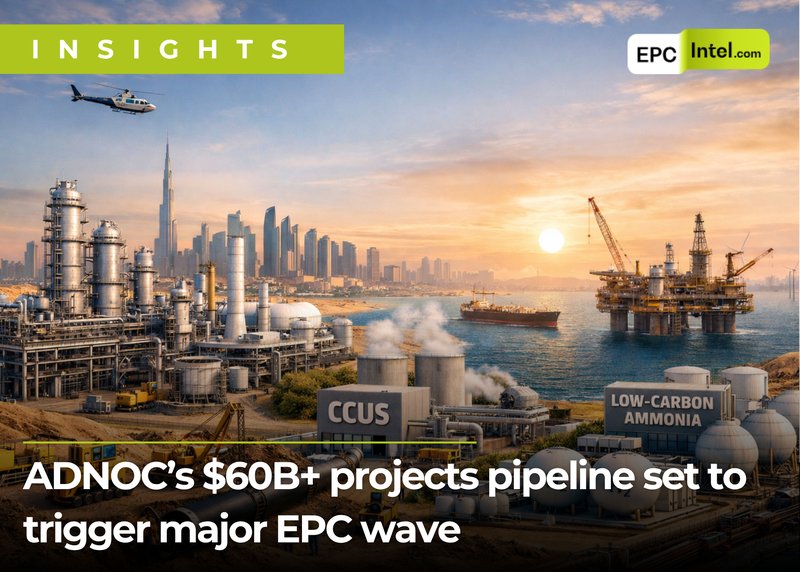
The UAE’s energy project pipeline is entering a decisive phase. After several years of concept development and early engineering, 2026 is shaping up as a transition year where strategy converts into procurement. ADNOC’s upstream expansion, gas monetization strategy and Ruwais industrial build-out are aligning to create one of the most active EPC cycles globally.
Gas and offshore developments lead the charge
The most immediate catalyst sits with the Rich Gas Development phases 2 and 3, where FID is expected in Q1 2026. With a combined value exceeding $8 billion, this program will unlock a wave of EPC tenders across gas processing, compression and associated infrastructure. The scale suggests multiple parallel packages rather than a single award, keeping competition open across international contractors and regional players.
In parallel, offshore capacity expansion is accelerating. The Upper Zakum 1.5 million barrels per day expansion, valued at around $30 billion, is already in active tendering for key packages covering surface facilities and subsea infrastructure. This is one of the largest offshore EPC opportunities globally, with execution expected to dominate contractor backlogs through 2028.
Lower Zakum follows closely behind, with $5 to $8 billion of long-term development work moving through the award phase. Unlike Upper Zakum, this program is more modular in nature, favoring repeatable platform designs and phased offshore installation campaigns.
TA’ZIZ anchors downstream and low-carbon growth
While upstream drives volume, TA’ZIZ is emerging as the UAE’s downstream and energy transition anchor. The long-term utilities agreement signed with TAQA Group signals that the infrastructure backbone is now in place to support the next wave of chemical and ammonia investments.
Phase 2 and 3 expansions, estimated at $5 to $7 billion, are progressing through partnership and structuring stages. These projects will not move as a single EPC package but rather as a series of discrete plants, creating a steady pipeline of mid-sized awards across process units, utilities integration and storage infrastructure.
The low-carbon ammonia facility at TA’ZIZ, valued at $2 to $3 billion, adds another layer of opportunity. With pre-construction activities underway and offtake agreements strengthening, EPC mobilization is expected toward late 2026, aligning with global demand growth for clean hydrogen derivatives.
Midstream and carbon capture add depth to the pipeline
Beyond upstream and downstream, midstream infrastructure continues to provide steady contract flow. The Estidama Gas Pipeline Phase 2 project, valued at $2.4 billion, is already under execution with NMDC Energy and Galfar Engineering & Contracting. While not a new award story, peak construction activity through 2026 and 2027 will sustain subcontracting demand across fabrication, installation and commissioning.
Carbon capture is also moving from concept to execution. The Habshan CCUS hub is under construction, while the Ruwais expansion and associated pipeline network are advancing through FEED. With a combined value of $3 to $5 billion, these projects represent a growing niche for EPC contractors with carbon capture integration capabilities.
Ruwais integration signals the next wave
Looking further ahead, the Ruwais hydrogen integration and Project Lightning Phase 2 point to the next cycle of offshore electrification and decarbonization. Both remain in early engineering and planning stages, but their alignment with LNG, refining and offshore infrastructure suggests that future EPC awards will increasingly focus on system integration rather than standalone facilities.
EPC outlook
The key takeaway is clear. The UAE is entering a synchronized investment phase where upstream expansion, gas monetization, downstream diversification and decarbonization are progressing in parallel.
For EPC contractors, this creates a layered opportunity set. Mega projects like Upper Zakum will dominate headlines, but the real volume of awards will come from the accumulation of mid-sized packages across gas, chemicals, pipelines and low-carbon infrastructure.
2026 is not just another active year. It is the inflection point where the UAE’s long-built project pipeline finally converts into sustained EPC demand.