Project momentum
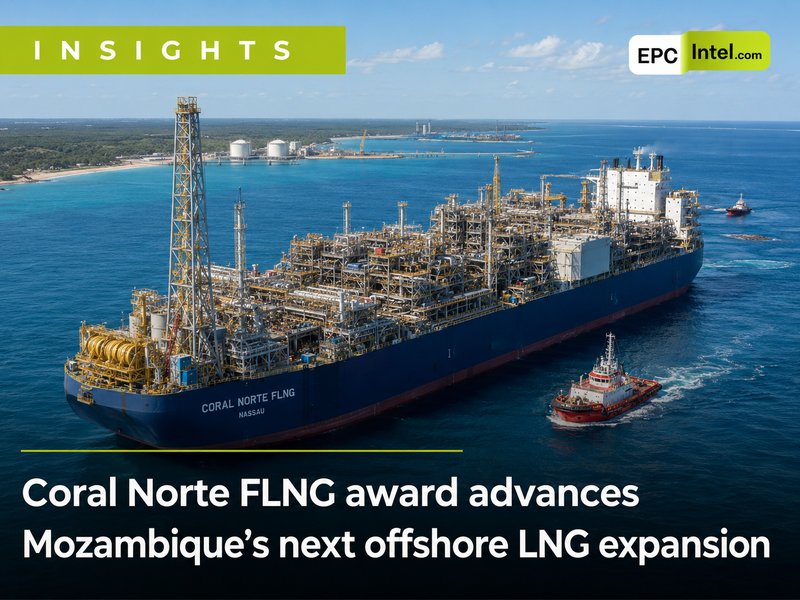
Technip Energies has confirmed another major step forward for Mozambique’s Coral Norte FLNG project, securing an EPCIC contract in partnership with JGC and Samsung Heavy Industries for Mozambique Rovuma Venture.
The award is classified by Technip Energies as “major”, meaning more than €1 billion of revenue for the company when including the aggregate value of its Coral Norte contracts already announced. For the EPC market, that is the real signal. Coral Norte is no longer just another LNG option in a long Mozambique queue. It is moving into execution around a proven floating LNG template.
The project will add around 3.6 million tonnes per year of LNG production capacity offshore Mozambique, effectively doubling the Coral hub to roughly 7 million tonnes per year. It is being developed by Eni and partners CNPC, ENH, XRG and KOGAS in Area 4, building directly on the Coral Sul FLNG model.
This is not a reinvention project. That is exactly why it matters.
Replication advantage
Coral Norte is being positioned as an enhanced replica of Coral Sul, Mozambique’s first offshore FLNG development. That gives the project an execution advantage that few frontier LNG schemes can claim.
Same basin. Similar feed gas. Comparable deepwater environment. Familiar project partners. Proven FLNG operating reference.
That “design one, build many” approach gives Technip Energies, JGC and Samsung Heavy Industries a cleaner route through engineering, procurement, hull integration and offshore commissioning than a first-of-a-kind development. For Eni and its partners, it offers a more predictable path to additional LNG volumes without waiting for the larger onshore LNG projects to fully clear their political, security and financing hurdles.
There is still nothing simple about a deepwater FLNG project. The topsides remain highly complex, the hull and integration campaign will be capital intensive, and subsea connectivity will still require disciplined interface control. But replication reduces uncertainty, and in the LNG world, reduced uncertainty is often the difference between a delayed concept and a bankable project.
Contractor positioning
The execution split follows a familiar FLNG logic. Technip Energies and JGC bring LNG process, topsides, engineering, procurement and integration capability. Samsung Heavy Industries brings the shipyard platform, hull construction and marine integration strength.
For Technip Energies, Coral Norte reinforces its position as one of the few EPC players with credible large-scale FLNG delivery experience. For JGC, it deepens a long LNG track record in another strategically important African gas province. For Samsung Heavy Industries, it supports continued positioning in high-value offshore gas floating infrastructure, where Korean yards remain central to global execution capacity.
The contract also has wider implications for the supply chain. FLNG projects create large procurement demand across cryogenic equipment, compression, gas treatment, power generation, marine systems, modular fabrication, subsea tie-ins, controls, electrical systems and commissioning support.
Coral Norte may be described as a replica, but the supplier opportunity remains very real.
Capital spend breakdown
Based on comparable FLNG developments in EPCIntel.com’s database, a 3.6 mtpa deepwater FLNG project of this type would typically carry a total installed cost in the range of approximately $5.5 billion to $7.5 billion, depending on scope boundaries, subsea tieback content, yard pricing, financing structure and owner-furnished equipment.
A typical capital allocation could look broadly as follows:
FLNG hull, marine systems and shipyard fabrication could account for around $1.4 billion to $2.0 billion.
Liquefaction topsides, gas treatment, utilities and process modules may represent around $2.0 billion to $2.8 billion.
Engineering, procurement, project management and integration could fall in the range of $600 million to $900 million.
Subsea systems, flowlines, risers, umbilicals and offshore installation may account for around $700 million to $1.1 billion.
Power generation, electrical, control, safety and telecom systems could represent around $400 million to $700 million.
Commissioning, hook-up, logistics, marine support and contingency could add another $500 million to $1.0 billion.
Within that structure, Technip Energies’ disclosed “major” award above €1 billion is consistent with a very large topsides-led EPCIC role, especially when combined with earlier Coral Norte contract activity.
Why it matters
Mozambique’s LNG story has often been dominated by uncertainty. Coral Norte shows a different path.
Rather than waiting for every megaproject variable to align onshore, Eni and its partners are scaling an offshore FLNG hub that already has an operating reference point. That gives Mozambique incremental LNG capacity, gives buyers more supply diversity, and gives contractors a major execution platform in one of Africa’s most important gas provinces.
For the EPC market, Coral Norte is also a reminder that the next LNG investment cycle will not be limited to giant onshore trains. Floating LNG is becoming a repeatable development model where the right reservoir, operator and contractor combination can move faster than traditional greenfield LNG.
Technip Energies, JGC and Samsung Heavy Industries now sit at the center of that opportunity in Mozambique.
And for the wider supply chain, Coral Norte should be watched closely. The headline EPCIC award is only the start. The real contracting wave will sit underneath it, across packages, modules, equipment, fabrication, marine support and specialist services.