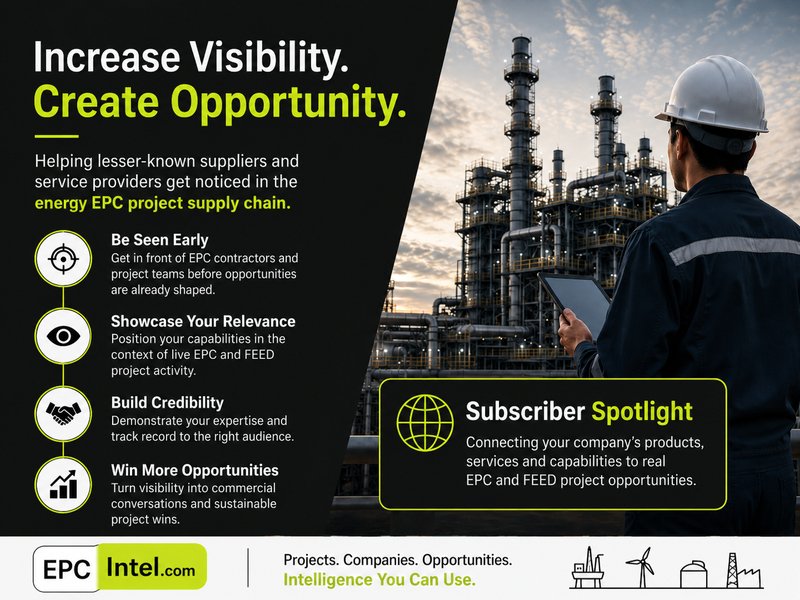
How lesser-known suppliers and service providers can increase visibility in the energy EPC project supply chain
Many capable suppliers and service providers struggle to get noticed before energy project opportunities are already shaped. This Insight explores the visibility gap in the EPC project supply chain, the high cost of traditional promotion, and how Subscriber Spotlight can help companies showcase their capabilities in a relevant project context.
For many suppliers and service providers in the energy sector, the hardest problem is not capability.
They may have the right product, the right people, the right track record and the right technical knowledge. They may be able to support EPC contractors, FEED contractors, operators, fabricators, construction companies and project owners across complex energy projects.
But if the market does not know they exist, or does not understand where they fit, that capability can remain invisible.
This is a familiar challenge for smaller and mid sized companies operating in the energy project supply chain. They are often technically strong, commercially hungry and highly responsive, but they do not always have the marketing budget, brand recognition or global network enjoyed by larger competitors.
The result is a visibility gap.
The company may be good enough to win work, but not visible enough to be considered early.
That matters because energy project opportunities are often shaped long before formal procurement begins. Relationships are built early. Vendor awareness is developed early. Technical preferences, procurement routes and package strategies may be influenced before a supplier ever sees an enquiry.
For suppliers and service companies, visibility is not a vanity metric. It is a commercial requirement.
The challenge for lesser-known suppliers
The energy EPC project market is crowded.
A buyer looking for valves, coatings, inspection support, engineering manpower, fabrication services, commissioning support, specialist equipment, technical consultancy or other project services may have many possible suppliers. Some are global names. Some are regional specialists. Some are long standing preferred vendors. Some are known personally to the procurement or project team.
Lesser-known suppliers face a difficult question: how do we get on the radar before the opportunity is already controlled by someone else?
That question is especially important for companies operating downstream from headline EPC and FEED contract awards. Their opportunity usually depends on getting noticed by the EPC contractor, package manager, procurement team, project controls team, engineering discipline lead, fabrication yard or subcontractor.
In other words, they need visibility into the market and visibility within the market.
They need to know where activity is happening, and they need the market to know why they are relevant.
Traditional ways to increase visibility
There are many ways suppliers and service providers try to increase market visibility.
They advertise in industry publications. They attend trade shows. They exhibit at conferences. They sponsor events. They publish brochures. They run LinkedIn campaigns. They send cold emails. They make cold calls. They rely on agents or local partners. They ask existing clients for referrals. They invest in search engine optimisation. They create technical articles, case studies and capability statements.
Each of these can have value.
Advertising can build awareness, particularly where the publication or platform has a relevant audience. Trade shows can create face to face meetings and help a company demonstrate commitment to a region or sector. Cold outreach can work when it is well targeted and supported by a clear message. SEO can help buyers discover a supplier when they are actively searching. LinkedIn can help keep a company visible to its network. Case studies can prove capability.
The problem is not that these methods are wrong.
The problem is that many are expensive, inconsistent or difficult to connect to live project activity.
A trade show stand can cost thousands or tens of thousands of dollars once space, design, travel, accommodation, logistics and staff time are included. Event sponsorship can be even more expensive. Advertising can be useful, but it can also be broad and hard to measure. Cold calling may generate conversations, but only if the target list is accurate and the timing is right. LinkedIn activity can help, but it requires consistency, content and audience development.
For a smaller supplier, the question is not whether visibility matters. It is how to achieve it in a practical and affordable way.
The cost of being invisible
The cost of poor visibility is often hidden.
A supplier may never know that an EPC contractor searched for a service they provide and found a competitor instead. A fabrication company may never know that a project team needed additional capacity but only contacted companies already known to them. A specialist engineering firm may never know that its expertise was relevant to a project because it was not visible when the project team was forming its supply chain view.
Lost visibility becomes lost opportunity.
This is particularly important in sectors such as oil and gas, LNG, offshore wind, carbon capture, hydrogen, power, petrochemicals, refining and industrial decarbonisation. These projects involve long supply chains and many decision points. A supplier does not need to win every project. It may only need one or two well timed opportunities to justify a year of focused marketing effort.
But to access those opportunities, the company must be discoverable, credible and relevant.
That is where content can play an important role.
Why content matters in business development
For suppliers and service providers, content is not just marketing decoration.
Good content helps explain what a company does, where it fits, and why buyers should care. It gives commercial teams something useful to share. It gives potential clients a reason to understand the company beyond a generic capability statement. It helps create search visibility. It supports credibility when a prospect checks the company online.
A brochure says “this is what we sell.”
A good article says “this is how our capability connects to real market activity.”
That difference matters.
Energy project buyers are busy. They may not be looking for a general supplier profile. They are more likely to respond to relevance. If a supplier can connect its product or service to a specific project type, sector trend, contractor award, regional development or procurement challenge, the message becomes more useful.
For example, a company providing specialist coating services can talk about corrosion protection needs in offshore projects. A manpower supplier can talk about resourcing pressure during construction and commissioning phases. A valve supplier can discuss how major downstream, LNG or hydrogen projects create demand for reliable flow control equipment. An inspection company can explain why quality assurance becomes critical as fabrication and module work accelerates.
The company is no longer just saying “we exist.”
It is saying “we understand where our capability fits in the project value chain.”
The problem with generic promotion
Many suppliers make the mistake of promoting themselves in very broad terms.
They say they are experienced, reliable, cost effective, client focused and technically capable. These claims may be true, but they are also common. Almost every supplier says similar things.
Generic promotion is easy to ignore because it does not connect to a live business problem.
A more effective message is specific. It links capability to market activity. It speaks to the type of project, contractor or supply chain need that the company can support.
That is where project intelligence and visibility can work together.
If a supplier knows which EPC and FEED contracts have been awarded, which sectors are active and which contractors are involved, it can shape its promotion around real market context. Instead of publishing a general capability statement, it can publish content that says, in effect:
This market is moving. These project types are creating demand. This is where our product or service is relevant.
That is more useful for the reader and more valuable for the supplier.
Introducing Subscriber Spotlight
Subscriber Spotlight is being developed by EPCIntel.com to help annual subscribers increase visibility in a practical, project relevant way.
The concept is simple. Eligible annual subscribers will have the opportunity to be featured in a published EPCIntel.com Insight article. The article will connect the subscriber’s product, service or capability to a relevant project, contract, sector or market development.
It is not just an advert.
It is not a generic listing.
It is a professionally written Insight that places the company’s offering in the context of real energy project activity.
For lesser-known suppliers and service providers, this can be valuable because it helps answer one of the hardest marketing questions: what should we say that makes us relevant now?
Subscriber Spotlight helps turn capability into market facing content.
Why project context makes promotion stronger
A supplier’s product or service is more compelling when it is linked to a real commercial context.
A company providing commissioning personnel is more relevant when major projects are moving toward execution and start up. A fabrication support provider is more relevant when EPC awards are creating modular construction and yard capacity requirements. A specialist equipment supplier is more relevant when new contracts point toward future procurement demand. A consultant is more relevant when developers and contractors are navigating technical, commercial or regulatory complexity.
Project context gives the reader a reason to care.
It also helps the supplier avoid sounding like every other supplier. Instead of promoting a broad capability in isolation, the supplier can show how that capability supports active market needs.
This is important for SEO as well. Search traffic is often driven by specific terms: project names, sectors, contractors, regions, technologies, products, services and contract types. A well written Insight can connect these terms naturally and usefully.
That means the content may support visibility beyond the immediate EPCIntel.com audience. It can also become a reusable marketing asset for the subscriber.
A practical alternative to expensive promotion
Subscriber Spotlight is not intended to replace every other form of marketing.
Trade shows still matter. Client visits still matter. LinkedIn still matters. Search visibility still matters. Sales outreach still matters. Technical credibility still matters.
But for many suppliers, the challenge is budget and focus.
A major exhibition stand can be expensive. Sponsorship can be hard to justify. Paid advertising can disappear once the campaign ends. Cold outreach can fail if the message is too generic. Internal marketing teams may not have the project context needed to create strong energy sector content.
Subscriber Spotlight can form part of a more balanced visibility strategy.
It gives the subscriber a published article on EPCIntel.com. It provides a clear link between their offering and real energy project activity. It gives their sales team something credible to send to prospects. It supports SEO through relevant content and a backlink to the subscriber’s website. It can be shared on LinkedIn, included in newsletters, added to email follow ups and referenced in commercial discussions.
For smaller companies, that combination is useful because it creates value in several places at once.
How suppliers can use a Spotlight Insight
The value of a Subscriber Spotlight article does not end when it is published.
A supplier can use the article in its own business development activity.
It can be shared with target EPC contractors to introduce capability in a relevant context. It can be included in a follow up email after a trade show meeting. It can be posted on LinkedIn by the company and its commercial team. It can be added to the company website as a news item or media reference. It can support conversations with agents, partners and regional representatives. It can be used by leadership when explaining the company’s market focus.
A good Spotlight article gives the sales team a reason to contact prospects without simply saying “please consider us.”
The message becomes stronger:
We are active in this space. This market development is relevant to our capability. Here is a short article explaining where we fit.
That is a better conversation starter than a cold brochure.
Visibility needs repetition
One article will not transform a company’s market position overnight.
Visibility requires repetition.
Buyers rarely act after seeing a company once. They notice patterns. They see a company in search results, on LinkedIn, in a relevant article, at an event, through an introduction, and in a targeted email. Over time, the company becomes familiar.
Subscriber Spotlight should be seen as one part of that visibility system.
The article creates a credible content asset. The subscriber then amplifies it through its own channels. EPCIntel.com provides the publishing context and industry audience. The supplier uses the article to support outreach, SEO, relationship building and account development.
That is how content becomes commercially useful.
Why EPCIntel.com is a relevant platform
EPCIntel.com is focused on energy sector EPC and FEED contract intelligence. Its audience includes people and companies interested in project awards, contractor activity, market developments and supply chain opportunities across the energy sector.
That makes it a relevant home for supplier visibility content.
A general advert on a broad platform may reach a mixed audience. A Subscriber Spotlight Insight is positioned in a project intelligence environment. The surrounding context is energy projects, EPC and FEED activity, contracts, contractors, clients and supply chain opportunity.
That matters because relevance improves the quality of visibility.
According to EPCIntel.com data and market intelligence, the platform tracks more than 3,000 contracts, more than 2,000 monitored companies and project activity across more than 100 countries. For suppliers and service providers, that project focused environment creates a natural setting for content that connects capability to opportunity.
Who can benefit from Subscriber Spotlight?
Subscriber Spotlight is particularly relevant to companies that have strong capability but need more market recognition.
That may include specialist suppliers, OEMs, fabricators, inspection companies, manpower providers, engineering consultants, construction support companies, logistics providers, technology companies, commissioning specialists, maintenance providers and niche service companies.
It may also suit companies entering a new region or sector. For example, a supplier already known in oil and gas may want to build visibility in hydrogen, carbon capture or offshore wind. A regional service company may want to appear more relevant to international EPC contractors. A specialist contractor may want to explain how its capability supports a particular project type.
The common theme is practical visibility.
Subscriber Spotlight helps companies explain what they do in a way that is connected to market activity, not isolated from it.
What Subscriber Spotlight is not
It is also important to be clear about what Subscriber Spotlight is not.
It is not a guarantee of leads. It is not a replacement for sales effort. It is not a paid claim that a company is approved by a project owner or EPC contractor. It is not a substitute for qualification, vendor registration, technical approval or commercial follow up.
It is a visibility tool.
Used properly, it can support business development by giving the subscriber a professional, relevant, shareable article that connects its capability to the energy project market.
The commercial impact will depend on how well the company uses it. A supplier that publishes the article and does nothing else will get less value than a supplier that shares it, uses it in outreach, connects it to target accounts and includes it in a broader sales plan.
Turning project intelligence into market visibility
The best commercial teams do not treat data and marketing as separate activities.
They use market intelligence to decide where to focus. They use content to explain why they are relevant. They use outreach to start conversations. They use relationships to qualify opportunities. They use credibility to convert interest into enquiries.
Subscriber Spotlight sits at the intersection of project intelligence and market visibility.
It takes the project focused environment of EPCIntel.com and gives suppliers a way to showcase their products, services or capabilities in that context.
For lesser-known suppliers and service providers, that can be a practical and cost effective way to support visibility, especially when compared with the higher cost of trade shows, sponsorships, advertising and broad promotional campaigns.
It will not replace the need for direct business development. But it can make that business development easier.
It gives companies something relevant to say.
Final thought
In the energy project supply chain, being capable is not enough.
Companies need to be visible, credible and relevant at the right time. They need buyers, EPC contractors, project teams and partners to understand where their products or services fit. They need content that supports outreach rather than generic promotion that is quickly forgotten.
Traditional visibility options such as advertising, trade shows, sponsorships, cold calling and digital campaigns all have a role. But they can be costly, difficult to measure and disconnected from live project activity.
Subscriber Spotlight offers a focused alternative.
By featuring a subscriber’s product, service or capability in a published EPCIntel.com Insight article, linked to relevant energy project activity, it helps turn market intelligence into market visibility.
For suppliers and service providers trying to build recognition in the EPC and FEED value chain, that can be an important part of the commercial toolkit.
Check out EPCIntel.com to explore energy sector EPC and FEED contract intelligence, improve your market visibility, and turn project activity into commercial opportunity.