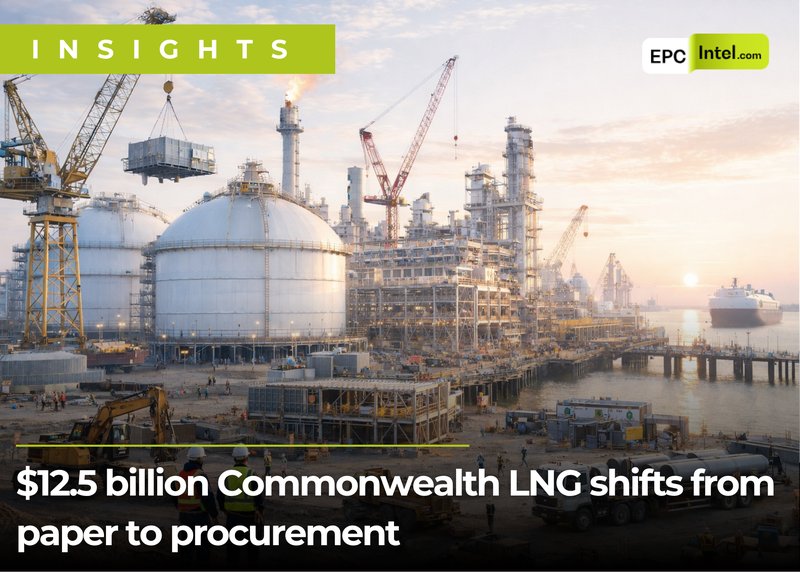
Commonwealth LNG has reached the point where the talking phase starts giving way to the spending phase. Caturus said the Cameron Parish project has now locked in long-term offtake agreements with EQT LNG Trading, Glencore, Mercuria, PETRONAS LNG, and Aramco Trading Americas, effectively closing out commercialization and clearing the path for lender engagement and a final investment decision in the coming weeks.
That matters because this is no longer just another Gulf Coast LNG proposal carrying a glossy slide deck and a target start-up year. With customer volumes secured, long-lead equipment ordered, and limited notices to proceed already in motion, Commonwealth is shifting into the zone where real contractors, suppliers, and marine works players start getting paid.
Phase 1 is pegged at $12.5 billion, with first operations expected in 2030. That puts it firmly in the upper tier of current U.S. LNG developments, and the latest update makes clear that Caturus is trying to compress the gap between financing close and full construction mobilization.
Why this update matters
The biggest tell in the release is not the offtake lineup, impressive as that is. It is the fact that purchase orders have already been authorized through Technip Energies for critical long-lead items. Baker Hughes will supply six mixed-refrigerant compressors driven by LM9000 gas turbines, Honeywell will provide six main cryogenic heat exchangers, and Solar Turbines will deliver four Titan 350 gas turbine-generators.
That is classic pre-FID risk management. Developers do not move on equipment like this unless they are serious about schedule protection. In LNG, missing slots for cryogenic exchangers, major rotating equipment, or power generation packages can push a project back materially and inflate cost at exactly the wrong moment.
The other important signal is that subcontracts have already been awarded for site preparation, surge wall development, and marine and material offloading facilities. Those early civil and marine packages are often the first real test of whether a project sponsor intends to move fast or simply keep the narrative warm. Commonwealth appears to be choosing speed.
Where the money will go
The $12.5 billion headline will naturally pull attention toward the liquefaction trains, but the opportunity set is much broader than that. Based on EPCIntel.com benchmarks for U.S. LNG export developments and comparable global liquefaction projects, a typical capital split for a project of this size would look something like this:
Liquefaction process units and core cryogenic systems: roughly $3.0 billion to $3.8 billion.
This is where the heavy proprietary content lives, including main cryogenic heat exchangers, compressors, turbines, refrigerant systems, and key process modules.
Balance of plant and utilities: roughly $1.6 billion to $2.1 billion.
Power generation, water systems, flare, instrument air, nitrogen, piping networks, and all the infrastructure that makes the trains operable.
Storage tanks and loading infrastructure: roughly $1.4 billion to $1.9 billion.
Tank EPC, pumps, loading systems, and associated transfer infrastructure usually absorb a major share of capital in greenfield LNG developments.
Marine works, berth, dredging, and offloading facilities: roughly $900 million to $1.4 billion.
The fact that marine and material offloading packages are already moving suggests this category will be one of the first visible subcontracting battlegrounds.
Site preparation, civil works, and flood or surge protection: roughly $500 million to $900 million.
The surge wall reference is particularly notable. In coastal Louisiana, these packages are not side items. They can become critical scope with meaningful specialist contractor demand.
Electrical, automation, and telecoms: roughly $600 million to $1.0 billion.
This remains a deep supplier opportunity across switchgear, substation works, control systems, cabling, and digital integration.
Buildings, camp, logistics, and temporary facilities: roughly $250 million to $500 million.
Not glamorous, but often lucrative for local and regional contractors once labor ramps.
Who is well positioned
Technip Energies is already in the EPC seat, so the main battlefield now shifts to major subcontractors and equipment vendors underneath that umbrella. Baker Hughes, Honeywell, and Solar Turbines have secured the early marquee packages, but that only tells part of the story.
The next layers of opportunity sit with tank contractors, marine specialists, dredging players, heavy civil firms, module fabricators, structural steel suppliers, pipe and valve manufacturers, electrical integrators, insulation and refractory contractors, and commissioning specialists. Coastal enabling works alone can create a substantial pipeline for Gulf Coast contractors long before the full plant reaches peak construction.
There is also a meaningful second-order opportunity in logistics. Any project ordering this scale of long-lead equipment early will need careful handling of laydown areas, transport planning, marine receipt, and heavy haul execution. That is often where local market intelligence matters more than headline EPC branding.
Bigger than one terminal
Caturus is also trying to sell a wider story. The company framed Commonwealth as part of a broader wellhead to water strategy, and linked the LNG progress with its pending acquisition of SM Energy’s Galvan Ranch assets in South Texas. The message is simple enough, build upstream scale, tie it to export capacity, and create a more integrated gas platform with control over molecules and market access.
That strategy will get attention from lenders, but it will also be watched closely by contractors. Integrated sponsors tend to move differently from pure infrastructure developers. They can be more aggressive on schedule, more disciplined on supply chain decisions, and more selective about where they spend premium dollars.
The real takeaway
Commonwealth LNG has not reached FID yet, but it is behaving more like a project entering execution than one waiting politely in line. The offtake book is now in place, lenders are next, and the first major equipment and enabling works are already being pushed into the market.
For EPC players and suppliers, that is the signal that matters. Once the financing gate opens, the contract flow below the top-tier awards could accelerate quickly. And in LNG, that is when the real opportunity starts showing up, not in the press release headline, but in the package list underneath it.