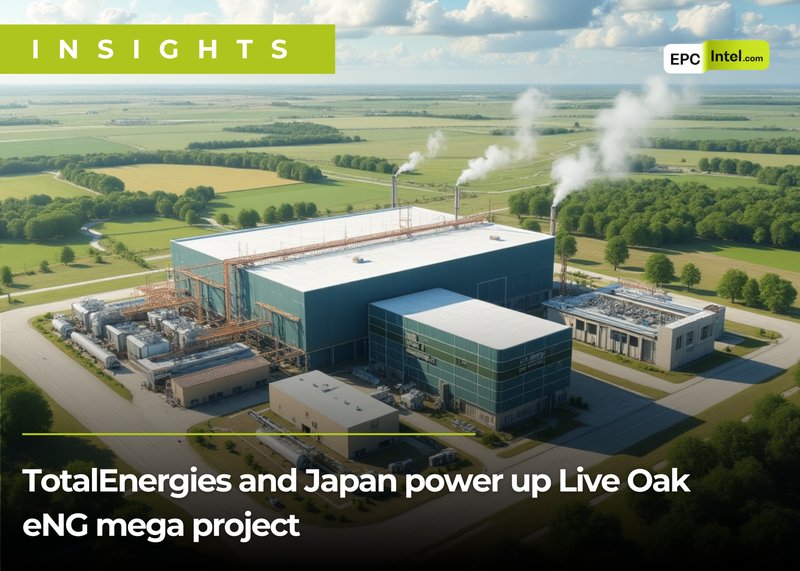
Japan’s appetite for carbon neutral gas has finally crossed from policy statements into hard equity commitments. TotalEnergies, TES, Osaka Gas, Toho Gas, and ITOCHU have signed a Joint Development and Operating Agreement that reshapes the Live Oak e NG project in Nebraska into one of the most strategically aligned synthetic methane ventures globally. The Japanese companies now hold a one third ownership collectively, while TotalEnergies and TES each retain just over one third. This sets up a balanced partnership ahead of a FEED launch in 2026 and an FID pencilled in for 2027.
For EPC contractors, this project sits at the intersection of three expanding markets. The first is renewable hydrogen production at scale in North America. The second is biogenic carbon capture linked to ethanol facilities. The third is the emerging e fuels export business model targeting Asia. The combined structure creates a pathway for a large engineering and construction program that stands out amid the early wave of synthetic methane projects.
What the FEED sets in motion
The partners are preparing a FEED package targeting two core process trains. Electrolysis capacity of roughly 250 megawatts will sit at the front of the complex, supported by balance of plant packages for water treatment, demin systems, compression, power distribution, and cooling. Downstream, methanation units designed for approximately seventy five thousand tonnes per year will convert captured biogenic CO2 and renewable hydrogen into grid compatible e NG.
On a typical basis in the EPCIntel.com database, a facility of this scale lands in the one point six to two billion dollar range once full EPC scope is awarded. Electrolysis islands usually account for thirty to forty percent of project cost given stack procurement, rectifiers, transformers, utility interfaces, and the significant electrical balance of plant required for high current systems. The methanation block and associated synthesis gas handling typically represent fifteen to twenty percent. Carbon capture, compression, and conditioning from upstream bioethanol plants often add a further ten to fifteen percent. Storage and send out facilities, including pipeline tie ins and metering, take around ten percent. Civil, structural, and site development can run fifteen to twenty percent depending on soil conditions and infrastructure. Electrical interconnection, substation builds, and long lead transformers vary but usually approach five to ten percent of total outlay.
This means EPC contractors will likely compete across a diverse package split. Electrolyzer OEMs and integrators such as Nel, Thyssenkrupp Nucera, Plug, and Siemens Energy will chase the hydrogen island. Japanese engineering firms could find alignment through the methanation and CO2 integration since Osaka Gas and Toho Gas have extensive experience with synthetic methane demonstration work. US contractors with heavy industrial track records including Fluor, Bechtel, Kiewit, Burns and McDonnell, and Worley have natural positioning on the full EPC wrap or on large balance of plant blocks.
Why the Japanese stake matters for EPC momentum
Japan’s gas majors have a target to inject one percent carbon neutral gas into the national system by 2030. Live Oak provides the closest to shovel ready capacity that could materially contribute to that objective. Securing long term offtake into Osaka Gas and Toho Gas gives the project demand certainty. Equity participation from ITOCHU plays the role of strategic coordinator and creates confidence that future LNG based infrastructure can flex seamlessly to handle e methane as a drop in fuel.
For EPC markets, the Japanese commitment has two important implications. First, it reduces financing uncertainty at FID. Synthetic methane projects require strong offtake agreements to justify capex due to the cost of electrolysis power and the complexity of CO2 logistics. Second, it encourages early contractor engagement. Japanese gas utilities tend to spend heavily on upfront engineering and risk reduction given their safety culture and long term asset stewardship approach. This often accelerates the FEED to EPC handover and supports robust lump sum contracting frameworks.
A US Midwest location built for scale
Nebraska offers a unique combination for synthetic methane production. The state hosts one of the densest clusters of bioethanol plants in North America. This provides an abundant supply of biogenic CO2 with predictable purity profiles. Renewable power growth in the Midwest, especially wind generation, supports future low cost electricity contracts that can underpin electrolysis economics. Existing gas pipeline infrastructure makes domestic distribution straightforward, while the export route to Japan leverages fully conventional LNG logistics since e NG is chemically identical to natural gas.
This compatibility means Live Oak avoids the build out of entirely new export chains. Liquefaction, storage, transport, and regasification use the same equipment and standards. This is a key advantage relative to other e fuels which require new handling systems. For EPC contractors, it keeps the project scope concentrated on hydrogen, methanation, and carbon integration rather than on a sprawling new value chain.
Live Oak positions itself as the flagship e NG project for Japan
The partnership between TotalEnergies and TES established in 2023 has now expanded into a trilateral configuration with Japanese utilities that brings both volume and credibility. Live Oak is on track to become the commercial scale anchor project that enables Japan’s early carbon neutral gas ambitions. With FEED about to commence and FID expected in 2027, the arrival of electrolysis and methanation mega packages into the EPC market is now a matter of timing rather than concept.
For contractors watching the synthetic methane opportunity, this is one of the first real projects that aligns policy, offtake, equity, technology maturity, and feedstock availability. The EPC cycle for e NG has been theoretical for years. Live Oak is preparing to turn it into work.