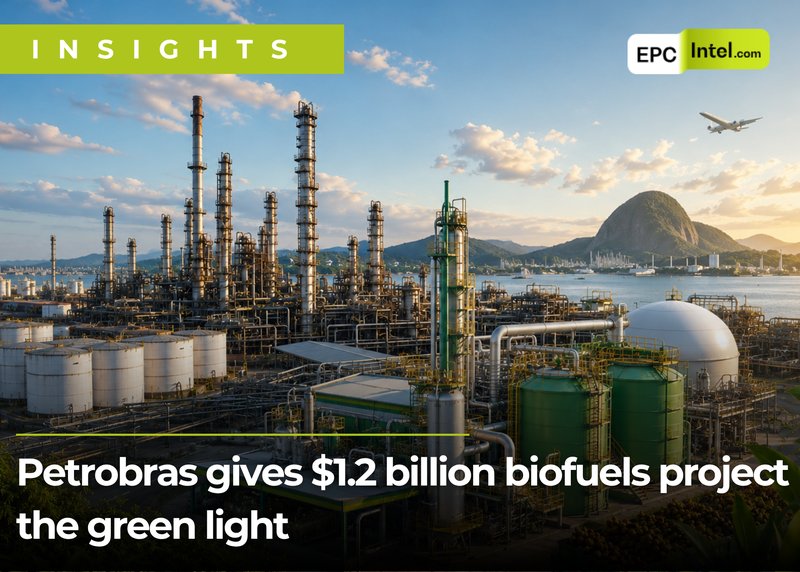
Petrobras has moved one of Brazil’s most important downstream energy transition projects from ambition into execution.
The company’s board has approved the final investment decision for the RPBC Biorefining project, a dedicated renewable fuels plant at the Presidente Bernardes Refinery in Cubatão, São Paulo. The investment is estimated at around $1.2 billion, with construction expected to begin by the end of 2026 and startup targeted for 2030. The plant is designed to produce up to 15,000 barrels per day of renewable diesel and sustainable aviation fuel, known locally as BioQAV.
That sounds like a clean fuels headline. For EPC players, it is more than that.
This is Petrobras taking a legacy refining site and turning it into a platform for lower carbon fuels. It is also a signal that the company’s 2026 to 2030 business plan is not just about upstream production growth, it is also about protecting refinery relevance as fuel markets start to fragment.
What is being built
The project will add a dedicated biorefining unit inside RPBC, Petrobras’ Presidente Bernardes Refinery. The facility will produce renewable diesel and BioQAV, supporting Brazil’s low carbon fuel strategy and the aviation sector’s CORSIA compliance pathway. Petrobras has also linked the project to Brazil’s Future Fuel Law, Law No. 14,993/2024.
The location matters. RPBC is not a greenfield site in the middle of nowhere. It is an existing refinery hub in Cubatão, with utilities, logistics, storage, marine and road fuel market access already around it. That reduces some execution risk, but it also creates a different kind of EPC challenge.
Brownfield integration is rarely pretty. Tie-ins, shutdown planning, permitting, utilities, hydrogen balance, feedstock logistics and product certification all sit behind the simple phrase “dedicated plant.”
For contractors, this is where the real work starts.
The EPC opportunity
Petrobras said that after the FID it will move into the final contracting phase and execution of agreements. That means the opportunity window now shifts from development talk to contract capture.
Based on typical EPCIntel.com downstream and biorefinery project benchmarks, a $1.2 billion investment of this type could break down approximately as follows:
Process units and licensed technology package, $300 million to $420 million. This includes renewable diesel and SAF process units, reactors, separation systems, feed pretreatment and integration with refinery systems.
Utilities and offsites, $180 million to $260 million. RPBC already has infrastructure, but renewable fuels plants still need hydrogen, steam, power, water treatment, flare, nitrogen, air systems and control room integration.
Storage, blending and logistics, $120 million to $180 million. Feedstocks such as vegetable oils, animal fats or other bio-based inputs require dedicated handling, while finished renewable diesel and BioQAV need storage, certification and distribution capability.
Civil, structural and site works, $90 million to $140 million. Brownfield foundations, pipe racks, steelwork, access roads, drainage and constructability modifications can absorb more value than headline capacity suggests.
Mechanical equipment, $160 million to $240 million. Major rotating equipment, heat exchangers, pumps, compressors, pressure vessels and specialty equipment will be a major supplier battleground.
Electrical, instrumentation and automation, $100 million to $160 million. Renewable fuels projects need tight process control, traceability, emissions monitoring and integration with existing refinery digital systems.
Construction, commissioning and project management, $220 million to $320 million. This is where Petrobras will look for predictability. Brownfield execution at an operating refinery rewards contractors that can manage interfaces without turning every tie-in into a crisis.
Who should care
This project should attract interest from downstream EPC contractors, process licensors, hydrogen and pretreatment technology suppliers, storage tank contractors, automation vendors, rotating equipment suppliers, electrical contractors and specialist brownfield construction firms.
The SAF angle will draw attention, but renewable diesel may be just as important commercially. Brazil has a large road fuel market, an established biofuels ecosystem and growing policy support for cleaner liquid fuels. Petrobras is positioning RPBC to serve both aviation decarbonization and heavy transport fuel demand.
For suppliers, the smart play is not to treat this as a standalone biofuels plant. It is a refinery integration project with clean fuels branding.
That means the winners will not only be those with the right technology. They will be the companies that can execute inside a complex operating asset, manage interface risk and give Petrobras confidence that 2030 startup does not drift into another long downstream delay.
The bigger signal
Petrobras is not abandoning hydrocarbons. It is doing something more practical. It is using its refinery base to defend market share in fuels that still need liquid molecules, but with lower carbon intensity.
That is why RPBC matters.
At 15,000 bpd, this is not the largest renewable fuels project in the world. But at $1.2 billion, inside Brazil’s largest energy company, at an existing strategic refinery, it is a serious EPC opportunity and a strong marker for how Latin America’s downstream transition may actually unfold.
Not through slogans. Through brownfield capex, refinery conversion, storage, hydrogen, process equipment and a long list of contracts that now need to be awarded.